
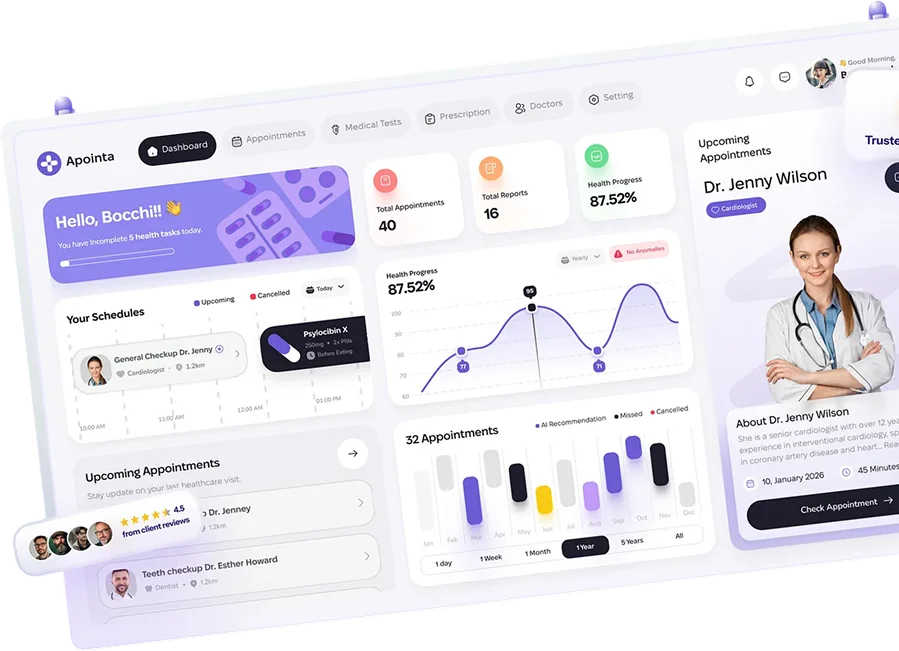
At Idea Maker, we design and develop high-performing healthcare software, including websites, web apps, mobile apps, and embedded software for medical institutions, following regulatory compliance. As a custom healthcare software development company, we provide secure, scalable systems for clinical workflows, patient data, scheduling, reporting, diagnosis, and system integrations.
Book Your Free Consultation Today!






Implies full-stack, end-to-end capabilities, not just simple apps
At Idea Maker, our custom healthcare software development services include a wide range of bespoke software designed to align technology with clinical and operational needs. We build secure, compliant solutions that support patient care, streamline workflows, and integrate seamlessly with existing healthcare systems. Every product is engineered for scalability, data protection, and long-term usability in regulated healthcare environments.
Work with the leading custom healthcare software development company to build secure, scalable solutions that transform patient care!
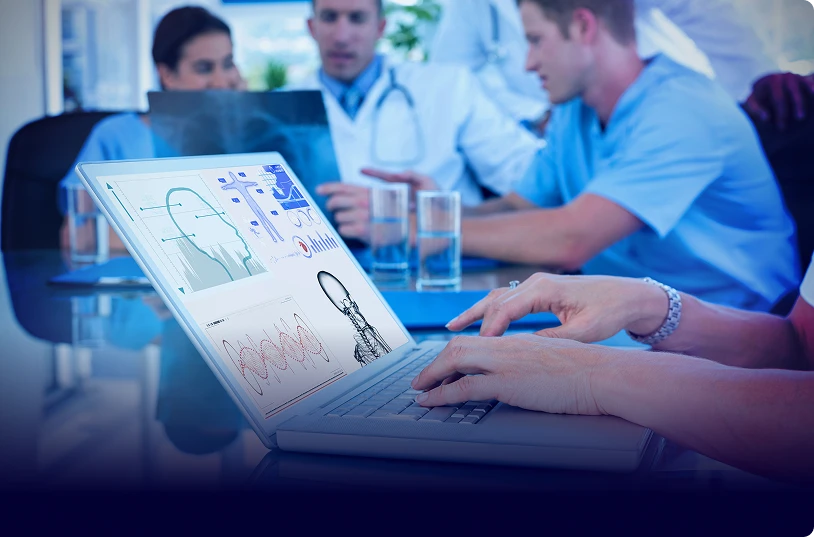
As a leading custom healthcare software development company, we offer expert guidance and a detailed roadmap before you begin your healthcare software development. Our healthcare consultants understand your clinical workflows, regulatory constraints, and operational gaps and provide you with a detailed report on software technical design, adoption strategy, estimated ROI, feature mapping, and compliance.
Our consulting also covers technical feasibility, system scope, interoperability needs, automation opportunities, and risk assessment. We aim to help healthcare organizations choose the right technologies, make informed decisions, prioritize investments, and ensure long-term system sustainability before committing resources to development or modernization.
Our custom healthcare software development services offer bespoke software tailored to hospitals, clinics, laboratories, and healthcare networks that solve their complex challenges. Our custom healthcare systems go beyond off the shelf softwares and are designed to support patient data management, clinical operations, telemedicine, EHR, administrative workflows, and reporting requirements within regulated healthcare environments.
Each solution is built to align with interoperability and compliance standards such as HL7 International, GDPR, and HIPAA. Our healthcare software developers ensure data integrity, secure access, and reliable performance across clinical and operational use cases.
As an expert custom healthcare software development company, we develop mobile applications for clinicians, staff, and patients with secure access to healthcare data and workflows. Our custom healthcare software development services offer native and cross-platform mobile apps with secure authentication flows, offline data handling, push notifications, and synchronized system communication that one can access anytime, anywhere.
Our mobile solutions are built to integrate seamlessly with existing healthcare systems with secure data transmission, performance optimization, and consistency across mobile and web environments used by medical institutions.
Leveraging machine learning and natural language processing, we integrate AI capabilities into healthcare software to support decision-making, automate workflows, and provide data-driven insights. This includes workflow optimization, patient diagnosis, personalized treatment plans, and clinical decision support systems.
Our AI integration is implemented responsibly, with careful handling of sensitive medical data and alignment with regulatory expectations. Our team focuses on augmenting clinical and operational processes, not replacing professional judgment or introducing unnecessary complexity.
We offer a comprehensive, multi-stage process to integrate digital solutions like Electronic Health Record (EHR) systems into an organization’s existing clinical and administrative workflows. Our healthcare software implementation team offers configuration, deployment planning, user access setup, and coordination with internal IT and clinical teams to ensure systems are introduced without disrupting operations.
Our software development for healthcare implementation focuses on stability, data accuracy, and adoption readiness. Each rollout is planned to support continuity of care and minimize downtime so that staff can transition confidently to the new system.
Our healthcare software integration services connect disparate software systems, applications, and data sources within the healthcare ecosystem, including EHRs, laboratory systems, and billing platforms, to create a unified flow of information. Our team leverages third-party services, secure pre-built or custom-built APs with middleware configuration, and secure data exchange planning.
All of our integrations follow healthcare interoperability standards and security best practices for reliable communication between systems while preserving data integrity, auditability, and regulatory compliance.
Our healthcare data and analytics services offer visual access to consolidated multi-source clinical, operational, and performance data in charts, graphs, and visuals. We enable reporting systems that support monitoring, compliance audits, operational insights, and informed decision-making.
Our analytics implementations offer data accuracy, traceability, and controlled access. We configure audit-ready reporting, usage tracking, and performance monitoring with robust data governance, privacy controls, and security safeguards.
As a trusted custom healthcare software development company, we provide ongoing support and maintenance for healthcare software to ensure its performance, reliability, and security over time. Our team conducts monitoring, bug fixes, updates, and performance tuning, compliance monitoring, as operational needs evolve.
Support is delivered with healthcare-critical systems in mind, prioritizing uptime, data protection, and rapid response so that your healthcare software remains dependable in environments where system failures are not an option.
We modernize legacy systems by refactoring outdated architectures, improving performance, enhancing security, and aligning software with current compliance and interoperability requirements. Our goal is to improve operational efficiency, regulatory compliance, data security, patient care, and keep your software competitive.
Modernization is handled through phased, low-risk transitions. We preserve critical data and workflows while upgrading architecture, ensuring legacy systems remain functional, compliant, and maintainable for the future.

Expert Strategic Guidance And Full-Stack Model Deployment
At Idea Maker, our healthcare software development solutions are centered on solving specific operational, clinical, and data challenges faced by modern healthcare organizations. From patient-facing applications to backend systems for care coordination and reporting, each solution is designed to improve accuracy, speed, and visibility across healthcare workflows.
Don’t settle for generic systems. Hire our healthcare software development team to create secure, scalable custom healthcare applications built just for you!
Client Success Stories

Idea Maker has done an amazing job of delivering and responding to our needs.

The team was very responsive and easy to work with. They are professional, talented, and experienced team. They were able to meet all our requirements.

Idea Maker is distinguished for their personalized collaboration and white glove services. The team is dependable and reliable, sticking to the project's plan, offering feedback, and pushing back on the right things.

The way they understand the requirements we present to them is fairly solid. Both in terms of bringing their own interpretation in nailing the requirements and their design sense. By the time we launched, I had gotten significantly more value from our collaboration than what we had discussed in the original specs.

This is a boutique development firm where the Founder is directly involved with the project and the primary contact. This is unlike many development firms where you are simply handed off to developers that are not stakeholders. This is an important distinction that results in much better project accountability.

I have never had a site like this built before. I felt that Idea Maker and Tom had built numerous sites like this, and they were pros.

Idea Maker's portfolio is what drew us in. Their design style was in alignment with what we were after. We had initial consultations with 3 companies that we had narrowed it down to. Once we had our initial meeting with Tom at Idea Maker we knew we had the right choice to make. Their communication style works well for us.

Their customer service is excellent — they’re incredibly accessible and available, which I appreciate. Furthermore, they have enough experience and bandwidth to fulfill all my needs. They’re one of the best vendors I’ve worked with.
Our Case Studies
AI therapy platform rescued with secure ChatGPT integration, customizable prompts, and professional overhaul
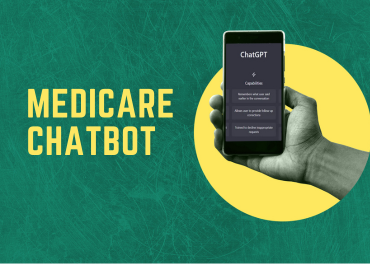
AI chatbot created for document search and simplified explanation using GPT and LLaMA technologies
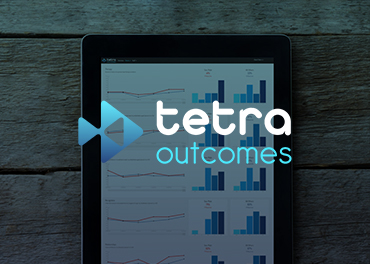
Custom SaaS, HIPPA complicant platform for secure, efficient data collection and analysis with user-friendly dashboards and automated features
Tech Enabled
Through our 10+ years of experience, we carefully choose the right tech stack, frameworks, and APIs based on system criticality, scalability needs, and long-term maintainability. We leverage modern technologies that support secure, high-performing, and compliant healthcare and enterprise-grade platforms.


How It Works
At Idea Maker, our software development services for healthcare follows a structured, traceable, and compliance-aware agile process. We move systematically from discovery to post-launch optimization in sprints with iterative feedback. We align engineering decisions with regulatory constraints, clinical workflows, and data standards such as HL7 and FHIR, while maintaining full documentation and change control at every stage.
We begin by working closely with stakeholders to understand workflows, data needs, operational constraints, and compliance requirements. This phase involves gathering requirements, mapping processes, defining system scope, and documenting functional expectations so development work starts with clarity and alignment across clinical and technical teams.

After analyzing requirements, we define the system structure, application components, data flow, scalability strategy, and integration points. In this phase, we plan development phases, responsibilities, and timelines. Dependencies are mapped, and delivery milestones are established for coordinated execution across design, development, testing, and deployment stages.
Our UX/UI team builds user-centric and visually stunning interfaces for clinicians, administrators, and patients. We create screen layouts, user flows, and interaction structures, interface elements, navigation logic, and data presentation based on defined requirements. This phase finalizes and validates design assets before development begins to prevent rework during implementation.
Once the design is ready, our software developers bring your idea to life. We build backend services, frontend applications, and mobile components using healthcare-compliant frameworks. In this phase, features are developed, integrations are implemented, and data exchange between systems is configured. Our custom healthcare app development process follows a structured sequence so that components function together as a unified system.
We implement compliance controls, access management, encryption, and audit logging aligned with HIPAA, ISO 27001, and regional healthcare regulations. Our QA engineers perform functional testing, integration testing, validation documentation, and security testing for data integrity, traceability, and regulatory readiness before launching your product.
Once everything is in place, we manage controlled deployments across cloud or on-premise environments, handling environment configuration, data migration, and system validation. This phase ensures the system is released according to the deployment plan and operates correctly in the live environment.
Following deployment, we offer ongoing monitoring, issue resolution, and system optimization. This includes performance tracking, security monitoring, dependency updates, and compliance reviews. Our ongoing support includes performance reviews, minor enhancements, and adjustments based on usage and change requests to keep the software aligned with operational needs.
Diverse Sectors, Custom Solutions
As a leading custom healthcare software development company, we serve a wide range of industries, each with its own regulatory, operational, and user-experience challenges. Our team adapts solutions to industry-specific requirements, workflows, and compliance standards with hands-on experience across multiple verticals to deliver software that aligns with real-world business and domain needs.
Book your free consultation today and see how we can offer tailored solutions designed for your specific industry needs!


EHR platforms, hospital management systems, clinical workflows, interoperability layers, analytics dashboards, and compliance systems

Practice management software, appointment scheduling, billing systems, EHR integrations, patient portals

Specialty-specific EHRs, care coordination tools, diagnostic systems, and outcome tracking software
Pharmacy management systems, prescription processing, inventory control, compliance tracking, and POS integrations
LIMS platforms, test workflow automation, reporting systems, and data exchange integrations
Device software, embedded applications, SaMD solutions, device connectivity platforms, data synchronization tools
MVP healthcare platforms, mobile health apps, cloud backends, API-driven integrations
Claims management systems, policy administration software, analytics platforms, interoperability solutions
Resident management systems, care documentation software, staff coordination tools, and compliance reporting platforms
Home care management software, remote monitoring systems, scheduling tools, mobile caregiver apps
Virtual care platforms, video consultation systems, scheduling software, and secure messaging solutions
Clinical trial management systems, research data platforms, and compliance tracking tools
Population health systems, surveillance platforms, reporting tools, data integration solutions
We leverage modern technologies like AI, cloud computing, IoT, and advanced analytics so that your custom healthcare applications remain competitive, scalable, and future-ready. By integrating cutting-edge tools, we enhance performance, improve patient engagement, and enable seamless expansion, giving your organization a technology edge that evolves with industry demands.
Stay ahead in healthcare innovation. Work with us to build technology-driven solutions that keep you competitive!
Customer Voice
Their customer service is excellent — they’re incredibly accessible and available, which I appreciate. Furthermore, they have enough experience and bandwidth to fulfill all my needs. They’re one of the best vendors I’ve worked with.
Aquila Bernard
Coach
We apply Artificial Intelligence and machine learning to analyze medical data, support clinical decisions, automate workflows, and turn raw data into actionable insights that help teams act faster with greater confidence.
Using secure cloud platforms such as Amazon Web Services and Microsoft Azure, we build healthcare systems that scale reliably, support high availability, and maintain strict control over data access and compliance.
Leveraging RPA, we handle repetitive healthcare tasks such as data entry, claims processing, and record updates, reducing manual workload while improving accuracy and consistency across administrative operations.
Our computer vision systems interpret medical images and video data to support diagnostics, image analysis, and automated detection, assisting healthcare professionals with faster reviews and improved visual data interpretation.
Our custom medical software development solutions connect with wearable medical devices to collect real-time health data, track patient vitals, and support continuous monitoring across clinical and remote care environments.
Our healthcare Internet of Things solutions connect medical devices, sensors, and systems, enabling real-time data exchange, equipment monitoring, and coordinated clinical workflows.
Virtual reality applications support medical training, simulation, and therapy use cases that allow healthcare professionals to practice procedures, educate patients, and explore treatment scenarios in controlled digital environments.
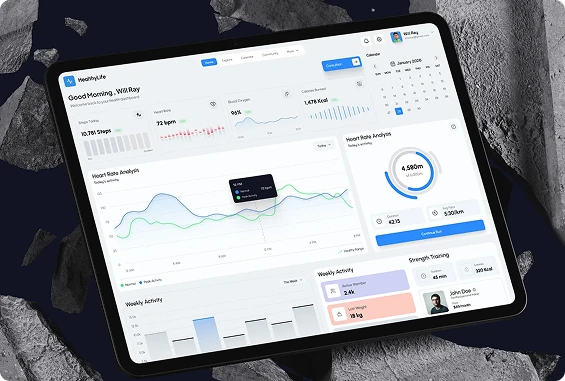
Healthcare organizations are under growing pressure to deliver better outcomes, operate efficiently, and adapt to rapid digital change. Generic systems often fail to support evolving care models, data interoperability, and compliance needs. That’s where you need to develop a custom healthcare software solution that offers flexibility, scalability, and long-term control over their digital infrastructure.
Launch your MVP faster and smarter. Talk to our team today to validate your ideas!
Outdated platforms slow the adoption of new technologies, restrict patient engagement, and hinder organizations from achieving scalable, efficient digital care models.
Fragmented systems create communication gaps, duplicate work, and delay care, emphasizing the need for integrated, connected healthcare software systems.
Executives recognize that tailored software enhances clinical workflows, improves outcomes, and supports long-term growth in a competitive healthcare landscape.
Expert Strategic Guidance And Full-Stack Model Deployment
When off-the-shelf healthcare falls short, custom healthcare software tackles the limitations by giving organizations greater control over workflows, data, and system evolution. It enables tailored functionality, seamless integration with existing platforms, stronger security measures, and improved user experiences for both patients and staff.
Custom healthcare software is designed around how your medical institutions actually work without forcing organizations to adapt to rigid, off-the-shelf limitations. Workflows, data fields, permissions, and logic are aligned with clinical roles, operational rules, and regulatory responsibilities.
Custom-built systems connect seamlessly with your existing healthcare software, medical devices, and third-party services. Data moves accurately, securely, and in real-time across systems, departments, and external partners.
Custom healthcare software puts your patients at the center, and gives you full control over the patient experience. Patients get personalized care, streamlined workflows, reduced errors, leading to better adherence and coordinated, high-quality treatment plans.
Custom systems remove unnecessary steps, duplicated tasks, and manual work. Daily operations, from scheduling to documentation, follow real clinical and administrative processes. This improves consistency, accountability, and staff efficiency across departments.
With a fully bespoke healthcare software, you control how data is collected, accessed, stored, encrypted, and deleted. You automatically adhere to laws like HIPAA, GDPR, and FDA guidance for SaMD.
Custom healthcare platforms are designed to grow with patient volume, data complexity, and organizational expansion. New departments, services, users, and integrations can be added without reworking the system or disrupting operations.
Custom healthcare software systems require a significant initial investment but ultimately lead to high ROI. Your systems reduce administrative overhead, minimize errors, automate workflows, and allow staff to focus more on patient care.
Bespoke healthcare software elevates security standards through advanced features like granular role-based access controls, tailored encryption and protocols, proactive compliance management, and continuous monitoring.

The cost of building healthcare software is driven largely by scope, complexity, feature depth, and compliance requirements. Simple solutions with basic features, such as appointment booking or patient messaging, cost less, while systems handling sensitive patient data, interoperability, and regulatory standards like HIPAA require significantly higher investment.
For example, a basic MVP with core functionality typically costs $30,000–$80,000. Simple healthcare applications such as patient portals, scheduling, and basic dashboards usually range between $80,000–$150,000. Complex platforms such as EHRs, telehealth systems, or AI-driven solutions often cost $250,000–$500,000+.
Long-term costs include maintenance, compliance updates, and scaling, often adding 15–25% annually. Industry research Key Factors Affecting the Cost of Medical Software Development: Cost and Modeling provides detailed cost benchmarks and development insights you can reference for validation.
Get your cost estimate in our free consultation session. Understand investment ranges for MVPs, simple apps, and complex systems!
Trust. Strategy. Value. Results.
Choosing us means partnering with a team that understands both healthcare complexity and real-world delivery. At Idea Maker, our healthcare custom software development combines domain expertise, regulatory awareness, and hands-on engineering to build solutions that launch faster, scale confidently, and deliver measurable outcomes—without compromising security, compliance, or usability.
Don’t compromise on quality or compliance. Partner with the best custom healthcare software development company!

At Idea Maker, healthcare software is not an add-on service; it is a core focus. Our team has years of hands-on experience working with clinical systems, healthcare data, compliance requirements, and regulated workflows, allowing us to design and deliver software that fits real medical environments.

We take full responsibility across the entire software lifecycle, from early discovery to long-term support. Clients work with a single accountable team that understands the system in depth, reduces handoff risks, and maintains consistency across decisions, documentation, and technical direction.

Our healthcare software puts end users at its core, including clinicians, administrators, care teams, and patients. We involve them in development and prioritize their feedback for clarity, efficiency, and usability. Every design decision is grounded in practical usage, not abstract assumptions.

We build healthcare systems with long-term growth in mind. Our architecture supports evolving regulations, increased data volumes, new integrations, and expanding user bases without rework. Our team adopts modular, cloud-based systems with high interoperability standards and also the integration of emerging technologies like AI and IoT.

We approach healthcare projects as ongoing partnerships, not one-time deliveries. Our developers maintain and support healthcare software even after launch, supporting enhancements, system evolution, and operational improvements. Clients rely on us as a technical partner who understands their systems as deeply as their teams do.

Our software development for the healthcare industry has a structured, predictable, and visible delivery process at every stage. Clients receive clear timelines, regular progress updates, and early access to working software. This transparency allows for informed decisions, controlled scope, and confidence that the project stays aligned with expectations.
FAQs
Building custom healthcare software usually takes anywhere from 3 months to over a year, depending on the complexity of the solution.
Key factors include regulatory requirements, number of integrations, data migration needs, clinical workflow complexity, security controls, and stakeholder availability. Changes in scope, delayed approvals, or third-party dependencies can also extend delivery timelines.
Healthcare software must meet strict regulatory, privacy, and data integrity requirements. Systems handle sensitive clinical data, integrate with medical devices, and support mission-critical workflows, making accuracy, security, and compliance far more demanding than typical business applications.
Custom development is ideal when existing tools cannot support unique workflows, regulatory needs, integrations, or data ownership requirements. It suits organizations that need long-term control, scalability, and alignment with complex clinical or operational processes.
We start with structured discovery and validation phases, helping stakeholders define priorities, constraints, and workflows. Requirements are refined incrementally, allowing decisions to be informed by real system usage rather than assumptions made upfront.
We collaborate closely with healthcare stakeholders, mapping daily clinical and administrative processes before development. Continuous feedback loops ensure workflows are reflected accurately and adjusted as real-world usage insights emerge.
Yes. We plan phased modernization and controlled migrations, ensuring data continuity and system availability. Parallel environments, staged rollouts, and rollback strategies help maintain uninterrupted operations during transitions.
We design integration layers that connect existing systems securely and reliably. This includes data mapping, synchronization logic, API connections, and validation processes for consistent data exchange across healthcare platforms.
We support widely adopted standards, including HL7, FHIR, and DICOM for structured data exchange, system compatibility, and long-term interoperability.
Patient data protection is enforced from the first project phase. We apply strict access controls, encrypted environments, isolated development systems, and audit logging. Real patient data is never used without safeguards, ensuring confidentiality during design, development, testing, and deployment.
Yes. We support contractual compliance requirements, including HIPAA obligations and Business Associate Agreements when applicable. Security, privacy responsibilities, and data handling requirements are clearly defined within the project and legal documentation.
Validation includes functional testing, data accuracy checks, security reviews, compliance verification, and controlled user acceptance testing. Systems are reviewed against clinical workflows and regulatory expectations before any live deployment is approved.
Yes. We design healthcare systems to support phased enhancements. AI models, automation layers, and clinical decision support components can be integrated later without disrupting existing workflows or requiring full system rebuilds.
We map existing manual processes, identify data touchpoints, and convert them into structured digital workflows. Documentation, approvals, reporting, and record management are consolidated into secure systems that reduce duplication and operational risk.
Clients retain full ownership of the source code, documentation, and intellectual property upon project completion. All rights are clearly defined contractually for long-term control, reuse, and freedom from vendor lock-in.
Scalability is planned at the architectural level. Systems are structured to support additional users, facilities, data volumes, and integrations without performance degradation or structural redesign.
Post-launch support includes monitoring, issue resolution, performance tuning, security updates, and planned enhancements. Support models can be structured as on-demand assistance or long-term managed support agreements.
We apply layered security practices, including access controls, encryption, vulnerability assessments, monitoring, and incident response planning. Healthcare-specific threat models guide security decisions across infrastructure, applications, and data layers.
Yes. We develop software that integrates with wearable devices, connected sensors, and remote monitoring systems, supporting secure data collection, transmission, and analysis across clinical and home-care environments.
Cloud infrastructure supports scalability, availability, disaster recovery, and controlled access. It enables healthcare systems to handle growing data volumes while meeting compliance, performance, and security requirements.
Projects usually begin with a discovery phase to define scope, constraints, compliance needs, and priorities. This phase establishes a clear roadmap, realistic timelines, and budget expectations before development starts.
Common risks include compliance gaps, data security failures, workflow misalignment, and integration complexity. These are mitigated through early validation, structured governance, security controls, and continuous stakeholder involvement.

Idea Maker © 2026 ● All Rights Reserved

