
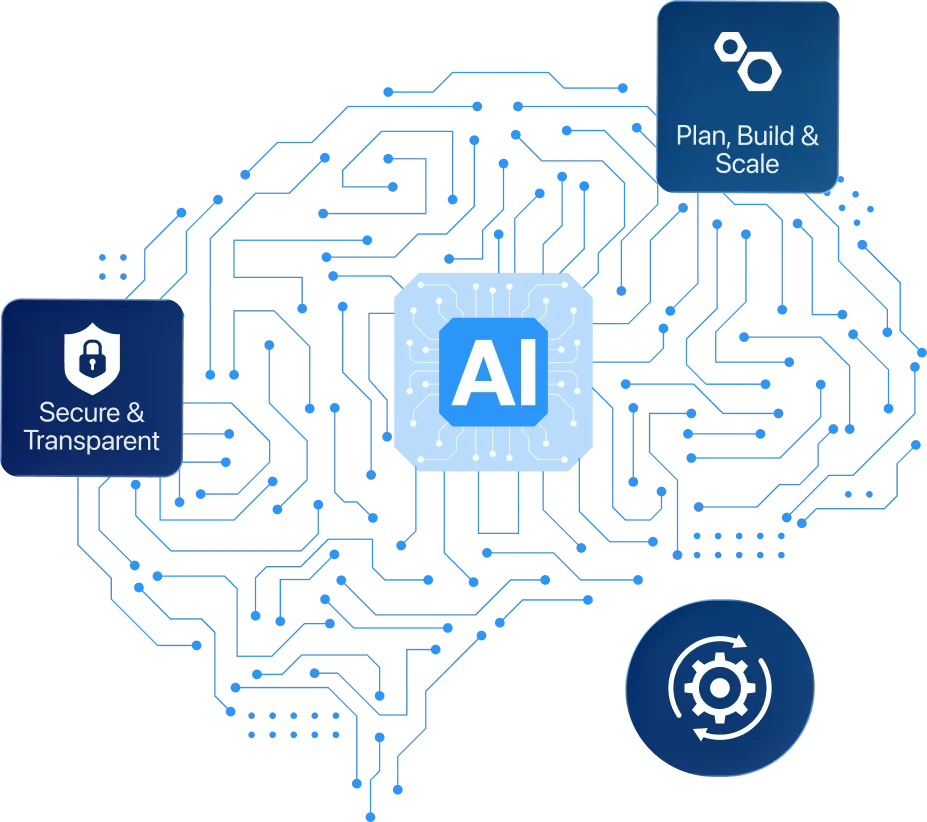
At Idea Maker, our AI integration services in the USA help businesses seamlessly integrate AI into existing systems, workflows, and products. We automate processes, generate insights, and optimize performance without requiring complete system overhauls. Our AI integration specialists ensure that every integration is secure, scalable, and aligned with your operational goals, providing a fully embedded capability that delivers a measurable ROI.
Book Your Free Consultation Today!
Implies full-stack, end-to-end capabilities, not just simple apps
At Idea Maker, we offer a wide spectrum of AI integration services in the USA designed to connect AI with the systems your business already runs on. Our team integrates models, data pipelines, and enterprise applications with secure real-time data exchange. Our AI integration specialists help businesses turn standalone AI tools into fully integrated, production-ready capabilities.
Let’s connect AI to where your business actually works. Book your free consultation today!
We offer AI integration consulting services for expert guidance around how AI should connect to your existing systems, data architecture, and operational workflows without disrupting your existing operations. We examine technical dependencies, integration constraints, compliance boundaries, and infrastructure readiness before any deployment begins.
Our generative AI integration services offer connecting large language models to your internal systems, knowledge bases, and business applications. For that, we leverage an API or a self-hosted deployment so the integration can work within real operational workflows. The work centers on structured data access, RAG pipeline architecture, prompt engineering, and reliable routing into your existing platforms.
If you already have predictive models built, we embed them directly into your business systems where decisions happen. Our advanced AI integration services in the USA are designed to handle the connectivity between model outputs and enterprise applications, operational databases, analytics dashboards, and transactional workflows. Our goal is to make predictions flow into day-to-day processes instead of remaining isolated in technical environments.
We integrate agents into enterprise environments so they can access approved data sources, trigger workflows, interact with internal systems, and operate within defined boundaries. Our AI agent integration services are designed to safely embed autonomous capabilities with real-time data exchange into business environments that were not originally designed for automation.
Organizations often need specialized AI capabilities without having to build custom models. As a leading AI development company, we provide integration services to connect external AI tools with your internal systems, enabling secure, real-time data exchange eacross your operational workflows. This service covers authentication handling, API orchestration, middleware configuration, structured input-output mapping, and performance management.
Our AI and GPT integration services embed conversational AI into your existing customer and employee channels. We connect AI chatbots seamlessly with your CRM, support systems, and internal knowledge bases for consistent, informed interactions. Our AI integration specialists ensure conversations sync with backend systems, follow escalation rules, and operate within your organization’s structure.
We connect vision-based AI systems to cameras, sensors, and operational software so image-driven insights feed directly into monitoring tools and business systems. Our AI system integration services cover configuring data ingestion pipelines, real-time output routing, alert systems, and integration with dashboards or control systems.
AI systems are only as reliable as the data feeding them. Our AI integration services in the USA offer designing and building the pipelines that move information from your core systems into AI models in a clean, structured, and timely way. Our work focuses on flow, transformation, and system connectivity so your models receive consistent, usable data every day.
Our enterprise AI integration services offer embedding AI directly into the business platforms your teams already rely on. That means connecting intelligence into workflows, automating triggers, enriching records, and enabling smarter reporting inside your existing enterprise systems. Our goal is to make AI a part of your daily operations rather than a separate, standalone layer.
For organizations running 10–20-year-old ERP or on-premises systems, replacing them is rarely practical. Our senior AI integration specialists design integration layers that let AI connect with your systems safely and reliably, using middleware, adapters, data extraction layers, and staged migration strategies. This service addresses compatibility barriers, data constraints, and structural limitations common in legacy enterprise environments.
To make AI scalable with your evolving business requirements, we design and implement cloud infrastructure (across Google Cloud, AWS, and Azure) to support integrated AI workloads. To that end, we define compute environments, storage architecture, secure API layers, and cross-environment connectivity. Our team builds the technical backbone that allows AI integrations to operate reliably in cloud ecosystems.
Once models are alive, they must be continuously supervised. To do that, we establish infrastructure that tracks model behaviour, manages versions, detects performance shifts, and governs retraining triggers. This ensures your AI integrations remain stable, controlled, and accountable long after initial deployment.
Before AI systems go live, we rigorously validate how they interact with your broader technology stack. Our QA engineers perform end-to-end integration tests regarding connectivity, response behavior, data throughput, system load handling, and failure recovery to verify integrated AI functions correctly under real operational conditions.
We provide maintenance and ongoing technical support for live environments by managing connectivity updates, resolving integration disruptions, and adapting to upstream system changes. The objective is to keep your AI integrations optimized so that they evolve as your systems and data change.

Expert Strategic Guidance and Full-Stack Model Deployment
AI integration is not one-size-fits-all. The right approach depends on your systems, your data, and the level of control you need. We’ll guide you on how integration typically gets done and when each path makes sense.
Pre-built APIs connect your systems to existing cloud AI capabilities through standard interfaces. It’s the most suitable choice when your use case fits a well-defined task already supported by external AI services. It works best when speed matters and the business problem doesn’t require custom model development or proprietary tuning.
When your challenge is unique to your data or industry, a purpose-built model is required. In this case, the integration work centers on embedding that model into your infrastructure so it can interact with real business workflows. This path suits organizations that need tighter control, higher performance, or differentiation that generic AI services cannot provide.
For knowledge-heavy environments, large language models are connected to internal documents, databases, and operational systems using retrieval-based architectures. Instead of operating in isolation, the model references your company’s own information in real time. This approach is well-suited for internal knowledge search, document analysis, and AI systems that must reflect enterprise-specific context.
Some enterprise systems were never designed to connect with modern AI. In these environments, a translation layer is built to bridge the gap so that AI can exchange information with older or closed platforms. It is the most suitable option when system replacement isn’t practical, but AI capability is still required within the existing infrastructure.
This model fits complex enterprises managing multiple use cases across modern platforms and legacy environments simultaneously. Because large organizations rarely rely on a single method. A hybrid architecture combines multiple integration approaches into one coordinated framework, allowing different AI capabilities to operate across varied systems.

Many organizations reach out after discovering that building an AI prototype is not the same as running AI inside real business systems. A pilot might work perfectly in a controlled environment, but once it needs to interact with production databases, internal tools, and operational workflows, everything becomes more complicated. In other cases, a company invests in an AI platform or tool only to realize that it operates alongside the tech stack rather than within it, leading to outputs that teams still have to move manually.
Another common barrier appears when infrastructure stands in the way. Many businesses rely on legacy systems that were never designed to integrate with modern AI capabilities, or they operate with data spread across multiple systems that don’t communicate easily with one another. These situations are more common than most teams expect, and solving them requires practical integration experience rather than theoretical AI knowledge.
Even after deployment, challenges can emerge. Models may drift as new data flows in, integrations may break when upstream systems change, or AI tools may remain isolated from the workflows where decisions actually happen. If any of these challenges sound familiar, we'd welcome a conversation about where you are and what it would take to get AI working inside your real operations
Partner with Idea Maker today to get the best AI integration services in the USA!
How It Works
At Idea Maker, our approach to AI integration is built around clarity, real-time connectivity, and minimizing risk. We guide your organization through every step of the process, from understanding existing systems to continuous monitoring to ensure they remain reliable.
Our engagement begins with a clear understanding of the environment in which integration will operate. We review your system landscape, application architecture, data infrastructure, and API capabilities to map how information moves across the organization today. Our team identifies legacy dependencies, undocumented connectors, and hidden constraints early so they do not surface later as costly surprises. This phase provides you with a detailed architecture map, an integration gap assessment, and a risk register that sets the foundation for the work ahead.

In this phase, we examine where the relevant data lives, how it flows across systems, and whether it is structured, accessible, and consistent enough for real-time or near-real-time use. Our team defines what needs to be addressed before connecting AI models to production systems. This phase produces a clear data readiness report along with a scoped plan for any required pipeline work.
Before development begins, our AI integration specialists define how systems will communicate, how real-time data exchange will occur, and how errors, latency, and security requirements will be handled. This includes API contracts, middleware architecture, connector specifications, transformation logic, and access controls. Our goal is to resolve design decisions upfront to prevent mid-project direction changes that can slow deployments or introduce instability.
With the architecture defined, our engineers build the integration components that connect AI capabilities to your systems. Here, we deliver integration components, test results, and a performance benchmark report. Connectors, adapters, pipelines, and middleware are developed and validated in a controlled environment that mirrors production conditions.
We introduce the integration through a staged rollout that allows monitoring and validation at each step before expanding usage. Fallback protocols, monitoring hooks, and rollback mechanisms are established before go-live so any unexpected issues can be handled quickly. When the integration is fully active, teams receive clear documentation (deployment confirmation, runbook, rollback plan) describing how the system operates and how to manage it independently.
Once an integration is live, the work shifts toward stability and long-term reliability. We monitor systems, track model performance, data pipeline health, and integration uptime. As upstream systems evolve or new data flows are introduced, our team adjusts integrations to keep everything running smoothly. This phase includes ongoing maintenance support, performance optimization, and a structured review of the first ninety days of operation.
Diverse Sectors, Custom Solutions
At Idea Maker, we understand that AI integration requirements vary widely by industry, from compliance-heavy environments to data-intensive operational systems. The good thing is our team has delivered integrations across multiple sectors where reliability, data governance, and system compatibility matter most.


Core banking integration, fraud detection systems, transaction scoring, and regulatory reporting automation.

EHR/EMR connectivity, HIPAA-compliant data pipelines, clinical NLP, and medical imaging AI systems.

Production line computer vision, predictive maintenance pipelines, sensor data integration, quality control automation.

Recommendation engines, demand forecasting models, inventory intelligence, and personalization data pipelines.

Route optimization models, fleet management connectivity, warehouse AI systems, and shipment anomaly detection.

Underwriting automation, claims processing AI, fraud detection models, and actuarial intelligence systems.

LLM-powered product features, AI API layers, RAG pipelines, and internal knowledge assistants.
Client Success Stories

Idea Maker has done an amazing job of delivering and responding to our needs.

The team was very responsive and easy to work with. They are professional, talented, and experienced team. They were able to meet all our requirements.

Idea Maker is distinguished for their personalized collaboration and white glove services. The team is dependable and reliable, sticking to the project's plan, offering feedback, and pushing back on the right things.

The way they understand the requirements we present to them is fairly solid. Both in terms of bringing their own interpretation in nailing the requirements and their design sense. By the time we launched, I had gotten significantly more value from our collaboration than what we had discussed in the original specs.

This is a boutique development firm where the Founder is directly involved with the project and the primary contact. This is unlike many development firms where you are simply handed off to developers that are not stakeholders. This is an important distinction that results in much better project accountability.

I have never had a site like this built before. I felt that Idea Maker and Tom had built numerous sites like this, and they were pros.

Idea Maker's portfolio is what drew us in. Their design style was in alignment with what we were after. We had initial consultations with 3 companies that we had narrowed it down to. Once we had our initial meeting with Tom at Idea Maker we knew we had the right choice to make. Their communication style works well for us.

Their customer service is excellent — they’re incredibly accessible and available, which I appreciate. Furthermore, they have enough experience and bandwidth to fulfill all my needs. They’re one of the best vendors I’ve worked with.
Our Case Studies
AI-Powered SOC2 compliance platform with modular framework support

An AI SaaS platform that guides users through compliance documents and builds strategies to meet regulations

Automated system to efficiently process and clean bulk data files, incorporating machine learning and Power BI
AI integration transforms how organizations operate by connecting intelligence directly into existing systems and workflows. Businesses now handle complex, data-driven tasks more efficiently, make decisions faster with real-time insights, and leverage their current technology investments without disrupting ongoing operations.
Partner with us today and discover how AI can reduce costs and accelerate decision-making for your business.
Customer Voice
Their customer service is excellent — they’re incredibly accessible and available, which I appreciate. Furthermore, they have enough experience and bandwidth to fulfill all my needs. They’re one of the best vendors I’ve worked with.
Aquila Bernard
Coach
When repetitive, data-heavy tasks shift from human processing to integrated AI workflows, operational friction drops instantly. Your teams spend less time reviewing documents, moving data between systems, or correcting avoidable errors. As a result, skilled staff can focus on higher-value work while processing costs decline steadily.
When AI insights appear directly inside operational workflows, decisions no longer depend on someone exporting reports or checking a separate dashboard. Your operations teams, managers, and analysts see relevant signals when action is required.
With AI integration, your existing ERP, CRM, and operational platforms operate with a layer of intelligence that was never built into them originally. Instead of replacing systems that already support the business, your organization extends their value for smarter forecasting, faster data interpretation, and more informed operational planning.
As transaction volumes, customer interactions, or operational workloads increase, integrated AI allows throughput to grow without adding equivalent headcount. Your organization can process more requests, analyze more information, and support higher business activity without the delay and cost associated with hiring to match demand.
Over time, as AI models learn from evolving data, they produce more accurate predictions through continuous learning, in which algorithms adjust parameters based on new data, experiences, and feedback loops. That turns your system into an operational asset that compounds value rather than quietly degrading.
When AI is integrated responsibly, it makes it far easier to demonstrate governance, compliance, and operational accountability to regulators and leadership. Since every data interaction and automated decision can be traced and understood. Your organization maintains visibility into how information flows, how models influence outcomes, and how sensitive data is handled.
Trust. Strategy. Value. Results.
At Idea Maker, our team combines 8+ years of experience delivering AI integration services in the USA with 30+ in-house senior specialists, all operating in U.S. time zones for seamless collaboration. We connect modern AI capabilities to real-world systems, tackle legacy and complex environments, and provide direct access to the architects driving your project. With us, you get a team that holds accountability, technical depth, and production-ready results.

Many AI vendors focus on modern, API-friendly stacks, making integration relatively straightforward. What differentiates us from others is our unique approach that connects modern AI capabilities into platforms that were never designed to support AI (legacy platforms, on-premise ERPs, and enterprise software). Your organization doesn’t have to rebuild its entire technology stack to use AI effectively; we design integrations that work with the systems you already rely on.

We treat data readiness as a well-defined phase because our experience shows that AI integrations fail more often due to data issues than to model issues. Our team examines where the data lives, how it moves between systems, and whether it’s structured for operational use. Your organization avoids the costly scenario in which AI is connected to production systems before underlying data issues are identified and resolved.

Successful AI integration is never a one-time deployment. That’s why, to keep your integrations running smoothly as requirements and data evolve, we monitor, alert, and track model performance. This ensures changes in data, upstream systems, or usage patterns don’t quietly degrade performance months after deployment.

At Idea Maker, the engineers who evaluate the architecture and scope the integration are the same people responsible for building it. That continuity matters in complex environments where early assumptions can determine whether the system works at a production scale. Our senior integration architects design for stability, failure handling, and long-term maintainability from the start.

Connecting AI to enterprise systems introduces new data flows, new access points, and new compliance responsibilities. That’s why we define security controls, data-handling policies, and auditability requirements early in the architecture stage to enable secure real-time data exchange later. Through transparency and explainability, we make governance, compliance reviews, and internal audits far easier to manage for your business.
FAQs
AI integration is the process of connecting AI capabilities to the systems your business already uses so the technology operates inside real workflows. Instead of running as a separate tool or experiment, AI becomes part of how data moves through applications, databases, and operational processes.
AI consulting provides a strategy for identifying where AI can create business value and planning the roadmap. AI development, on the other hand, involves building AI models themselves. AI integration connects those models to the systems where real work happens to operate inside business processes.
AI can be connected to a wide range of enterprise systems, including ERP platforms, CRM systems, internal databases, cloud infrastructure, third-party SaaS tools, and legacy enterprise software. Integration is often designed to work across multiple systems so AI can interact with the same data and workflows your teams already rely on.
Project timelines vary depending on system complexity and data readiness. A straightforward API-based integration may take around 2–6 weeks, while projects involving custom models typically run 6–16 weeks. Integrations involving legacy systems, complex infrastructure, or extensive data preparation can take 3–6 months or more.
Our work is grouped into three areas: system connectivity, data pipeline integration, and AI operations infrastructure. These services cover everything required to connect AI to enterprise environments so that it operates reliably in production. Most engagements begin with a technical scoping conversation or an integration readiness review.
Yes. Many enterprise environments still depend on legacy platforms that were never designed for AI connectivity. We address this by building middleware and adapter layers that allow AI systems to exchange data with older or closed platforms without replacing the underlying system.
Yes. AI can be integrated with most enterprise platforms, including ERP systems, CRM software, data warehouses, cloud platforms, and industry-specific applications. The exact approach depends on the APIs, data access methods, and infrastructure surrounding the platform, which is why we review system architecture before defining the integration plan.
Pricing depends on the complexity of the systems involved, the scope of integration points, and the level of infrastructure required. Projects may be structured as fixed-scope engagements, phased implementation work, or longer-term support agreements. Most organizations begin with an Integration Readiness Audit to determine the level of effort before a proposal is prepared.
Yes. We are happy to sign an NDA before reviewing your architecture or system information.
If the data needed for integration isn’t accessible, structured, or reliable enough, we address the issue before connecting AI models to production systems. A dedicated data readiness review identifies gaps such as fragmented sources, inconsistent schemas, or missing pipelines, and defines what needs to be resolved before integration proceeds.
We monitor AI systems continuously once they are connected to production workflows. Idea Maker offers performance tracking, alerting, and retraining triggers so changes in incoming data or system usage can be detected early. This ensures the model continues delivering reliable results as the business environment evolves.
Security controls are designed into the integration architecture from the start. This includes access permissions, secure data transfer, encryption in transit, controlled data handling practices, and full audit trails for system interactions. The integration is aligned with the client’s existing security and compliance requirements.
In many cases, yes. Failed pilots usually fail because the model was never fully integrated into production systems or because data pipelines were not prepared properly. An integration audit helps identify exactly what broke down and what changes are required to make the system work reliably.
Yes. Many enterprise environments operate across multiple cloud platforms along with on-premise systems. AI integration architectures can be designed to operate across hybrid or multi-cloud environments while maintaining consistent data flow and operational monitoring.
Post-deployment, our support covers monitoring dashboards, performance tracking, integration health checks, and updates when upstream systems change. Our ongoing maintenance agreements ensure the integration continues operating reliably as the surrounding infrastructure evolves.
When connected enterprise systems are updated, migrated, or reconfigured, integrations sometimes require adjustment. Our support agreements include reviewing these changes, updating connectors or data pipelines where necessary, and validating that the integration continues operating correctly.
Yes, models can lose accuracy over time as data patterns change, a phenomenon known as model drift. Monitoring systems track model behavior and trigger retraining or recalibration when performance drops. This keeps the AI system aligned with current operational data rather than relying on outdated patterns.

Idea Maker © 2026 ● All Rights Reserved

