
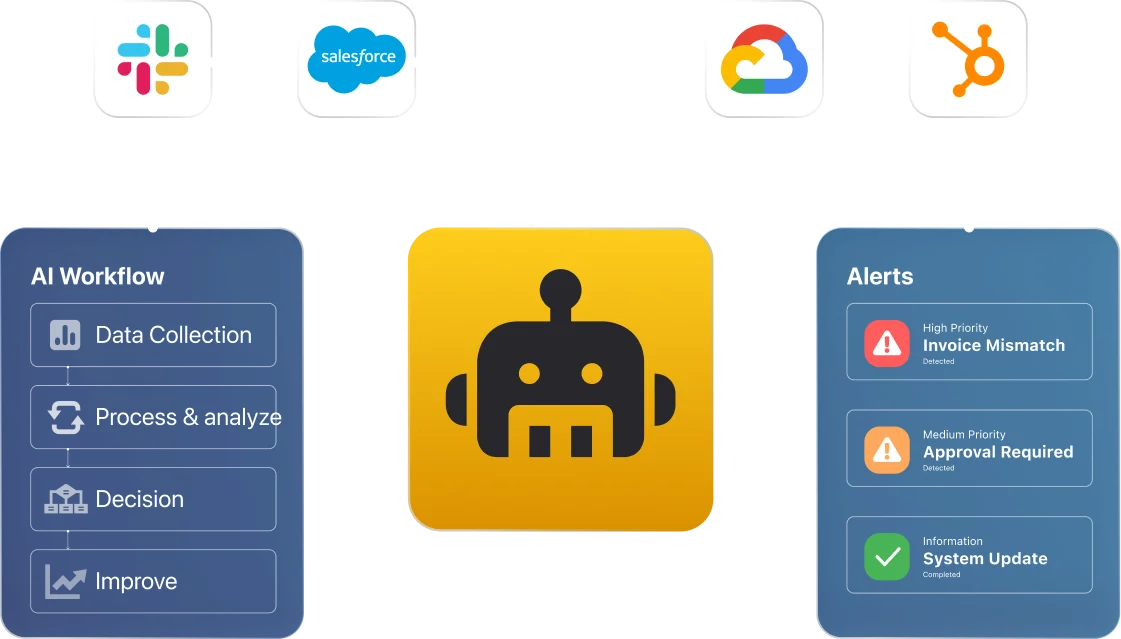
At Idea Maker, we design and develop AI agents that reason through complex tasks, take action across your systems, and improve as your operations evolve. Our AI agent development services in the USA deliver production-ready agents scoped to your actual workflows, built with the guardrails, integrations, and architecture decisions needed to operate reliably from day one.
Book Your Free Consultation Today!







Implies full-stack, end-to-end capabilities, not just simple apps
At Idea Maker, we offer a wide range of AI agent development services in the USA for startups, SMBs, and enterprises built around actual operational needs, not just fancy demos. We cover everything from building individual agents to architecting complex, multi-agent systems and integrating them into real environments.
Move from single-use automation to fully integrated agent systems. Talk to our team about your use case.

We build custom AI agents that automate high-volume, resource-intensive workflows across your organization. Each agent is engineered around your specific business logic, integrated with your existing systems, and deployed to handle tasks. Our development process covers architecture, security, integration, and ongoing optimization so your team stays focused on execution, not maintenance. If your business runs on repeatable processes and structured decisions, a purpose-built AI agent will outperform any generic tool on the market.
We design and build multi-agent systems in which specialized AI agents collaborate to execute complex, end-to-end business processes. Instead of relying on a single model to do everything, each agent handles a defined role: research, validation, decision-making, execution, and communication within an orchestrated framework. We handle the full architecture: agent coordination, memory management, fallback logic, and system-level security. If your operations require more than simple automation, with tasks that depend on context, sequencing, and cross-functional data, a multi-agent system is the infrastructure to support them.
As part of our expert custom AI agent development services, we build AI agents powered by Retrieval-Augmented Generation that deliver accurate, context-aware responses grounded in your organization’s actual data. Instead of relying on generic model knowledge, each agent retrieves relevant information from your internal documents, databases, and knowledge bases in real time before generating a response. We handle the full pipeline: data ingestion, chunking strategy, vector storage, retrieval optimization, and agent deployment. If your teams need AI that can reason over proprietary information policies, contracts, product data, and customer records, a RAG-powered agent turns your existing knowledge into a reliable operational asset.
We build AI copilots that work alongside your team inside the tools they already use, CRM platforms, support dashboards, internal operations panels, and document workflows. Each copilot is designed around a specific decision point: where does the user need context surfaced, a draft generated, a risk flagged, or a next action suggested? We define the interaction model, the handoff logic between the copilot’s recommendation and the user’s final decision, and the contextual triggers that determine when assistance appears. For workflows where full automation isn’t appropriate, legal review, financial approvals, and complex customer escalations, a copilot augments judgment rather than replacing it. We also build AI voice agents for customer-facing workflows, handling inbound and outbound calls with the same contextual awareness and system access as text-based agents.
As a leading software development agency, we deliver a focused, working AI agent built around a single high-impact use case, scoped, developed, and validated within 2–4 weeks. Each engagement uses your real data with clearly defined success criteria to test feasibility and inform architecture decisions before you commit to a full build. The scope is intentionally constrained to deliver clarity rather than complexity. Our process covers core agent logic, system connectivity, and controlled execution design. The result is a working model that reflects actual implementation effort, not a conceptual demo. If you need to prove value to stakeholders before scaling, this is where to start.
We deploy AI agents into production environments where real usage, real load, and real constraints exist. Our team handles containerized deployments across cloud, hybrid, and on-premises infrastructure, with scaling rules, access control layers, and audit-ready logging built in from day one. Every deployment is configured for the operational, security, and compliance standards your organization requires. If your agents are built but sitting in staging, we move them into production with the reliability and governance that enterprise operations demand.
At Idea Maker, we connect your AI agents directly to the systems where business operations happen CRMs, ERPs, internal databases, ticketing platforms, and third-party APIs. Every integration includes secure API connectors, defined authentication flows, and structured read/write permissions so agents can retrieve data, trigger actions, and update records inside live environments. No workarounds. No manual handoffs. If your agents need to operate within your existing tech stack without disrupting current workflows, we build the integration layer that makes it work.
Once deployed, we refine how agents behave under real workloads by adjusting latency, token usage, and reasoning efficiency. We analyze inference patterns to spot and optimize unnecessary computations. We also refine prompt structures using proven prompt engineering techniques and optimize model configuration for cost-sensitive or high-frequency execution, where performance consistency directly impacts operational load.
Our AI agent development services in the USA are designed to support you even after deployment. We establish continuous monitoring layers that track agent behaviour, error rates, output quality, and system health across production environments. Our engagement also covers performance tuning, ongoing refinement cycles as business data, workflows, and connected systems evolve over time.
We closely work with leadership teams to identify where AI agents create high impact and measurable operational value across business functions such as customer operations, finance workflows, and internal service delivery. We help leaders evaluate build vs. buy decisions, and define governance structures that determine how agents are safely and compliantly introduced into production environments.
You built something that works. Now it needs to work at scale. We help teams that have rapidly prototyped AI-powered applications using tools like Cursor, Bolt, Lovable, or Replit take those projects from functional demos to production-grade systems. Our team audits your existing codebase and addresses what vibe coding leaves behind, infrastructure planning, error handling, security hardening, database optimization, CI/CD pipelines, and complex third-party integrations. We restructure what needs fixing, build what’s missing, and deploy with the reliability your users and stakeholders expect. If you’ve built the first version fast and now need it to perform under real conditions, we turn your prototype into a product.

Expert Strategic Guidance and Full-Stack Model Deployment
Not every workflow needs the same kind of agent. The right architecture depends on how decisions are made, how many systems are involved, and whether the work requires full autonomy or human oversight. At Idea Maker, we provide AI agent development services to build across a range of agent architectures from focused, single-task agents to fully coordinated multi-agent systems. The goal is to match the solution to the complexity of your workflow, not force your workflow into a rigid solution.
Validate your use case quickly with a scoped, real-data proof of concept before full build. Partner with us today!
Built for clearly defined tasks like claims triage, invoice processing, or lead qualification, where consistency matters more than complexity. The scope is narrow by design, making these agents faster to validate, easier to deploy, and simpler to operate without layered orchestration or unnecessary system overhead.
Built for clearly defined tasks like claims triage, invoice processing, or lead qualification, where consistency matters more than complexity. The scope is narrow by design, making these agents faster to validate, easier to deploy, and simpler to operate without layered orchestration or unnecessary system overhead.
Built to retrieve and apply your actual company data at runtime, keeping outputs accurate, current, and aligned with how your business operates. Designed for environments where decisions depend on internal policies, documentation, or historical records, not general model knowledge.
Built to operate directly inside your business systems updating records, triggering workflows, and executing tasks across connected platforms. The difference is operational: actions are completed within the system, not described outside of it.
Human-in-the-loop agents for decision-critical workflows where judgment cannot be automated, such as financial review, legal workflows, or complex customer cases. The copilot surfaces context, drafts outputs, and highlights risks, while the final decision remains with the user.
Built for end-to-end execution across defined workflows with strict boundaries, failure handling, and escalation rules. These agents manage processes from trigger to completion, moving through multiple steps, updating systems, and resolving exceptions without requiring constant human intervention.
Built for These Use Cases
AI agents don’t create value in isolation; they deliver impact inside specific workflows where work is repetitive, decision-driven, and spread across systems. AI agents are ideal in situations where time is lost, context is fragmented, and consistency is hard to maintain. The scenarios below reflect how they are applied in day-to-day operations:

A customer raises a query at midnight. Instead of being routed through a scripted decision tree, the agent pulls the customer's order history, identifies the issue, and resolves the ticket. Cancellation processed, confirmation sent, and case closed. When a query requires judgment, the agent escalates it with the full conversation history, prior interactions, and a recommended resolution already attached. The support team handles exceptions, not repetition. For teams handling high call volumes, AI voice agents extend this same capability to phone-based interactions, resolving routine queries, collecting information, and escalating with full context without requiring a human on every call.

Leads come in, but reps don’t have time to chase every one. Instead of manual qualification and scattered follow-ups, the pipeline is pre-filtered. Low-intent leads are handled automatically, while high-potential ones are surfaced with context, interaction history, and next-step suggestions.

Internal operations stall when approvals are delayed, data doesn't match across systems, and exceptions pile up with no one to route them. With agents embedded in these workflows, requests are routed, discrepancies are flagged and resolved, and status updates are generated without someone having to chase every step across disconnected systems.

When invoices arrive in different formats, expenses need categorization, and every action must be traceable. Instead of manual processing and review cycles, entries are structured, checked against policies, and logged with clear audit trails. When something doesn’t align, it’s flagged early before it becomes a reporting issue or a compliance risk.
Onboarding a new hire means emails, documents, system access, and coordination across teams. Routine HR queries regarding benefits, policies, and status updates consume time that should be invested elsewhere. These interactions get handled instantly, while HR teams stay focused on decisions and employee experience.
Alerts fire, logs grow, and small issues take too long to diagnose. Instead of engineers manually digging through systems, incidents are triaged with context already assembled. What changed, where it broke, and what might fix it. Routine checks, documentation updates, and deployment validations happen in the background, which reduces operational load on engineering teams.
Finding the right information required sifting through documents, past cases, or scattered knowledge bases. With AI agents, relevant material surfaces in a connected, summarised, and structured form around the question. Whether it’s legal precedent, compliance requirements, or internal strategy documents, the time spent searching drops significantly.

If your team is dealing with work that follows a general pattern but never the exact same steps twice, you’re already outside the limits of simple automation. These are workflows that involve multiple decisions, shift based on context, and require moving across systems to complete a task. Think of exception-heavy processes, case handling, approvals that depend on multiple inputs, or operations where the next step depends on what just happened. When the work can’t be fully scripted but still needs structure, that’s where an agent fits.
Another clear signal is when the same type of work needs to happen more often than your team can realistically handle. For a small team, it looks like skilled people are spending hours on repetitive but important tasks that slow down growth. At scale, it shows up as inconsistent outcomes because the same process is handled by many people under varying conditions. In both cases, the issue isn’t capability; it’s the mismatch between human execution and required consistency.
Before building an agent, a few things need to be evaluated. The workflow should be clearly defined, the data it depends on should be accessible, and there should be a shared understanding of what a successful outcome looks like. Just as important, the agent needs to be tested in a real environment before expanding its role. This is exactly what a scoped PoC or early-stage engagement is designed to validate.
Get direct guidance on feasibility, architecture, and the right agent approach for your business. Talk to our senior AI engineers today!
How It Works
AI agent development is a controlled progression from problem definition to production stability. At Idea Maker, our approach ensures each phase reduces uncertainty, validates assumptions, and makes the agent safe to operate in real business environments. For smaller teams, the process can stop earlier at a validated PoC, while enterprise deployments continue through full-scale production and optimization.
Ready to move from idea to implementation? Book a scoping call with our engineering team.
At Idea Maker, we start with understanding your actual workflow. Our consultants break down your business problem, map where decisions happen, and define what the AI agent is responsible for versus what stays human-led. For SMBs, this phase also clarifies whether an AI agent is even the right solution or if a lighter automation layer is enough.
Deliverable: Scoping document, use case definition, success criteria, system boundary map, and go/no-go recommendation.

Before any architecture decisions are made, we evaluate what the AI agent will actually depend on, including data quality, structure, accessibility, and system readiness. Our team reviews APIs, internal tools, databases, and every third-party platform the agent must interact with. Most development engagements skip this step and discover data gaps after architecture is locked, when fixing them is significantly more expensive. We run this audit upfront so that the agent is designed around what your systems actually support, not what they're assumed to support.
Deliverable: Data readiness assessment, system access map, and integration dependency list documenting what is usable, what is missing, and what must be resolved before architecture decisions are made.
Once the foundation is clear, our architects define how the AI agent will function internally. The goal is to lock technical decisions before writing production code.
Deliverable: Agent architecture document, tool specification, guardrail design, and security plan locking every technical decision before production code is written.
A working version of the AI agent is built around the primary use case using real data and live system connections. Our PoC is not a demo but a constrained functional implementation that is tested directly against the success criteria defined earlier.
Deliverable: Functional PoC, performance report measured against the success criteria defined in Phase 01, and a full development recommendation. SMB clients may choose to stop here with a validated PoC before committing to production development. This is a genuine decision point, not a milestone on a fixed path.
Following a validated PoC, we will build the full production-grade system with proper error handling, retry logic, security controls, and performance optimization for real workloads. This is where the agent becomes stable enough for operational use across teams or business units.
Deliverable: Production agent with integration confirmed, security controls validated, and a full testing report.
Deployment is handled as a controlled rollout into cloud, hybrid, or on-prem environments with monitoring and rollback mechanisms already in place. You get a live system, a monitoring layer, and a structured deployment runbook that supports safe operational launch. We ensure the AI agent is fully observable from day one, with audit logs and system health tracking enabled.
After launch, we shift our focus to stability over time. For that, we track performance, detect behavioural drift, and refine the system as data, usage patterns, or business rules evolve. This includes ongoing optimisation cycles, performance benchmarks, and scheduled reviews to ensure the AI agent continues operating reliably in changing conditions.
Client Success Stories



Idea Maker has done an amazing job of delivering and responding to our needs.

The team was very responsive and easy to work with. They are professional, talented, and experienced team. They were able to meet all our requirements.

Idea Maker is distinguished for their personalized collaboration and white glove services. The team is dependable and reliable, sticking to the project's plan, offering feedback, and pushing back on the right things.

The way they understand the requirements we present to them is fairly solid. Both in terms of bringing their own interpretation in nailing the requirements and their design sense. By the time we launched, I had gotten significantly more value from our collaboration than what we had discussed in the original specs.

This is a boutique development firm where the Founder is directly involved with the project and the primary contact. This is unlike many development firms where you are simply handed off to developers that are not stakeholders. This is an important distinction that results in much better project accountability.

I have never had a site like this built before. I felt that Idea Maker and Tom had built numerous sites like this, and they were pros.

Idea Maker's portfolio is what drew us in. Their design style was in alignment with what we were after. We had initial consultations with 3 companies that we had narrowed it down to. Once we had our initial meeting with Tom at Idea Maker we knew we had the right choice to make. Their communication style works well for us.

Their customer service is excellent — they’re incredibly accessible and available, which I appreciate. Furthermore, they have enough experience and bandwidth to fulfill all my needs. They’re one of the best vendors I’ve worked with.
Our Case Studies
AI-Powered SOC2 compliance platform with modular framework support

An AI SaaS platform that guides users through compliance documents and builds strategies to meet regulations

Automated system to efficiently process and clean bulk data files, incorporating machine learning and Power BI
Core Logic/Engine
AI agents change how work gets done at an operational level. Instead of adding another layer of tooling, they take on execution-heavy tasks that slow teams down or introduce inconsistency at scale. The impact shows up in how work flows, how decisions are made, and how much manual effort is required to keep systems running efficiently.
Get a clear, expert assessment of where AI agents can create real impact in your workflows. Book your free consultation now!

Scale output without growing your team because your team no longer spends time on repetitive qualification, triage, or research tasks. Now, whether it’s a 5-person startup or the 500-person ops team, the same workload gets handled continuously in the background at only a fraction of the cost.
You and your customers get the same quality on the thousandth task as on the first. Every request, transaction, or check is handled using the same logic and standard, eliminating variation caused by fatigue, workload spikes, or manual errors across repeated tasks.
Your workflows no longer stall while people gather context across systems and wait for the right information to make a decision. Agents surface what’s needed at the moment of action: the right data, the right history, the right recommendation, so the next step executes without delay.
Your workflows move across platforms like CRM, finance systems, and internal tools without losing context or requiring manual handoffs. Tasks that once stalled between systems now continue end-to-end, reducing delays caused by fragmented operations.
As usage grows, more data is gathered, which can be utilized to further train AI agents to handle evolving business scenarios. What started as a single use case now scales into a broader operational capability that compounds in value.
Since AI agents operate in defined boundaries and guardrails, every action is traceable, auditable, and explainable. That makes AI agents highly suitable to operate in regulated environments without losing oversight or accountability.
Diverse Sectors, Custom Solutions
As a leading AI agent development company in the USA, we understand that every industry operates under different constraints, whether it’s compliance requirements, data sensitivity, or complex workflows. The good thing is that at Idea Maker, we have years of experience working across these environments. That’s why we design AI agents that align with those realities rather than forcing a one-size-fits-all approach.


Appointment management agents, patient query agents, prior authorisation workflow agents, clinical documentation agents, and EHR data extraction agents.

Customer support agents, returns and refund processing agents, inventory coordination agents, product recommendation agents, and supplier communication agents.

Claims intake and triage agents, underwriting research agents, policy servicing agents, fraud detection agents, and audit documentation agents.

Shipment tracking agents, exception resolution agents, RFQ automation agents, demand planning agents, and warehouse coordination agents.

Incident triage agents, developer workflow agents, onboarding automation agents, internal knowledge navigation agents, and support ticket deflection agents.

Document review agents, contract analysis agents, research synthesis agents, compliance checking agents, and due diligence workflow agents.

Quality inspection agents, maintenance triage agents, production reporting agents, supply chain exception agents, and operational data consolidation agents.
Trust. Strategy. Value. Results.
Every agent we deliver is scoped against a real workflow, validated in a live environment, and designed to operate reliably under production constraints. The team that defines the problem is the same team that architects the solution, builds it, and supports it after launch there is no handoff between scoping, development, and maintenance. That operational continuity is what keeps assumptions from getting lost and systems from drifting from their original design.

Before any design decisions are made, your data and systems are examined for what they actually support, not what they’re assumed to support. At Idea Maker, every engagement starts with a data and system audit because we avoid building agents on incomplete records, inaccessible APIs, or poorly structured inputs. Our upfront effort shifts failure risk away from deployment and into early-stage validation, where it’s far less costly to resolve.

The same engineers who define the problem, ask questions, and map constraints are the ones making architecture decisions during development. There is no handoff from a sales engineer to a delivery team. Our continuity removes the typical gaps where assumptions get lost, requirements shift, and the final system no longer reflects what was originally agreed.

At Idea Maker, every PoC engagement starts with a scoped use case, a connection to real data and live systems, and success criteria agreed before development begins. At the end, you receive a functional agent and a performance report measured against those criteria. The report gives you what you need to make a clear decision: proceed to production, adjust the approach, or stop based on evidence from your own environment, not a projected estimate.

We design access controls, output validation rules, escalation thresholds, and audit trails into the system from the start. Without these, agents operate with unclear boundaries, and failures surface only after deployment. Designing them early ensures actions are traceable, constrained, and aligned with how your business expects decisions to be made.

Real environments introduce broken APIs, inconsistent data, unexpected inputs, and sudden spikes in usage. At Idea Maker, these conditions are accounted for during development through fallback logic, retry handling, and controlled failure paths. The result is a system that continues operating even when surrounding systems don’t behave as expected.

Once the AI agent is live, the team working on it already understands how systems connect, where dependencies exist, and what changes can break behaviour. When an API updates or a workflow shifts, adjustments are made with the full context of the original design to avoid the delays that come from rediscovering how the system works.
FAQs
An AI agent is software that observes inputs, reasons through them, plans next steps, and takes action toward a defined goal. It can interact with systems, adapt based on outcomes, and operate within set boundaries. Unlike static automation, it adjusts its behaviour based on context.
The distinction is simple: chatbots talk, agents do. A chatbot is designed to handle conversations. It responds to queries but doesn’t act beyond that. An AI agent goes further by executing tasks across systems, making decisions, and progressing workflows.
An AI agent works toward a goal and can act independently within defined limits. A copilot operates alongside a human, surfacing information, drafting outputs, or suggesting actions while leaving the final decision to the user.
A multi-agent system is a coordinated network of specialised agents, each responsible for a specific role such as planning, execution, or validation. These agents work together through an orchestration layer to complete complex, multi-step tasks.
A proof of concept usually takes 2–4 weeks when scoped to a single use case. A production-ready single AI agent falls in the 6–12 week range, while multi-agent systems can extend to 3–6 months. Exact timelines depend on data readiness, system integration complexity, and governance requirements.
A PoC is built around a clearly defined use case and connected to real data and systems. It includes a functional agent, pre-agreed success criteria, and a performance report measuring how the AI agent behaves against those criteria. The goal of a PoC agent is to decide whether to proceed, refine, or stop.
Yes. Our agents are designed to operate within existing environments, including CRM systems, ERPs, internal databases, APIs, and collaboration tools. Specific integrations are mapped during scoping to ensure the AI agent can read, write, and act where your workflows already exist.
Yes. Smaller teams often start with a scoped PoC to validate a single workflow before expanding further. At the same time, full-scale production systems and multi-agent architectures are built for enterprise environments with more complex requirements.
Yes. An NDA can be signed at the start of the first conversation.
We take a model-agnostic approach; the model is selected based on the agent's task, not a default vendor preference. For tasks requiring deep reasoning, we work with models like GPT-4o, Claude, or Gemini. For latency-sensitive or high-frequency execution, we use smaller, faster models, including Mistral, Llama, or task-specific fine-tuned models. For cost-sensitive deployments, we evaluate open-source options that can run on private infrastructure. The goal is to match each agent's model to its operational requirements: reasoning depth, response speed, cost per task, and data privacy constraints.
Framework selection depends on the architecture being designed. However, we leverage modern tools like LangChain, LangGraph, CrewAI, LlamaIndex, and AutoGen where they fit the problem, not as fixed defaults.
Agents operate within defined boundaries that include access controls, output validation layers, and escalation rules for sensitive actions. High-risk decisions are routed to human review, and all actions are logged for traceability. These controls are built into the system design rather than added after deployment.
Failures are detected through monitoring systems that track errors, anomalies, and output deviations. The AI agent can trigger fallback logic, retry specific actions, or escalate to a human when needed. Issues are contained within defined boundaries, preventing a single failure from disrupting the broader workflow.
Our AI agents are designed to access only the data required for their task, with strict controls on what is stored, processed, or retained. Access is governed through permission layers aligned with your internal policies and regulatory requirements, such as GDPR, HIPAA, or SOC 2. Data handling is defined at the architecture level, not left to implementation choices later.
Yes. Agents can be deployed in public cloud environments, within a private VPC, or fully on-premise, depending on security and compliance needs. Options include containerised deployments and private model inference setups where data cannot leave internal infrastructure.
Boundaries are enforced through role-based access control, predefined action limits, and audit trails that log every decision and system interaction. High-stakes actions trigger escalation protocols or require human approval before execution. This ensures agents operate with authority while remaining fully accountable within regulated environments.

Idea Maker © 2026 ● All Rights Reserved

