

Guide on Secure Software Development Lifecycle (SSDLC)
Software has become the backbone of modern business operations, enabling organizations of all sizes to run, scale, and compete effectively. It now powers everything from basic data entry to complex decision-making across industries.
In 2026, faster development driven by cloud-native systems, AI-assisted coding, and distributed teams often pushes security late in the lifecycle. According to the 2026 OSSRA report, open source vulnerabilities doubled to 581 per codebase as AI adoption explodes, with 87% of codebases at risk.
This is where the Secure Software Development Lifecycle (SSDLC) becomes critical. It embeds security into every stage of development so vulnerabilities are identified and addressed early. If you're building secure, scalable applications, working with an experienced partner in custom software development services can help ensure SSDLC principles are applied from day one.
This article explains what SSDLC is, how it differs from traditional SDLC, its key phases, and best practices for implementing it effectively with expert guidance.
What is Secure Software Development Lifecycle (SSDLC)?
Secure Software Development Lifecycle (SSDLC) is a software development framework in which security requirements, controls, and verification activities are treated as first-class deliverables at every phase, on par with functional requirements. Rather than bolting security on before launch, SSDLC re-engineers each phase of the traditional Software Development Lifecycle (SDLC) around security as a co-equal objective alongside functionality, performance, and time-to-market.
The defining principle is shift-left security: identifying and addressing vulnerabilities at the earliest possible stage, where they are cheapest to fix and least likely to reach production. A flaw caught during threat modelling in the design phase can cost a fraction of what the same flaw costs to remediate after deployment.
Why does SSDLC matter?
The importance of SSDLC becomes clear when looking at the cost of late fixes and the scale of modern threats. According to IBM research, fixing a defect after software goes live can cost up to 100x more than addressing it during the design phase. Even during later maintenance, it can still cost around 15x more than fixing it early in development.
At the same time, the threat landscape is expanding rapidly. According to a 2025 retrospective by Talos Intelligence, there were 48,196 CVEs (around 132 per day) and 241 known exploited vulnerabilities (KEVs). It marks a 30% increase in active exploitation compared to 186 in 2024. With attack surfaces expanding through open-source dependencies, IoT, and AI-driven exploitation, bolting security on at the end of development is no longer viable. SSDLC exists because security has to ship with the code, not after it.
The stakes are highest for enterprise software solutions, where a single application may handle financial records, customer data, and core business operations across thousands of users. A vulnerability in an enterprise system rarely affects just one feature; it cascades across integrations, legacy databases, and downstream services, which is why building security into the development lifecycle from day one is no longer optional for organizations operating at this scale.
The outcome of a mature SSDLC is software that is engineered to withstand real-world attacks from day one, protecting customer data, preserving trust, and reducing the business risk that follows every deployment. It is not a compliance exercise or a tooling decision. It is a structural commitment to building software that is secure by design rather than secure by patch.
Key Differences Between SSDLC and SDLC (SSDLC vs SDLC)
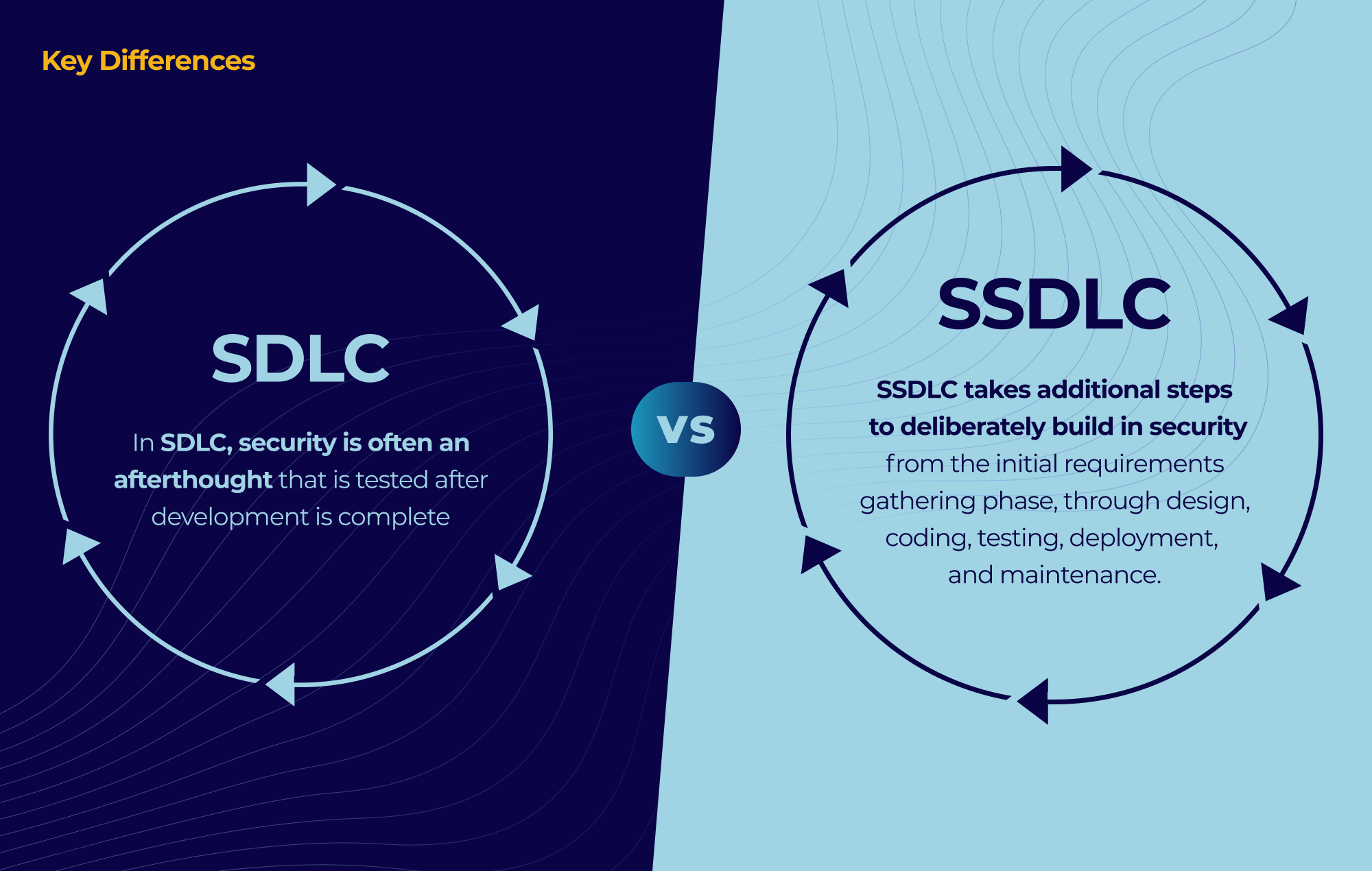
SSDLC is not a different lifecycle from SDLC it is SDLC re-engineered around the principle that security is a co-equal objective at every phase, not a final checkpoint. The differences are not in what phases exist, but in what happens inside them, who is accountable, and when vulnerabilities are caught. Three dimensions matter most. Here are the key differences between SSDLC and SDLC:
| Dimension | Traditional SDLC | SSDLC |
|---|---|---|
| Primary goal | Deliver functional software on time | Deliver functional and secure software on time |
| When security is addressed | Late — typically pre-launch | Continuously — from requirements onward |
| Requirements phase | User stories, functional specs | User stories + abuse cases + threat modeling |
| Design phase | Architecture and data flow | Architecture + attack surface analysis + trust boundaries |
| Implementation phase | Code style and functional standards | Secure coding standards + SAST + SCA in CI |
| Testing phase | Functional and regression testing | Functional testing + DAST + fuzzing + pen testing |
| Deployment phase | Ship the build | Hardened runtime + secrets management + monitoring |
| Maintenance phase | Bug fixes and feature patches | Vulnerability disclosure + threat intel + incident feedback loop |
| Security ownership | Separate security team (gatekeepers) | Shared across product, dev, QA, ops (security as enabler) |
| Cost of fixing vulnerabilities | High — most flaws caught in production | Low — most flaws caught in design or implementation (~30–100x cheaper) |
| Cultural posture | Security as compliance checkpoint | Security as engineering discipline |
| Core question asked | "Does it work?" | "Does it work, and how can it be abused?" |
1. When security work happens
In a traditional SDLC, security is typically a pre-launch gate: code is written, features are tested for functionality, and a security review or penetration test happens shortly before release. Anything found at that stage is expensive to fix and often gets deferred to a future sprint.
SSDLC inverts this. Threat modeling happens during requirements. Secure architecture decisions happen during design. SAST runs on every commit during implementation. DAST and pen testing run continuously throughout testing, not just at the end. The economic argument is decisive: long-standing industry estimates suggest fixing a vulnerability during design can cost an order of magnitude less than fixing the same flaw in production. Shift-left is not a slogan; it is the entire business case for SSDLC.
2. What activities exist inside each phase
The phase names are unchanged, but the deliverables expand:
- Requirements:
- SDLC captures user stories. SSDLC adds abuse cases — the inverse of user stories, describing how an attacker might misuse a feature — along with formal threat modeling and explicit security requirements tied to risk appetite.
- Design:
- SDLC defines architecture. SSDLC adds attack surface analysis, trust boundary mapping, and secure-by-default configuration choices baked into the data model.
- Implementation:
- SDLC enforces code style. SSDLC enforces secure coding standards, with SAST and SCA running automatically in CI.
- Testing:
- SDLC validates functionality. SSDLC adds DAST, fuzzing, dependency scanning, and adversarial pen testing as gating criteria.
- Deployment:
- SDLC ships the build. SSDLC hardens the runtime, manages secrets, and instruments the environment for continuous monitoring.
- Maintenance:
- SDLC patches bugs. SSDLC runs vulnerability disclosure programs, monitors threat intelligence feeds for newly disclosed CVEs in dependencies, and feeds incident learnings back into requirements for the next cycle.
3. Who owns security
In SDLC, security is typically owned by a separate team that reviews work after the fact and is often perceived by developers as a blocker. In SSDLC, security is a shared responsibility distributed across product managers, architects, developers, QA, and operations.
Developers write secure code, architects design secure systems, and security teams provide guidance and validation, ensuring accountability is distributed across the lifecycle rather than isolated.
Security teams then shift from gatekeepers to enablers: providing tooling, training, threat models, and security champions embedded inside engineering teams. This cultural change is as important as any technical control; without it, SSDLC processes get worked around rather than adopted.
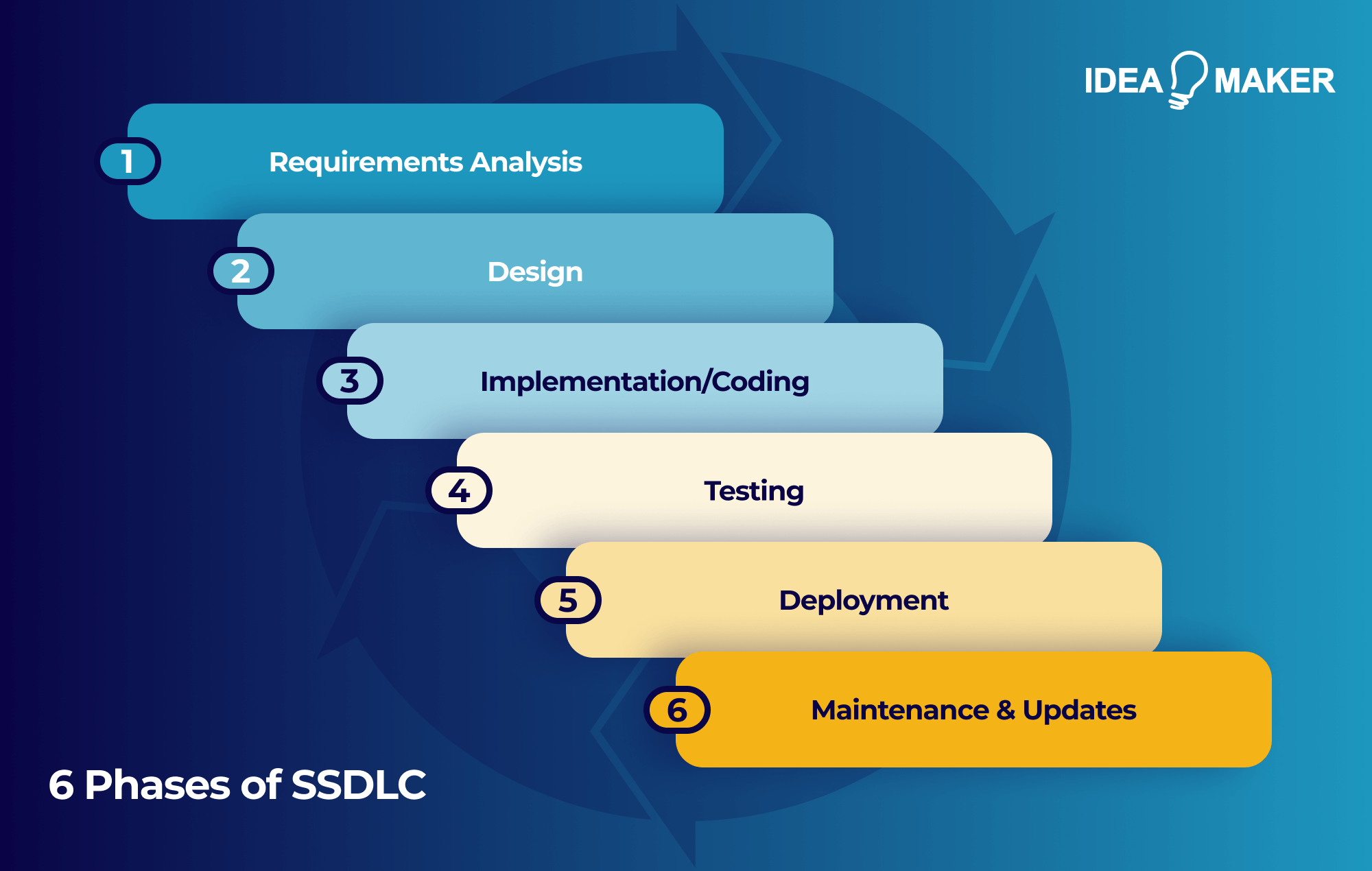
6 Phases of Secure Software Development Lifecycle (SSDLC)
Before walking through the phases, it's worth anchoring SSDLC against the most widely recognized industry standard: NIST Secure Software Development Framework (SP 800-218). NIST SSDF organizes secure development into four practice groups: Prepare the Organization, Protect the Software, Produce Well-Secured Software, and Respond to Vulnerabilities. It is now the de facto reference standard for US federal software procurement and a growing number of enterprise programs.
The six phases below map directly to SSDF practices and provide your team with an actionable structure for implementation.
1. Requirements Analysis
The first stage is where SSDLC most visibly diverges from SDLC. Alongside functional user stories, your team captures security requirements, abuse cases, and threat models early.
Abuse cases describe how an attacker might misuse a feature, helping teams think beyond intended functionality. These are supported by formal threat modeling using frameworks like STRIDE, which categorizes risks into Spoofing, Tampering, Repudiation, Information Disclosure, Denial of Service, and Elevation of Privilege.
Compliance requirements such as PCI DSS, HIPAA, GDPR, and SOC 2 are also translated into concrete, actionable security requirements at this stage. The stakes are especially high in regulated industries. Software built for financial or legal services, for example, must meet strict data protection and fraud prevention standards. Missing a requirement here can lead to serious regulatory consequences after launch.
Having a clearly defined software development plan before this phase begins ensures your team arrives with documented risk appetite, compliance obligations, and security priorities already aligned, rather than discovering conflicts mid-requirements gathering.
2. Design
The design phase is where security moves from intent to structure. Here, your team translates security requirements into architecture, components, and data flows. Instead of only defining how features should work, you decide how the system will withstand real-world attacks from day one.
Early decisions made in this phase carry long-term impact. For example, implementing encryption at-rest, in-transit, or at the field level during design is far simpler and cheaper than retrofitting it later. The same applies to access control, data validation, and system boundaries.
This matters even more when you consider the financial impact of late fixes. The global average cost of a data breach has reached $4.44 million, making architectural decisions made at this stage a direct factor in long-term risk and cost exposure.
At this stage, teams map trust boundaries, identify potential attack surfaces, and embed secure-by-default configurations directly into the architecture, rather than leaving them to be handled during deployment.
Key SSDLC activities undertaken during the design phase include:
- Data flow diagrams: Map how data moves through your application and annotate each flow with trust boundaries to identify where validation and access controls are required.
- Authentication and authorization architecture: Define how users will be authenticated, how sessions will be managed, and how permissions will be enforced across your application.
- Secrets management strategy: Plan how API keys, database credentials, and tokens will be stored, rotated, and accessed without exposure in source code or configuration files.
- Threat model documentation: Produce a formal threat model that your engineering team will reference throughout implementation to validate that design assumptions hold as code is written.
- Encryption planning: Decide which data must be encrypted at-rest, in-transit, or at the field level, and select algorithms and key management approaches that align with compliance requirements.
The goal of this phase is to make security an architectural property of your software rather than a feature added later. Decisions made here shape the security posture of every subsequent phase, which is why the design phase is one of the highest-leverage stages in your SSDLC.
3. Implementation/Coding
The implementation phase is where secure design decisions get translated into code. Developers work against established secure coding standards such as OWASP, CERT, or language-specific guidelines. At the same time, security checks are integrated directly into the development workflow.
With automation in software development, security testing runs automatically in the CI pipeline on every commit instead of acting as a final gate. The goal is to catch vulnerabilities at the developer's keyboard, when they are easiest and cheapest to fix.
Three categories of tooling matter most during implementation:
- Static Application Security Testing (SAST): Analyzes your source code for injection flaws, buffer issues, and insecure patterns without executing the program. SAST runs on every commit and surfaces issues directly in the developer's pull request.
- Software Composition Analysis (SCA): Scans your third-party and open-source dependencies for known CVEs. According to Black Duck's (formerly Synopsys) Open Source Security and Risk Analysis report, open source code grew by 30% year-over-year, making SCA arguably the highest-leverage tool in your entire SSDLC.
- Secrets scanning: Catches API keys, tokens, and credentials that developers may have accidentally committed to source control before they reach production or end up in public repositories. This is becoming more critical in the AI era, where code is often generated, copied, or reused at scale. With a growing percentage of code entering systems outside traditional package managers, exposed secrets can easily slip through without dedicated scanning in place.
So, tooling alone is not enough. Mandatory peer code reviews remain essential for catching what automated tools miss, particularly business logic flaws and authorization gaps that require human judgment to identify. Your goal during implementation is to make secure coding the default path for your developers rather than an extra step they have to remember.
4. Testing
The testing phase in SSDLC is layered rather than sequential. Functional QA still ensures the software behaves as expected, but it now runs in parallel with security testing. The focus is not just on what the system should do, but also on how it behaves under misuse, attack, or unexpected conditions.
Surprisingly, vulnerabilities remain widespread across modern applications, with research showing that roughly 76% still contain at least one security flaw.
That’s why several categories of security testing are essential during this phase:
- Dynamic Application Security Testing (DAST): Tests the running application against real-world attack patterns such as SQL injection, cross-site scripting, and authentication bypass. It helps uncover vulnerabilities that only appear during execution.
- Interactive Application Security Testing (IAST): Instruments your application during testing to combine the depth of SAST with the runtime context of DAST, catching vulnerabilities that either approach alone would miss.
- Fuzzing: Feeds malformed, unexpected, or random inputs into your application to surface edge-case crashes, memory corruption issues, and input validation failures that structured tests would not reach.
- Penetration testing: Engages human testers to simulate real-world attackers, probing your application for chained vulnerabilities, business logic flaws, and creative attack paths that automated tools cannot find.
- Negative testing: Intentionally tests misuse scenarios to ensure the system fails safely. This includes validating error handling, access control boundaries, and how the application responds under invalid or malicious inputs.
Detailed security test cases should be created to validate every authentication path, access control boundary, encryption mechanism, and input validation routine in your application. Findings should flow back to your developers through the same issue tracker as functional bugs, rather than living in a separate security backlog that gets deprioritized over time.
This is particularly critical when developing enterprise applications, where a single overlooked vulnerability can expose financial records, customer data, and core business workflows across thousands of users at once. Treating security findings as first-class engineering work is what makes the testing phase meaningful in an SSDLC. Treating security findings as first-class engineering work is what makes the testing phase meaningful in an SSDLC.
5. Deployment
The deployment phase in SSDLC is not just about shipping your build to production it is about hardening the runtime environment your software will operate in. A well-structured software deployment plan in SSDLC ensures that security hardening, secrets management, and runtime monitoring are all accounted for before your application faces real-world exposure. As your application transitions from staging to production, your team conducts a comprehensive vulnerability assessment to uncover any security gaps that may have emerged during integration with other systems. Teams managing custom software integration at this stage should ensure that every new connection point is treated as a potential attack surface and hardened accordingly before production exposure. This is your last opportunity to catch high-severity flaws before real-world exposure.
Several SSDLC activities are critical at this stage:
- Infrastructure-as-code scanning: Scan your Terraform, CloudFormation, or Kubernetes manifests for misconfigurations before they are applied to production environments.
- Secrets management: Inject secrets through a dedicated secrets manager rather than environment files or configuration baked into the build.
- Container image signing and scanning: Sign your container images to verify provenance and scan them for known vulnerabilities before they are pulled into production.
- Pre-production penetration testing: Conduct a final adversarial test to validate that integration with downstream systems hasn't introduced new attack paths that were invisible during isolated testing.
- Runtime monitoring instrumentation: Set up application self-protection, anomaly detection, and centralized logging before launch never after.
Once your application is live, your security team should continuously scrutinize user traffic, data flows, access logs, and system activities to detect anomalies that indicate potential attacks before they escalate. eams that are new to this process can benefit from first understanding what software deployment actually entails the configuration, rollback planning, and environment hardening that separates a controlled release from an exposed one.Your production environment is where adversaries focus their efforts, which is why hardening it both before and after release is critical to your SSDLC.
6. Maintenance & Updates
Your work doesn't end once your software is released. The maintenance phase is where SSDLC becomes a true cycle rather than a linear pipeline, and where the long-term security posture of your application is either sustained or eroded over time. This is also where many organizations first recognize the limitations of older systems — security patches become harder to apply, dependencies fall out of support, and vulnerabilities accumulate faster than they can be addressed. In these cases, modernizing legacy applications using SSDLC principles from the ground up is often more sustainable than continuing to patch architecture that was never designed with security in mind.
Four activities run continuously throughout the maintenance phase:
- Vulnerability disclosure program: Operate a public channel through which security researchers can report flaws responsibly rather than disclosing them publicly or selling them on underground markets.
- Threat intelligence monitoring: Track newly disclosed CVEs in your dependencies so that critical patches can be applied within defined service-level agreements before attackers weaponize them.
- Incident response: Maintain documented playbooks, on-call rotations, and blameless post-mortems that ensure your team responds quickly and learns from incidents when they occur.
- Feedback loop into earlier phases: Feed every incident, near-miss, and newly discovered vulnerability class back into your requirements and design phases for the next development cycle.
This last point is what separates a mature SSDLC from a checklist exercise. Lessons from production should flow upstream into how the next feature is built, turning each incident into a permanent improvement rather than a one-time fix. Without this feedback loop, SSDLC becomes just SDLC with extra tools attached. With it, your organization's security posture compounds over time — each cycle leaving your software more resilient than the last.
Best Practices for SSDLC
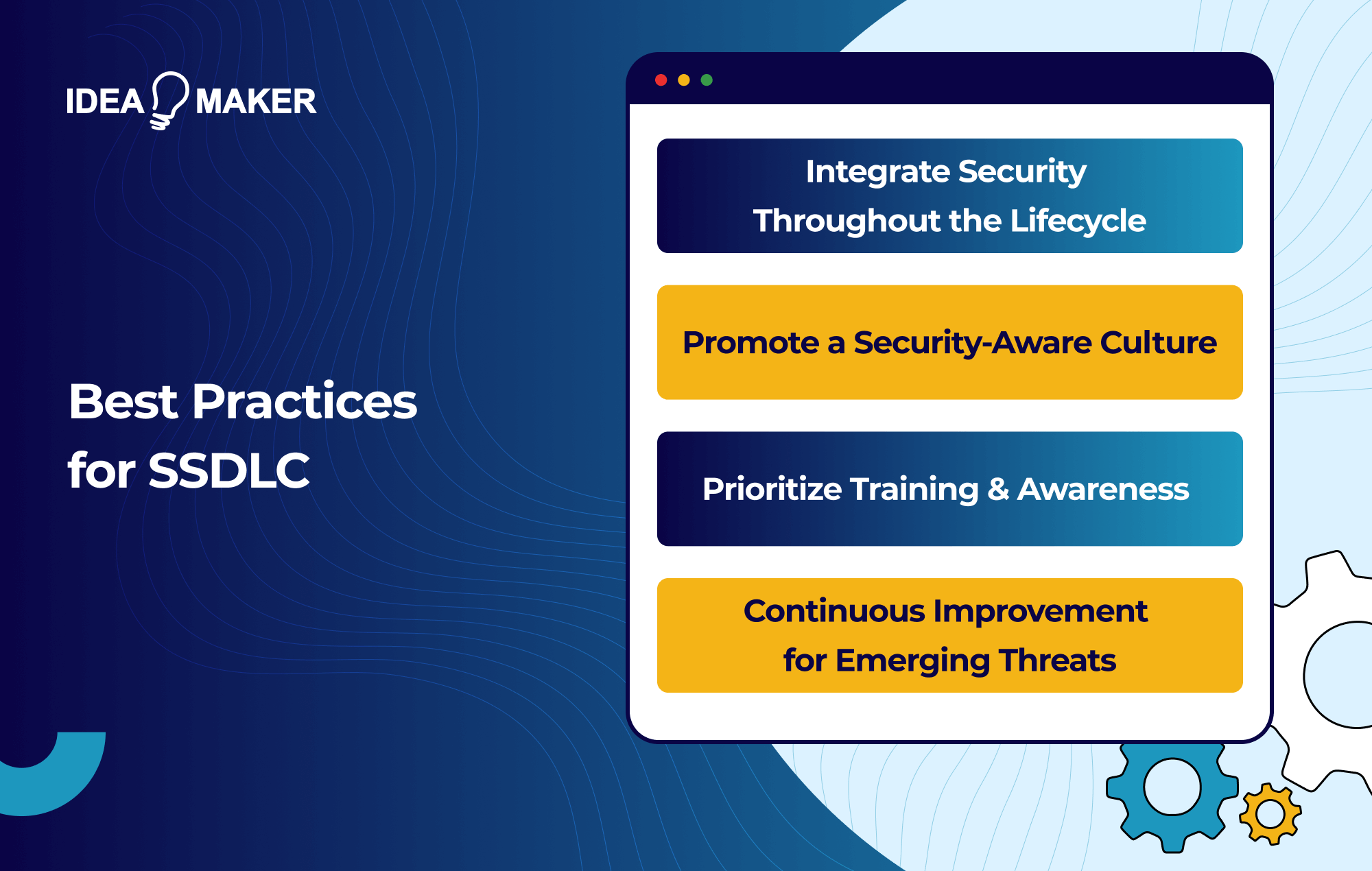
Implementing SSDLC effectively is less about following phases and more about how engineering teams operate across those phases. Many organizations adopt SSDLC as a framework but fail to realize security gains because the underlying engineering practices, incentives, and tooling are weak. Mature SSDLC programs are defined by execution discipline, not documentation.
In 2026, we strongly recommend the following best practices to follow in your software development strategy:
Embrace DevSecOps and Shift-Left Security
According to Veracode, nearly 82% of organizations are still carrying security debt, highlighting how many teams continue to ship software with unresolved vulnerabilities.
That’s why in 2026, SSDLC is tightly coupled with DevSecOps. Security checks are embedded directly into CI/CD pipelines so that every commit, build, and deployment is continuously validated. SDLC tools such as GitHub Actions, GitLab CI, and integrated security scanners make this process automatic rather than dependent on manual reviews at the end of development.
A second critical layer in 2026 is software supply chain security. Teams now maintain a Software Bill of Materials (SBOM) for every release, sign artifacts for provenance, and continuously monitor dependencies. This shift has accelerated after real-world incidents like SolarWinds cyberattack and the Log4Shell, both of which exposed how deeply embedded third-party components have become in modern systems.
With regulatory pressure increasing through frameworks like the EU Cyber Resilience Act, SBOMs, and vulnerability disclosure timelines are becoming compliance requirements rather than optional practices.
AI-Generated Code Audit
AI-generated code should be treated as a high-speed draft, not production-ready output. Surprisingly, according to an industry report by JetBrains, 85% of developers now use AI tools, and 62% rely on at least one coding assistant.
This level of adoption makes it essential to introduce structured validation before any AI-assisted code reaches production. A practical starting point is the pull request stage, where AI-generated changes are automatically flagged and routed through security tooling before human review.
Key safeguards include:
- Pre-merge scanning with SAST tools to detect insecure patterns early
- Dependency validation using SCA tools to catch vulnerable or unnecessary packages introduced by AI suggestions
- Secrets detection pipelines integrated into CI/CD to prevent accidental exposure of API keys or credentials
- PR-level security gates that block merges if critical issues are detected in AI-generated changes
Teams should tag or track AI-assisted commits so that security teams can monitor patterns over time and identify recurring weaknesses in generated code. High-risk modules such as authentication, payments, or data handling should always require deeper manual review regardless of automated tool results.
Integrate Security Throughout the Lifecycle
Security should be integrated into your entire development lifecycle from initial requirements gathering through to post-deployment monitoring, rather than retrofitted as an afterthought once vulnerabilities surface. Teams that document this as a structured software process with defined security gates at each phase are far less likely to discover critical vulnerabilities late in delivery when remediation is most expensive. It should be treated as an equal priority to functional goals at every phase, not as a gate that work passes through before launch.
Threat modeling should start during requirements and continue to evolve across phases as your understanding of the attack surface deepens. Security-focused code reviews, SAST, SCA, DAST, and penetration testing should all be wired directly into your CI/CD pipelines so that vulnerabilities are caught when they are cheapest to fix. The economic argument is decisive: addressing a flaw during design costs a fraction of what the same flaw costs to remediate in production. Accounting for security tooling and testing as a defined line item in your software budget prevents the far greater cost of emergency remediation after launch.
Build a Security-Aware Culture Through Concrete Artifacts
SSDLC succeeds only when security becomes part of day-to-day engineering behavior. That shift does not come from policy documents alone; it comes from operational structures that reinforce accountability. These mechanisms turn security from a guideline into a working system that influences daily engineering decisions.
Effective programs include:
- Security champions programs: Engineers within each team act as the first line of security support, bridging product and security functions.
- Blameless post-mortems: Incident reviews focus on system failures and process gaps rather than individual fault, encouraging transparency and faster learning cycles.
- Security-focused engineering metrics: Teams track measurable outcomes such as vulnerability remediation time, SAST coverage, and critical findings per release.
- Developer-led threat modeling: Engineers responsible for features actively participate in identifying threats during design discussions.
- Executive sponsorship: Leadership ties security outcomes to business priorities, ensuring funding, visibility, and accountability at the organizational level.
Prioritize Training and Continuous Education
Your team should conduct regular secure coding training sessions, workshops, and tabletop exercises to keep developers, QA, and security personnel current on the latest application risks, tools, and remediation techniques. Compliance training on frameworks such as PCI DSS, HIPAA, GDPR, and NIST SSDF should be paired with hands-on coding exercises so that abstract requirements translate into concrete engineering habits.
Effective training helps your team ingrain secure coding habits while empowering them to own security rather than view it as a bottleneck imposed by another team. Prioritizing continuous education is one of the highest-leverage investments your organization can make in the success of your SSDLC.
Continuously Improve for Emerging Threats
The cyber threat landscape evolves rapidly, with attackers innovating new attack vectors faster than most defenses can adapt. Your SSDLC must adapt accordingly through continuous assessment and upgrades rather than periodic audits that quickly become stale.
Your team should learn from past security incidents, near-misses, and external threat intelligence to uncover control gaps and derive insights that strengthen your SSDLC. Iterative improvements to your tooling, processes, and threat models should happen on an ongoing basis. For example, integrating new SCA capabilities as supply chain attacks evolve, or updating threat models as your application architecture changes.
Let Idea Maker Help You With a SSDLC
Most software development agencies treat security as something you add later — or worse, as someone else's problem. At Idea Maker, secure development is built into how we deliver every project, from the first requirements conversation through to launch and beyond.
When we build software for your business, SSDLC principles are part of the engagement by default. This applies whether you are building a consumer-facing product or require dedicated enterprise software development services where compliance, access control, and data protection carry the highest stakes.
- Security requirements captured upfront alongside functional requirements, so there are no surprises late in the project.
- Threat modeling during design to identify risks before a single line of code is written.
- Secure coding standards and code reviews applied throughout development, with SAST and dependency scanning integrated into our pipelines.
- Security testing before launch including penetration testing through trusted partners when your project requires it.
- Documentation and handover that gives your team everything needed to maintain the security posture we build.
Whether you need a new web application, a mobile app, or a custom software built from scratch, Idea Maker delivers software that is engineered to be secure from day one rather than patched after launch. Contact us today to discuss your project and how we can help you ship with confidence.
Frequently Asked Questions
Why is SSDLC required?
SSDLC is needed because modern software faces a growing number of vulnerabilities, with 48,185 CVEs reported in 2025 alone. It helps organizations build security into development early to avoid breaches, compliance issues, and costly post-deployment fixes.
How long does it take to transition from SDLC to SSDLC?
There’s no fixed timeline. Most teams see initial improvements in 3–6 months with basic tooling and process changes, while full maturity typically takes 12–24 months, depending on complexity and team size.
Is SSDLC only relevant for large enterprises?
No. SSDLC benefits startups and small teams as much as enterprises. With accessible tools like OWASP ZAP, Trivy, and built-in CI/CD security features, it can be implemented at any scale.
How does SSDLC impact development speed and time-to-market?
A common misconception is that SSDLC slows development down. Initially, there may be slight friction as teams adopt new practices. Over time, SSDLC improves speed by reducing rework, production issues, and emergency fixes that disrupt delivery.
What's the difference between SAST, DAST, and IAST?
SAST scans source code for issues without execution, DAST tests running applications from the outside, and IAST combines both for deeper, runtime-aware vulnerability detection.
How do I measure the success of an SSDLC program?
Key metrics include vulnerability detection and remediation time, reduction in critical issues per release, tool coverage, and frequency of security incidents over time.
What is a Software Bill of Materials (SBOM) and why does it matter?
A Software Bill of Materials is a formal inventory of every component, library, and dependency used in your software. SBOMs matter because modern applications rely heavily on third-party and open-source code, and knowing exactly what's in your stack is essential for responding to newly disclosed vulnerabilities.
What are the most common mistakes organizations make when adopting SSDLC?
Common mistakes include treating SSDLC as just a tooling upgrade, lacking leadership support, overwhelming teams with tools, and ignoring training and cultural adoption.