Before you bring a product to market, you have to make a series of critical decisions, and the first is where to begin. Do you start with a POC, a prototype, or an MVP? Do you need just one of them, or a combination in the right order? Choosing the wrong starting point means solving the wrong problem first and losing months in the process.
It is widely reported that around 90% of startups fail in the long term. While approximately 10% shut down within their first year, the most vulnerable period tends to occur between years two and five, when early funding runs out, and companies struggle to find sustainable traction.
The primary reason behind these failures is not a lack of effort or technical skill. In fact, 42% of startups collapse because there is no real market need for what they built. Founders invest time and resources into developing products before fully validating whether customers actually want them.
Some teams jump straight into development before confirming that the technology even works. Others spend months improving UI without knowing if users actually care. When early assumptions go untested, the cost compounds fast.
Before approving the budget, you're probably asking yourself: Are we building the right thing, or just building fast?
This is where the POC vs. Prototype vs. MVP decision actually matters. These three terms are often used interchangeably, yet they serve entirely different purposes, answer different questions, and belong at different stages of development. Choosing the right one could be the difference between a smart build and an expensive mistake.
What Is a Prototype?
A prototype makes your product concept demonstrable to stakeholders, users, and investors before any engineering commitment is made. This helps decision-makers evaluate direction, usability, and presentation before allocating development budget or capital. It is a preliminary representation of the product that shows how the solution would look and behave, without requiring production infrastructure.
Prototypes can take many forms, like paper sketches, clickable digital mockups, interactive demos, or simplified physical models. The format is less important than the purpose: turning an abstract idea into something tangible enough for others to assess and challenge.
At this stage, the focus is not on infrastructure, scalability, or performance. Instead, the objective is to explore usability and interaction logic. By walking through key end-to-end user journeys, you can identify friction points, clarify navigation, and refine the overall experience before development begins.
You should also understand what a prototype is not meant to validate. A prototype does not answer business or infrastructure questions. It does not:
- Validate real customer demand
- Test production performance or scalability
- Serve as a version ready for public release
What Prototyping Should Achieve
A well-executed prototype should result in:
- A shared understanding of how the product will function
- Validated key user flows before the development budget is committed
- Lower risk of costly design rework during engineering
- A tangible artifact for investor discussions that reduces perceived execution risk
- Greater confidence in product direction before technical build begins
Types of Prototypes
Prototypes can take different forms depending on what you need to evaluate:
1. Low-Fidelity Prototypes
Low-fidelity prototypes are simple representations such as paper sketches, whiteboard drawings, or basic wireframes created in tools like Figma or Balsamiq. They are quick to produce and intentionally exclude UI styling, branding elements, and finalized visual components.
You would choose a low-fidelity prototype when exploring early concepts, testing layout direction, or facilitating internal discussions before investing in detailed design. They are particularly useful when the goal is speed and iteration rather than realism.
2. High-Fidelity Prototypes
High-fidelity prototypes closely resemble the final product in layout, branding, typography, and visual detail. They are usually created in design tools and may include realistic content and refined interface components.
You would choose this approach when presenting to stakeholders or investors, testing visual perception, or validating design decisions that depend on aesthetics and layout precision. They require more time and design effort but provide a clearer representation of the intended experience.
3. Clickable Prototypes
Clickable prototypes help users navigate between screens or states through linked interactions. These are typically built using design platforms that simulate navigation without real backend logic.
This type is useful when testing user journeys and flow logic, for example, whether users can move from onboarding to the dashboard without confusion. It is appropriate when validating navigation structure rather than feature functionality.
4. Interactive Prototypes
Interactive prototypes simulate limited system behavior, such as form validation, conditional flows, or basic feature logic. They may be built using advanced prototyping tools or lightweight frontend code.
You would choose an interactive prototype when you need to test more complex behaviors, such as how a filtering system works or how a workflow responds to user input. While still not production-ready, this type begins to approximate functional experience rather than only the visual structure.
Prototyping Models (Build Strategy)
While the types above describe the artifact, prototyping models describe the strategy for building and evolving it.
1. Rapid (Throwaway) Prototyping
Rapid prototypes are built quickly to test a specific idea or function and are intentionally discarded afterward.
This model is useful when validating a single assumption, such as whether users understand a new workflow, without committing to reusing the prototype in the final product. Speed and feedback matter more than durability.
2. Evolutionary Prototyping
In evolutionary prototyping, the initial prototype is continuously refined until it becomes the foundation of the final product.
This approach is chosen when requirements are unclear at the outset, and the product must evolve through user feedback. It reduces rework by progressively refining the production system rather than rebuilding it from scratch.
3. Incremental Prototyping
Incremental prototyping involves dividing the product into smaller components or modules, prototyping them separately, and later integrating them into a unified system.
This model works well for complex systems where different features can be explored independently before consolidation. It supports parallel progress while maintaining architectural flexibility.
4. Extreme Prototyping
Extreme prototyping is commonly used in web development and emphasizes staged delivery. It typically involves three phases: static interface creation, service layer simulation, and final integration with real backend systems.
This approach prioritizes speed to market and progressive refinement over exhaustive early discovery. This is suitable for fast-moving digital products that expect iterative deployment.
Each type serves a different purpose. Some help explore layout ideas quickly. Others demonstrate how a specific feature behaves without building the full system behind it.
Now you understand how a prototype protects you from usability mistakes. The next step is looking at technical feasibility through a proof of concept.
What Is a POC (Proof of Concept)?
A proof of concept is an early technical feasibility validation conducted during the project discovery phase before full product development begins. It is a small internal project created to confirm that a core feature or architectural approach can be implemented and operate as planned. Instead of building the entire system, you isolate one critical component and test it under controlled conditions.
Unlike a prototype, which focuses on the interface and usability, a POC focuses on technical capability. When people discuss prototypes vs. proofs of concept, they often confuse the two.
- A prototype shows how the product looks and feels.
- A POC proves the technology can actually deliver what the product promises.
You should consider a POC before moving into design or MVP when:
- The product depends on complex algorithms or advanced data processing
- You plan to use new or untested technology
- Integration with external systems is uncertain
- The infrastructure requirements are unclear
- Failure at a later stage would be expensive
A POC addresses technical risk. It answers whether the system can be built and function as intended. It does not address market risk. It answers one question: Can we build this?? Questions about user demand, adoption, and product fit belong to later validation stages, such as a minimum viable product.
Common use cases for a POC include:
Common situations where use a POC include:
- Testing a new architecture pattern
- Validating an AI model or machine learning workflow
- Confirming that a selected tech stack can support performance expectations
- Experimenting with a complex algorithm
- Evaluating integration with external systems
- Measuring system limits before scaling
Technical feasibility removes one layer of uncertainty. The next question is whether real users will actually use what you build.
What Is an MVP (Minimum Viable Product)?
The concept of the Minimum Viable Product was formalized by Eric Ries in The Lean Startup as part of the Lean methodology. An MVP is a functional version of a product that includes only the core features necessary to test a specific market hypothesis with real users. Its purpose is not to demonstrate completeness, but to generate validated learning under real-world conditions.
Unlike a prototype or internal experiment, an MVP is released to actual users in a live environment. It operates with production infrastructure sufficient to support genuine usage, even if feature scope is intentionally limited.
The objective of an MVP is to validate market demand through observable behavior. As defined in Lean methodology, the goal is to measure whether users find enough value to adopt, engage, and return before investing in full-scale product development.
This approach aligns well with broader product development frameworks, such as Lean Product Development and Agile methodologies, which use incremental releases to reduce risk and gather empirical feedback early in the lifecycle.
An MVP allows you to:
- Test product market fit with real users
- Collect usage data and customer feedback
- Validate business assumptions
- Decide whether to scale, refine, or pivot
This is also where people often mix up proof of concept vs MVP. The difference becomes obvious once you look at the goal. A proof of concept removes technical uncertainty. An MVP tests market response. One asks, “Can we build it?” The other asks, “Will people use it?”
It is also important to distinguish an MVP from a demo or beta release. A demo is typically controlled and presentation-oriented. A beta version often includes broader feature coverage intended for near-production testing. A true MVP is intentionally constrained in scope and designed primarily to generate validated learning through real usage, as described in Lean Startup methodology.
Core Characteristics of an MVP
Small and fast does not define a real MVP. Many organizations build something small, but fewer build something viable. Viability means the product works in a real environment and delivers value.
An MVP includes:
- A clear core feature set that solves one primary problem
- A functional product that users can access and use without assistance
- A narrow target audience rather than a broad market launch
- Measurable user interactions such as signups, retention, or transactions
- A feedback loop that is useful for the next iteration
When users first try your MVP, they should be able to complete something that matters. If they cannot complete a meaningful action, the product is minimal but not viable.
Teams that specialize in MVP software development services focus on this balance. They build only what is necessary to test demand while keeping the product stable and usable.
You now see how each option solves a different type of problem. It helps to compare them with more details before you decide.
POC vs MVP vs Prototype: Key Differences Explained
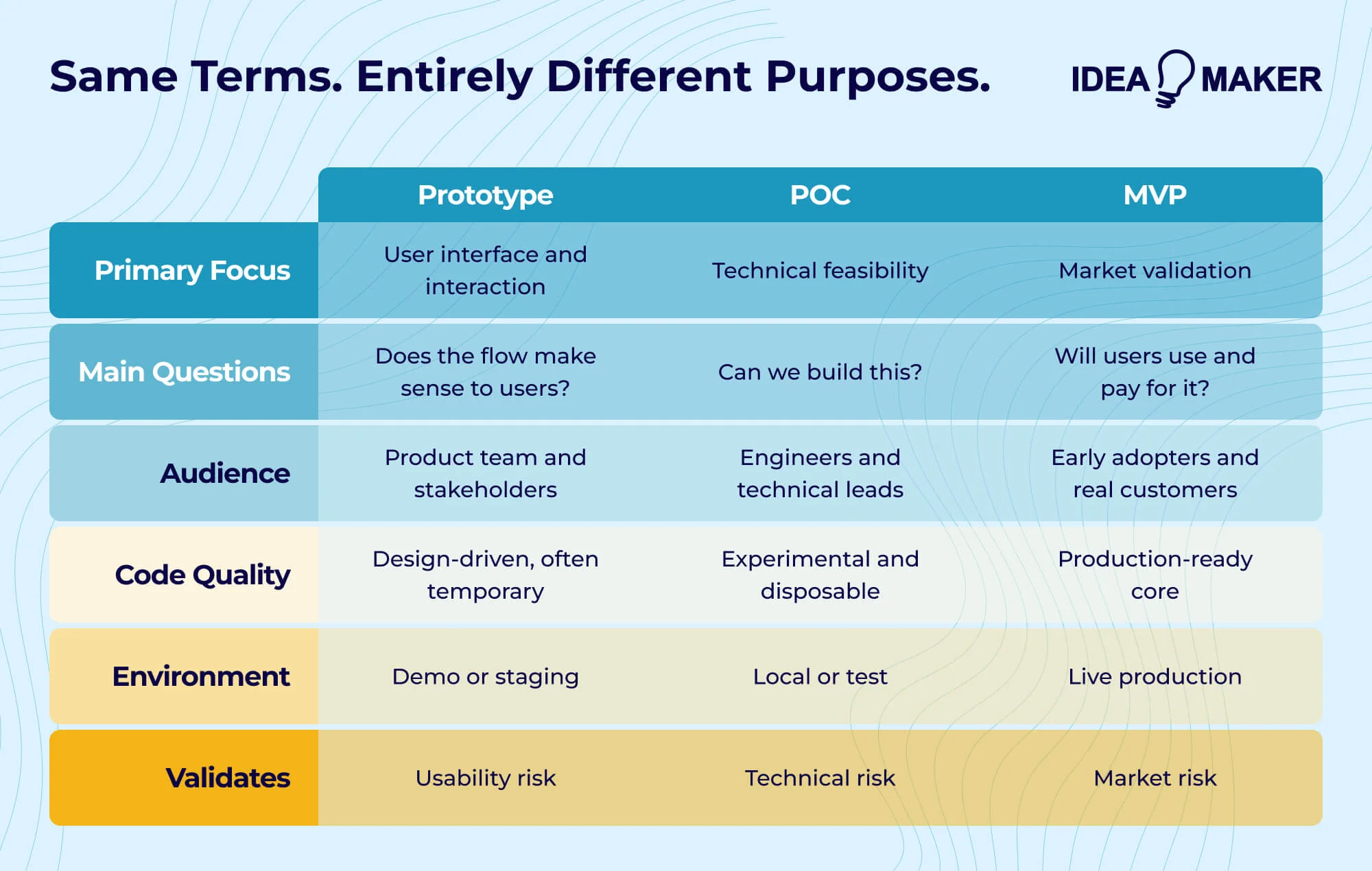
Choosing the wrong one at the wrong time can slow development or distort feedback. That is why understanding the difference between POC, prototype, and MVP is important.
Purpose and scope
A prototype focuses on design and interaction. Companies use it to visualize flows and test usability before development begins. It helps refine the user experience.
A POC works at a deeper technical level. It confirms that a specific component or architecture can function as expected.
An MVP moves beyond design. It enters the market with working core features. Its goal is to test product market fit in real conditions.
Level of functionality
A prototype often lacks real backend logic and simulates interaction without full system behavior.
A POC may contain only experimental code. It isolates a technical element and validates performance or feasibility under controlled conditions.
An MVP provides functional core features that allow users to complete real actions inside a live environment. The system must operate reliably.
Audience and timing
A prototype may involve product teams and selected stakeholders. Small focus groups may also evaluate it to provide usability feedback before development moves forward.
A POC remains largely within engineering and technical stakeholders. This stage usually appears early in discovery to reduce technical uncertainty.
An MVP targets early adopters and real customers. Once released to the market, it generates measurable data that helps validate real demand.
Time, cost, and engineering effort
A prototype needs design input along with close work between product/UX specialists. It usually goes through a few revisions before the flow is finalized. The budget is moderate since the work centers on screens and interaction rather than full backend implementation.
A POC runs for a short period, often a few days/weeks. Engineers use it to test a specific architectural choice or validate one critical component. The expense is low because the scope is tight and the code is written for testing, not production.
An MVP requires development sprints that may extend for several weeks or longer. Engineers build the core infrastructure first. They then deploy to a live environment and support real usage. Costs increase at this stage because the product must operate reliably under real traffic.
Type of validation achieved
A prototype reduces usability risk. It improves clarity around interaction and flow.
A POC reduces technical risk. It confirms that the system can be built.
An MVP reduces market risk. It tests whether real users find value in the product.
| Dimension | Prototype | POC | MVP |
| Primary focus | User interface and interaction | Technical feasibility | Market validation |
| Main question | Does the flow make sense to users | Can we build this solution | Will users use and pay for it |
| Typical audience | Product team and stakeholders | Engineers and technical leads | Early adopters and real customers |
| Functionality level | Simulated or partial behavior | Isolated technical component | Working core features |
| Code quality | Design-driven and often temporary | Experimental and disposable | Production-ready core code |
| Time investment | Short design cycles | Short technical experiments | Development cycles |
| Cost level | Low to moderate | Low and focused | Higher and planned |
| Deployment | Demo or staging environment | Local or test environment | Live production environment |
| Validation type | Usability validation | Technical validation | Market validation |
| Outcome | Clear design direction | Confirmed architecture choice | Data for scaling or pivoting |
When Should You Build a Prototype?
There comes a stage when discussion alone is no longer enough. At that point, you need something visible that everyone can review and react to.
Exploring early ideas and concepts
A prototype is useful when your product idea is still mainly in discussion. You may describe the vision clearly, but are you sure everyone is getting the same product in their heads? That gap is more common than most founders expect.
It moves the discussion from imagination to something you can actually click through. The idea is no longer abstract. It becomes visible and testable.
Testing UX flows and interaction patterns
You should build a prototype when the user journey still raises open questions. How many steps should onboarding include? What happens after a failed login attempt? Where does a user land after completing a key action? If those answers are still being debated, development should pause.
A prototype is also necessary when interaction states remain unclear. How does the interface respond to errors? What does an empty dashboard show? How do permission levels change what users see? When these scenarios are unresolved, it is safer to simulate them visually before committing engineering effort.
Aligning stakeholders and gathering early feedback
A prototype brings product owners, designers, and investors into the same frame of reference. Instead of walking through slides or abstract diagrams, you review something tangible. The quality of feedback improves immediately because everyone reacts to the same artifact.
In many discussions around poc vs prototype vs MVP, this alignment factor is underestimated. Yet misalignment at this stage often leads to costly rework later.
Reducing design and usability risk
Design decisions influence user perception from the first release. When those decisions are vague, confusion spreads quietly through the build. A prototype gives you breathing space to refine details while improvements are still affordable.
If your main concern is no longer usability, then design is not the bottleneck. At that point, technical feasibility becomes the actual focus.
When Should You Build a POC?
Sometimes progress slows because technical confidence is missing. That is when you test the technical stack before investing further.
Evaluating new or unproven technologies
A POC becomes critical when the product relies on unfamiliar tools or a complex architecture. It gives engineers a controlled environment to verify whether the chosen approach holds up under realistic technical conditions.
Testing integrations, performance, or scalability assumptions
You should build a POC when integration points or system limits remain uncertain. External services may behave differently under load. Infrastructure choices may introduce constraints you did not anticipate. If you find yourself wondering whether this is a proof-of-concept vs. MVP situation, step back for a second. When the risk is technical, start with a POC.
Reducing engineering and architectural uncertainty
You should build a POC when your architecture is still a hypothesis rather than a proven structure. If engineers are unsure whether a core service, data pipeline, or integration layer can operate as expected, development should not proceed yet.
This is the kind of uncertainty that poc vs prototype vs MVP discussions often overlook. Only a POC addresses technical risk at this depth.
Supporting technical decision-making before product investment
You should also consider a POC before committing a serious budget to development. If you are about to invest in infrastructure, third-party services, or long development cycles without technical validation, pause first.
A POC helps confirm that the planned technical stack holds. If the critical component performs as expected, you proceed. If it fails, you need to revise early rather than rewrite months of engineering work.
Once you confirm the system can work, you still need proof that people care. That is where an MVP comes into play.
When Should You Build an MVP?
Internal validation can only take you so far. The next step is to put a working product in front of real users and observe how they respond.
Testing product-market fit
You should go for an MVP when you need feedback from real market conditions. Internal validation is no longer enough. At this stage, you introduce a working product to early adopters and observe actual behavior.
Validating user adoption and willingness to pay
An MVP reveals how users behave once the product is live. Do they return? Do they engage deeply? Do they convert? In MVP in software development, the focus switches from feasibility to measurable demand.
Collecting real-world usage data
An MVP opens the door to behavioral analytics that earlier stages cannot provide. You can measure engagement, retention, and feature adoption in real time. Those metrics guide iteration during MVP product development. Instead of relying on internal opinions about what to build next, you prioritize based on actual user behavior.
Preparing for scaling, fundraising, or go-to-market
An MVP demonstrates traction in a way presentations never can. When you approach investors or strategic partners, they want to see evidence that your product works in real conditions. A well-executed MVP shows that you are ready to move beyond internal testing and take the product to a wider market.
How POC, Prototype, and MVP Fit Into the Product Development Lifecycle
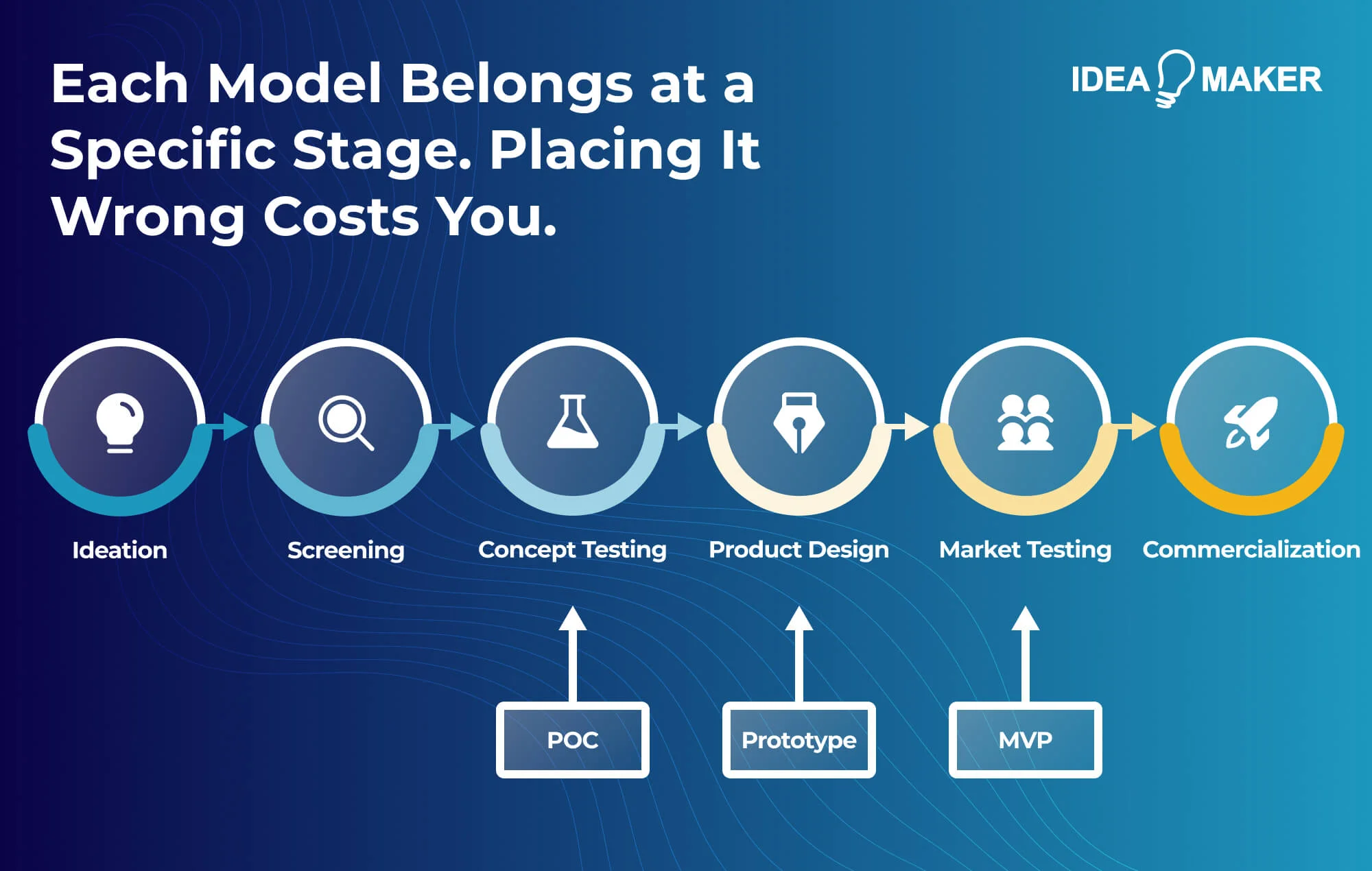
Every product moves through the product development lifecycle.
Ideation > Screening > Concept testing > Design > Market testing > Commercialization
A POC usually takes place during concept testing. At this stage, you test whether a technical approach can work before you move deeper into design. It supports idea screening by removing concepts that cannot function in practice.
A prototype belongs inside the product design stage. This is where interaction patterns, user interfaces, and user journeys need to be finalized.
An MVP fits into market testing. Here, you release a functional version to real users in controlled conditions. You collect behavioural data before moving to commercialization and scaling production.
The progression often follows this order:
POC for concept validation >> Prototype for product design >> MVP for market testing >> Scaled product for commercialization.
That said, not every project requires all three models in strict order. Some stages overlap. In other cases, you may skip one entirely if the risk is already resolved.
You may skip a POC when:
- The tech stack already has a stable existing product
- The feature builds on proven architecture
- The technical complexity is low and predictable
You may shorten or simplify prototyping when:
- The UX follows well-known industry patterns
- The product targets a familiar user group
- You iterate on an existing interface rather than designing from scratch
You may move faster to scaling and reduce MVP time when:
- You already validated demand with earlier releases
- You operate in a market with strong and proven demand metrics
- The product already has an existing customer base
Flexibility is useful. Discipline is still essential. Skipping a step works only when you remove real uncertainty, not when you ignore it.
That is where many products run into trouble:
- Premature scaling usually happens between market testing and commercialization. You invest in infrastructure before usage justifies it. As a result, you increase operational costs before confirming stable demand.
- Overbuilding often starts during design. Teams add features before confirming that users care about the core value. Due to this, the product expands faster while real learning about user behavior moves more slowly.
Choosing the right artifact depends on the current risk inside the lifecycle stage:
- Technical feasibility risk >> Build a POC during concept testing
- Usability risk >> Build a prototype during product design
- Market demand risk >> Release an MVP during market testing
At Idea Maker, we often see founders jump from ideation straight to commercialization planning. We guide them back to the stage that matches their real uncertainty. When each stage does its job properly, the product grows step by step without unnecessary setbacks.
Seeing the lifecycle makes the sequence clearer. Even then, you still make avoidable mistakes.
Common Mistakes When Choosing Between POC, MVP, and Prototype
At Idea Maker, we work with founders, product owners, and technical leaders every day. Many of them are building their first product. Others are launching something new inside an existing company. One pattern repeats itself again and again. Teams mix up poc vs prototype vs MVP and make decisions at the wrong stage.
Treating a Prototype Like a Production-Ready App
At Idea Maker, we usually meet startup founders who believe their high-fidelity prototype is almost ready for launch. They invest heavily in design and assume development will be a small step. Later, they understand that performance, security, and backend architecture require a completely different level of work. A prototype helps you validate experience. It does not replace engineering.
This mistake often happens in early-stage organizations that equate design quality with system readiness.
Building an MVP Before Validating Technical Feasibility
We have worked with product managers who moved straight into mvp in development without confirming whether the architecture could support their concept. They believed the technical details would sort themselves out during the build. Midway through development, they hit scalability limits and had to redesign core components.
An MVP is created after technical feasibility is clear. If technical uncertainty persists, a POC should be conducted first.
Over-Investing in a POC With No Product Path
We often meet CTOs and engineering leaders who usually take the opposite route. They build technical experiments that grow more sophisticated over time. The POC expands, but no one defines how it will transition into a real product.
A proof of concept should answer one specific technical question and then stop. Once that question is resolved, you either move into design or market validation. If the POC keeps growing without a product roadmap, you end up maintaining a technical experiment rather than building a product.
Confusing Internal Validation With Real Market Feedback
We also see decision-makers rely too heavily on internal demos. Stakeholders test a flow, give positive feedback, and assume the idea is validated. No real users interact with the system. No behavioural data confirms demand.
Internal approval feels reassuring. Only real market exposure shows you whether people will actually use and value the product.
Knowing what not to do is helpful. You also need a simple way to decide what to do next.
How to Decide Between a POC, MVP, or Prototype
Selecting the correct starting point in the POC, prototype, or MVP sequence determines how efficiently uncertainty is reduced. The decision should not be driven solely by urgency, but by identifying which risk category currently blocks progress.
Begin by isolating the dominant unknown:
- Is the technical architecture unproven or dependent on a new integration?
- Is the user flow or interaction model unclear?
- Is market demand unvalidated?
Each of these questions corresponds to a different form of uncertainty. Technical uncertainty suggests a POC. Usability uncertainty points toward a prototype. Market uncertainty requires an MVP.
Beyond conceptual clarity, practical constraints must also be evaluated:
- Which type of risk presents the highest exposure if ignored?
- What level of capital can be allocated without compromising the runway?
- How much time exists before stakeholder, investor, or competitive pressure increases?
The correct choice is the one that removes the most critical uncertainty with the least irreversible cost.
If technical feasibility is the primary concern, a POC should precede any user-facing build. If the interaction logic is unclear, a prototype will clarify the structure before engineering resources are committed. If the product’s market viability is an open question, an MVP provides measurable evidence through real usage.
In some situations, a constrained or lightweight MVP may be used to test market response quickly, but this should not replace technical validation where feasibility remains uncertain.
When Multiple Risks Exist Simultaneously
In practice, risk categories often overlap. A product may involve both an unproven technical architecture and an untested market. This is where sequencing becomes critical.
When technical risk and market risk coexist, technical feasibility should generally be resolved first. Releasing an MVP built on unstable architecture creates downstream rework and credibility risk. A short, focused POC can eliminate structural uncertainty before market exposure.
When usability risk and market risk coexist, the order may reverse. If the architecture is stable but the user journey is unclear, a prototype can clarify interaction before committing to production-level infrastructure. Launching an MVP with unresolved usability friction can distort market feedback, as a poor experience may be misinterpreted as a lack of demand.
Tools Commonly Used for POCs, Prototypes, and MVPs
Tool selection directly affects how quickly you reduce risk, and how much that reduction costs. The wrong stack for the wrong model can lock you into unnecessary complexity and inflate budgets.
When you build a prototype, you should not be solving infrastructure problems. When you validate a POC, you should not be optimizing for long-term scalability. No-code or low-code platforms can accelerate early market testing when demand is still uncertain. At the MVP stage, the tools you choose determine whether your product can support real users and handle live traffic.
Understanding the tools commonly used in each model helps you avoid overengineering early and underengineering later.
Prototyping and Design Tools
When you build a prototype, you move quickly. Your goal is to see the product in action. You want to test flows and interactions before engineering begins.
Common tools include:
- Figma for interactive UI mockups with real-time collaboration
- Adobe XD for designing user navigation paths (usability testing)
- Sketch for detailed interface design
- InVision for clickable walkthroughs
- Miro for mapping user journeys
These tools help you explore behavior without building backend systems. You test navigation. You examine the layout structure. You observe where users hesitate.
POC-Focused Development Tools and Environments
When you build a POC, you focus on technical proof. You want to know whether the idea works in practice. Speed of validation matters more than production polish.
Common environments include:
- Python with Flask or FastAPI for backend experiments
- Node.js for quick API validation
- Docker for controlled test environments
- Postman for API verification
- Jupyter Notebooks for data and AI trials
- AWS Lambda for isolated runtime testing
In this stage, you write experimental code. You isolate one capability. You push it under test conditions.
No-Code and Low-Code Platforms
Sometimes you need validation fast. In those cases, you rely on these platforms.
Common platforms include:
- Webflow for design-driven landing pages
- Bubble for functional web applications
- Glide for simple mobile apps
- Airtable for structured data management
- Zapier for workflow automation
These platforms allow you to test interest without heavy development. You release something small. You observe real behavior. If demand appears, you invest further. If not, you adjust without major loss.
MVP-Ready Tech Stacks and Frameworks
When you enter the MVP stage, the standard changes. You now build for real users. Stability becomes essential.
Common MVP stacks include:
- React or Next.js for frontend applications
- Node.js, Django, or Spring Boot for backend systems
- PostgreSQL/MongoDB for data storage
- AWS, Azure, or Google Cloud for infrastructure
- Docker with Kubernetes for deployment
At this stage, you prepare for live usage. You implement authentication and add monitoring. Also, you track performance metrics.
Trade-offs Between Speed, Scalability, and Maintainability
Every stage forces a choice. You cannot optimize speed, scalability, and long-term maintainability at the same time. You decide based on what matters most right now.
To make this clearer, follow the table below that highlights practical trade-offs across poc vs prototype vs MVP stages:
| Dimension | Prototype | POC | MVP |
| Development Speed | Very fast | Fast | Moderate to longer |
| Code Quality | Minimal or simulated | Experimental | Production-ready core |
| Scalability | Not required | Limited | Required |
| Infrastructure | Design tools only | Local or sandbox environment | Cloud-based production setup |
| Maintainability | Disposable | Temporary | Long-term maintenance expected |
| Security Focus | Low | Minimal | High |
| User Exposure | Internal review | Internal testing | Real users |
How Idea Maker Helps Teams Choose the Right Approach
Choosing between a POC, prototype, or MVP can feel challenging when you are close to the idea. What risk are you actually facing right now?
At Idea Maker, we start there. Our expertise lies in identifying whether your primary risk is technical, usability-related, or market-driven. Many founders assume they need an MVP when the real blocker is technical feasibility. Others spend months improving the design process when the market risks remain unanswered. We help you slow down just enough to make the right first move.
We Clarify the Real Risk Before You Invest
Before writing code, we work with you to define the core uncertainty. Is the architecture unproven? Are user journeys unclear? Are you unsure whether customers will adopt the product?
Our expertise in strategy and technical feasibility validation helps you avoid costly detours.
We Design Prototypes That Reduce Engineering Waste
A prototype should do more than look good. It should remove ambiguity. We design prototypes that map real user journeys and interaction states so engineers are not left filling in gaps later.
We Build POCs That Validate Feasibility Before Full Investment
When your concept depends on complex logic, AI developments, integrations, custom developments, or performance thresholds, you need technical proof first. Our engineers build proof-of-concept solutions that isolate the risky component.
We do not overengineer experiments. We validate one core capability. Once feasibility is confirmed, you invest in full development with confidence rather than hope.
We Develop MVPs That Can Grow Into Scalable Products
An MVP should not be a throwaway build. It should form the foundation of your long-term product. Our expertise covers native iOS and Android development using Swift, Objective-C, Java, and Kotlin. We also build cross-platform solutions with React Native and Flutter. For web applications, we use modern stacks such as React, Next.js, Node.js, and Django.
We integrate analytics, payment gateways, monitoring, and cloud infrastructure based on your real business needs. When early traction appears, your MVP can scale rather than be rebuilt from scratch.
At Idea Maker, we have partnered with more than 200 clients across e-commerce, fintech, healthcare, and enterprise SaaS. A 4.9 client rating reflects consistent delivery across multiple validation stages and product releases.
You do not need to choose blindly. You need a partner who understands when to prototype, when to prove feasibility, and when to enter the market. That is how products move forward without unnecessary friction.
Frequently Asked Questions About POC vs MVP vs Prototype
Is a POC the same as a prototype?
No. A POC proves that one technical capability can work under controlled conditions. A prototype checks whether users can move through screens and complete a flow without friction.
Can a prototype be turned into an MVP?
Sometimes you reuse the flows and screens as a blueprint for the build. You still rebuild the system because prototypes do not include production backend logic and deployment basics.
Do all products need a POC first?
No. You only need a POC when you cannot confirm feasibility from known patterns or proven infrastructure. Skip it when you already trust the technology stack, and you only change standard business logic.
How long should each phase take?
A POC usually runs for days or a few weeks because you test one narrow technical point. A prototype often needs multiple design passes and user checks. An MVP takes longer because you release something usable, stable, and measurable.
Can a POC or prototype be reused in production?
In most cases, no. POC code often uses shortcuts, mock data, and hard-coded logic. Prototype artifacts help you communicate intent, but they do not meet security, performance, and maintainability requirements.
Final Thoughts on Choosing Between POC, MVP, and Prototype
Choosing between a POC, prototype, or MVP is not about picking what sounds most impressive. It is about identifying what uncertainty is actually blocking progress right now. Speed helps only when you are solving the correct problem.
You should not treat these three approaches as competing options. They are complementary tools within a broader validation process. In many cases, you will use more than one, sometimes all three, in deliberate sequence. You may start with a POC to remove architectural uncertainty, move to a prototype to refine usability, and then release an MVP to validate real demand. Using multiple models is not wasted effort; it is intentional risk reduction.
Many products fail not because the idea was weak, but because the team validated the wrong thing first. You can build a good interface, but the architecture cannot scale. You can validate technical feasibility while no one actually wants the product. You can even launch an MVP when the core user flow still confuses people.
If you are deciding what to build next, focus on these actions:
- Identify the single biggest risk in your product today.
- Decide whether that risk is technical, usability, or market-related.
- Choose the approach that removes that specific risk first.
- Define what evidence will prove the risk has been reduced.
- Move to the next stage only after you have that evidence.
When you work this way, you can build on proof.