
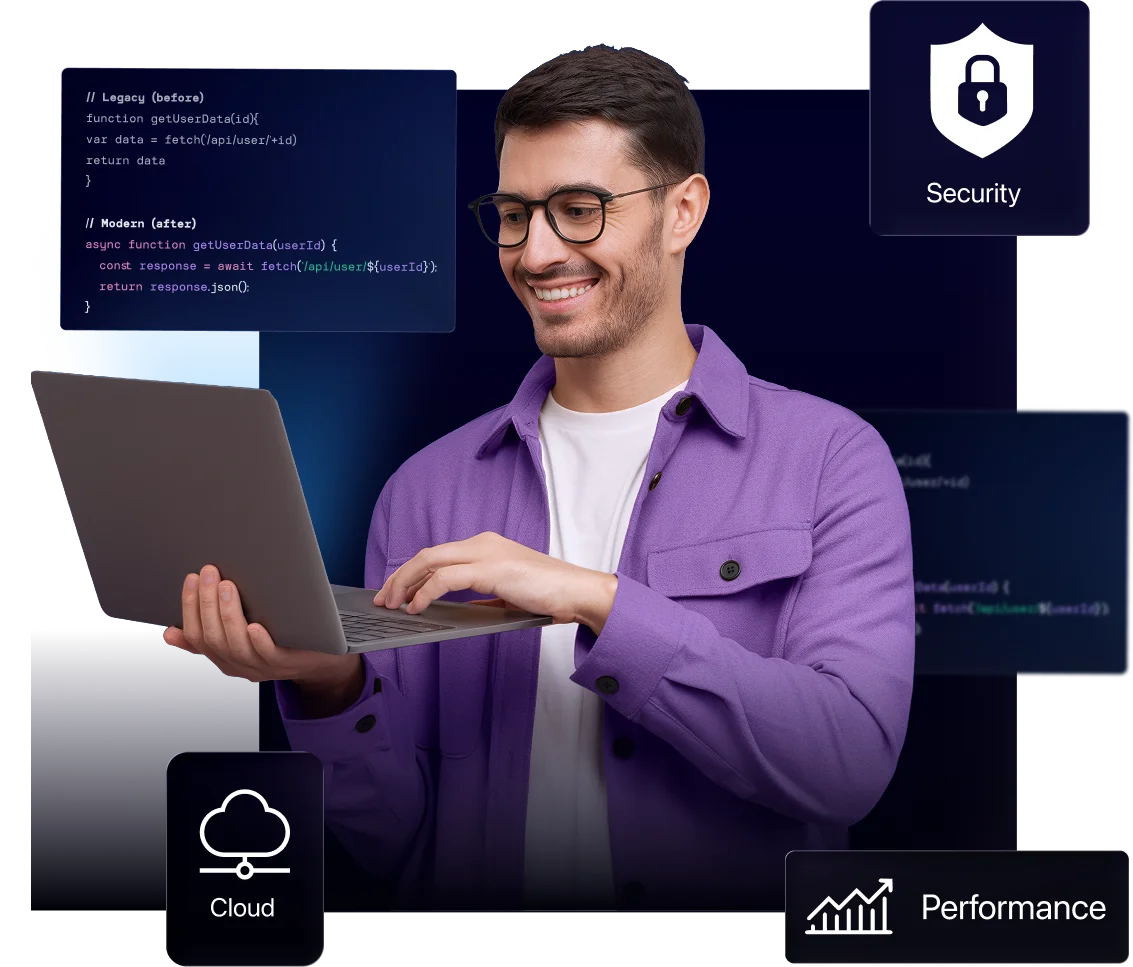
At Idea Maker, our legacy application modernization services transform outdated legacy platforms to cloud-native applications to meet today’s standards. Our expert team performs code-refactoring, performance optimization, and security hardening to make your app scalable, cost-effective and competitive. We transform your application to make it compatible with modern frameworks while preserving critical business logic and data integrity.
Book Your Free Consultation Today

Despite heavy investment in digital transformation, 73% of enterprises report that their legacy systems remain a primary obstacle to innovation. Aging COBOL-based banking platforms, monolithic ERP suites, and customized mainframe applications hinder cloud adoption, integration with modern APIs, and deployment of AI, analytics, and mobile solutions.
A disproportionate share of IT spend goes toward sustaining aging hardware, software licenses, and support contracts. This leaves limited capacity for modernization, new platform adoption, or strategic technology investments.
Legacy platforms hinder integration with modern applications, real-time data analytics, and cross-platform automation. Enterprises struggle to modernize processes while maintaining operational continuity.
Many mission-critical systems in large enterprises are over a decade old, carrying accumulated complexity, technical debt, and knowledge gaps. These systems remain essential but increasingly brittle.
Rising recognition of legacy risk and increased digital transformation investment are fueling rapid growth in the modernization market. Enterprises are prioritizing modernization projects to remain competitive.
Leadership increasingly views modernization as critical to innovation, risk mitigation, and future readiness. Modernization is no longer optional; it’s a strategic path to stay competitive.
Implies full-stack, end-to-end capabilities, not just simple apps
As a leading custom software development company, Idea Maker helps enterprises transform critical systems without disrupting operations. Our legacy app modernization services are AI-infused and innovation-driven, helping you achieve faster time-to-market, lower maintenance costs, and improved efficiency. From mainframes and monolithic ERP platforms to aging databases and custom applications, we modernize complex environments to boost scalability, integration, and future-ready architectures with minimal downtime.
Explore how our legacy software modernization services can unlock agility and reduce operational risk. Book your free consultation today!
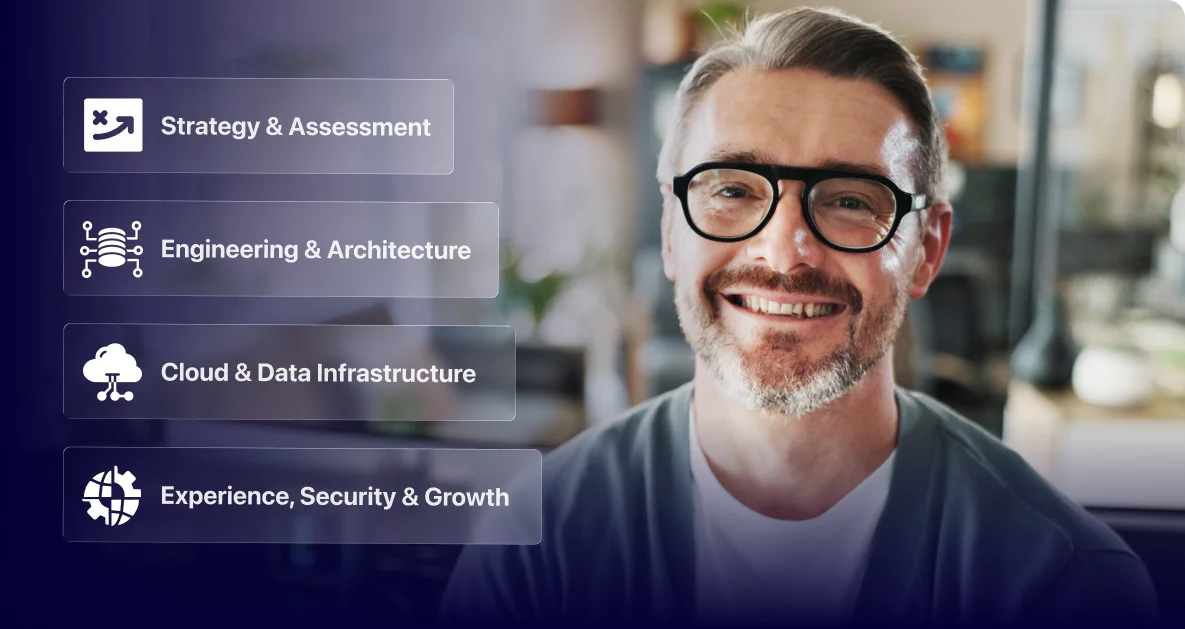
Our legacy system modernization services offer evaluating existing applications, infrastructure, and dependencies to understand technical debt, architectural constraints, and operational risks. We conduct codebase reviews, data flow analysis, and platform audits. After that, our team provides a modernization roadmap that aligns legacy environments with current business priorities and technology standards.
As a trusted legacy software modernization company, we offer re-engineering legacy systems to improve structural clarity, extensibility, and maintainability while preserving the critical business logic embedded in the system. Our team eliminates redundant logic, improves test coverage, upgrades frameworks, and aligns codebases with modern development standards to improve performance, stability, and future extensibility.
We provide application re-architecture and redesign services to support scalable deployment and modern integration models. Our legacy software modernization services cover redefining system boundaries, introducing modular/ service-based structures, APIs, and event-driven components, and redesigning data flows. We aim to support modern deployment models while preserving critical domain logic and system behaviour.
As a leading legacy modernization agency, we update, migrate, and transform outdated, monolithic systems (COBOL- or AS/400-based) into agile, cloud-ready environments to reduce costs, server load, and security issues. Our modernization approach offers minimal downtime by gradually transforming your platform using strategies like rehosting, refactoring, and replatforming.
At Idea Maker, our legacy app modernization services offer moving legacy applications to cloud, such as AWS, Azure, or Google Cloud, without a full application rewrite. We perform workload assessment, environment mapping, replatforming strategies, and secure migration execution to ensure systems operate effectively in cloud-native or hybrid setups.
We migrate legacy databases to modern relational or cloud-managed platforms while preserving data integrity to maximize performance, scalability, and cost-efficiency. Our legacy modernization services range from simple data movement to complex, heterogeneous migrations across database types, requiring expert data mapping and validation.
Our legacy application modernization services provide a complete lifecycle for designing, building, testing, deploying, and managing APIs that connect your legacy systems to modern applications and external platforms. We implement REST and event-based APIs, data contracts, middleware configuration, and authentication flows for secure data exchange with ERPs, CRMs, cloud services, and partner ecosystems.
As a leading legacy software modernization company, we replace outdated user interfaces with modern, human-centric and visually stunning web-based front ends to improve user engagement, responsiveness, accessibility, and conversions. We ensure a seamless UI transformation without disrupting your backend logic or integration layer.
To keep your platform secure, our legacy system modernization services offer updating security layers across applications, data stores, and infrastructure. This includes identity and access management integration, encryption standards, audit logging, and policy enforcement aligned with ISO, SOC, HIPAA, or industry-specific requirements. Our goal is to ensure legacy environments meet modern security and regulatory expectations.
We move data from legacy databases into modern platforms with strict controls. Our legacy database modernization services cover schema mapping, transformation logic, reconciliation checks, and integrity validation. We ensure records remain accurate, complete, and consistent across applications, analytics tools, and reporting systems.
As a premier legacy app modernization company, we offer a structured and secure approach for modernization of legacy applications. Rather than switching everything at once, we offer a low-risk, step-by-step approach to implement new technology (such as an ERP system) by gradually rolling out modules while simultaneously running the old and new systems for operational continuity.
We systematically shut down obsolete applications in a controlled phased manner. Our team removes dependencies and keeps historical data in a secure, governed archive. We decommission infrastructure, revoke access, and preserve documentation to ensure systems are fully retired without leaving operational, security, or compliance gaps behind.
After migration, legacy software modernization services offer continuous monitoring and refinement to maintain stability, security, and scalability. This includes performance tuning, configuration updates, feature addition, dependency reviews, and issue resolution. We ensure modernized applications continue operating reliably as usage patterns, platforms, and operational demands evolve.

Expert Strategic Guidance and Full-Stack Model Deployment
At Idea Maker, our legacy modernization solutions deliver a complete set of capabilities and tooling designed to de-risk transformation. We combine deep system insights, automated testing frameworks, CI/CD pipelines, security hardening, and performance benchmarking. Each inclusion is designed to structure transformation, reduce risk, and enable long-term operational stability.
Partner with us to discover how our framework brings clarity and control to complex modernization projects!
Every platform we modernize includes a complete system audit covering applications, databases, integrations, batch jobs, and infrastructure. We provide visual dependency maps that show how data and logic move across systems to highlight tightly coupled components, fragile integrations, and undocumented linkages.
Our engagement offers legacy codebase analysis using AI-assisted tools that reconstruct logic, workflows, and functional behavior. The deliverables include detailed documentation, flow diagrams, and rule mappings that explain what the system actually does today, where original specifications, comments, or institutional knowledge no longer exist.
Our legacy app modernization services are inclusive of delivering working proofs-of-concept to demonstrate selected modernization paths using real application components. These artifacts validate architectural choices, integration methods, and platform compatibility in practice. Our goal is to give stakeholders a concrete outcome to review before committing to broader modernization decisions.
Our legacy modernization solutions include automated test assets that capture current system behaviour across critical workflows. Regression baselines document how the application behaves today, enabling future changes to be verified against known outcomes and reducing the risk of unintentionally altering business logic during modernization.
Preconfigured CI/CD pipelines are provided with defined build steps, environment separation, and deployment controls. Our tooling integrates source control, automated testing, and release management so changes can be promoted consistently across environments with traceability and repeatability built in from the start.
For each project, our security deliverables include documented access models, encryption standards, audit logging configurations, and compliance mappings. Vulnerabilities are identified and addressed through implemented controls rather than recommendations. We embed security expectations directly into the modernized application and its supporting infrastructure.
We provide training materials focusing on system understanding rather than theory. Teams receive role-specific documentation, walkthroughs of updated architectures, and practical training on tools and workflows. Our training programs enable internal teams to operate, support, and extend the modernized systems without creating long-term dependencies.
Each modernization scope includes validated rollback paths and recovery documentation. Backup strategies, restore points, and failover scenarios are defined and tested, providing clear guidance on how systems can be restored quickly if issues surface during transition or post-deployment.
Baseline performance metrics are captured and documented before changes begin. These benchmarks define acceptable response times, throughput levels, and availability targets to serve as objective reference points for evaluating system behaviour during and after modernization activities.
We provide monitoring configurations, alert thresholds, and logging standards that are delivered as part of the engagement. These assets provide continuous visibility into application health and performance for informed optimization decisions and long-term operational stability once systems are live.
How It Works
Modernization can take many paths, and choosing the right strategy depends on system complexity, business priorities, and risk tolerance. Understanding legacy application modernization strategies helps organizations plan transformations that align with technical realities, budget, and long-term goals.
Explore which legacy application modernization strategies fit your enterprise's needs today. Talk to our senior experts today!
Rehosting moves an application from the existing infrastructure to a new environment, often the cloud, without altering the code. It’s typically chosen when timelines are tight or operational stability is critical. Rehosting prioritizes speed and continuity, making it a suitable first step before deeper modernization decisions are made.

Replatforming updates the underlying environment while leaving core application logic untouched. Operating systems, databases, or runtime layers are modernized to improve compatibility and supportability. This legacy modernization approach is used when applications function correctly but rely on outdated platforms that limit scalability, hinder security updates, or provide limited long-term vendor support.
Refactoring focuses on reorganizing and improving existing code without changing how the application behaves externally. Code is modularized, simplified, and optimized to align with modern development and deployment standards. Refactoring is an appropriate choice when applications provide high business value but offer no scalability, security, simplicity, or maintainability.
Re-architecting involves redesigning an application’s structure using modern architectural patterns such as microservices or event-driven models. It is considered when existing designs no longer support business complexity, integration needs, or scale. Re-architecting is a high-effort, high-reward strategy that requires bigger change but provides flexibility for long-term evolution and system growth.
Replacement removes the legacy application entirely and introduces a new commercial or custom-built system. For modernizing legacy applications, replacement is chosen when the existing technology hinders growth, poses a significant risk, or becomes too costly to maintain. Common scenarios include unsupported software or hardware, the system’s inability to meet regulatory compliance standards, and planning for SaaS/Cloud.
Hybrid modernization applies different legacy modernization approaches across systems or even within a single application. Some components may be rehosted for speed, others refactored for flexibility, and certain functions replaced altogether. This strategy is common in large enterprises where systems vary widely in value, risk, and technical condition.
Core Logic/Engine
Legacy systems rarely fail all at once. Instead, they slowly become blockers, slowing teams down, draining budgets, and making change harder each year. Aging infrastructure, accumulated technical debt, and outdated workflows introduce risks that show up in cost, security, performance, and integration gaps. If your organization is experiencing the following challenges, it’s a clear signal that modernization can no longer be postponed.
Don’t let aging systems hold you back. Partner with Idea Maker and future-proof your systems today!

In many organizations, legacy systems account for 80% of IT spend, just to keep operations running. Small updates become long-term projects, external specialists are needed for routine fixes, and support contracts grow year over year. Eventually, maintenance costs more than progress.
Legacy systems were not designed for today’s threat landscape or regulatory scrutiny. As regulations evolve, gaps in access control, logging, and encryption become harder to ignore. Teams often spend months reacting to audit findings rather than resolving root issues.
Legacy systems are reluctant to integrate with modern technologies due to compatibility issues and a lack of supporting features. Workarounds lead to failures, including data exchange issues, security vulnerabilities, and platform incompatibility, unless modernization is considered.
As experienced engineers retire or move on, fewer people truly understand how legacy systems behave. Knowledge is concentrated among a small group of individuals, increasing operational risk when they are unavailable.
When systems built for smaller workloads begin to strain under growth, response times degrade, batch jobs run longer, and performance issues surface during peak periods. These bottlenecks start affecting both internal teams and end users.
Some legacy platforms rely on external vendors, tools, or licenses that no longer exist or are no longer supported. As a result, support becomes uncertain, pricing escalates, and roadmaps fail to align with business needs.
User expectations continue to rise, but legacy systems remain tied to rigid, outdated interfaces. Even small UI improvements often require backend changes, which slow delivery and frustrate users.
Developers want to work with modern tools and architectures. But when teams are anchored to aging platforms, morale drops, turnover increases, and hiring becomes increasingly difficult.
Successful legacy modernization demands careful alignment between business priorities, system realities, and operational risk. Deep analysis, phased transformation, and knowledge preservation ensure modernization efforts are controlled, sustainable, and deliver platforms teams can confidently operate long-term.
Let our team map, modernize, and optimize your legacy infrastructure efficiently!
Customer Voice
Their customer service is excellent — they’re incredibly accessible and available, which I appreciate. Furthermore, they have enough experience and bandwidth to fulfill all my needs. They’re one of the best vendors I’ve worked with.

Aquila Bernard
Coach
Successful modernization starts with a precise understanding of current systems, including their data flows, dependencies, hidden coupling, and failure points. Deep analysis prevents accidental breakage, avoids redundant rebuilds, and exposes which components can be reused, refactored, or retired.
Modernization succeeds when technical, operational, and regulatory risks are mapped early. Planning should include identifying high-impact systems, data sensitivity, rollback paths, and blast radius to minimize disruption while protecting revenue-critical workflows.
Instead of replacing everything at once that increases failure probability, Incremental modernization breaks systems into manageable units for controlled change, faster feedback, and measurable progress without halting day-to-day operations.
Technical upgrades should be directly tied to corporate goals, such as increasing revenue, improving customer experience, enhancing agility, and reducing operational costs and downtime. The goal is to achieve measurable outcomes from modernization, not a long-running technical debt.
Modernization works when engineering, product, operations, security, and business teams share context. This alignment prevents misaligned assumptions and accelerates decision-making, ensuring technical changes support real operational and commercial needs.
AI-driven code analysis, dependency mapping, test generation, and migration tooling reduce manual effort and human error. Automation shortens timelines, improves consistency, and surfaces risks earlier than traditional, documentation-heavy approaches.
Modernized systems fail when knowledge stays locked with vendors or individuals. Maintain clear architecture documentation, system diagrams, decision logs, and onboarding artifacts. The goal is to ensure that internal teams can independently maintain, extend, and operate platforms.
Integrate testing into the CI/CD pipeline to run automated regression tests, performance benchmarks, and real-world validation, ensuring new components function correctly and legacy functionality remains intact during each modernization phase.
Diverse Sectors, Custom Solutions
At Idea Maker, we have modernized multiple legacy systems across industries where complex, mission-critical platforms drive daily operations. From financial services and healthcare to manufacturing, government, insurance, and retail, our work spans diverse environments, ensuring systems remain compliant, scalable, and ready for future digital initiatives.
Share your industry’s unique challenges and let our modernization experts unlock agility and resilience!


COBOL and PL/I mainframes, core banking systems, payment switches, batch settlement engines, regulatory reporting platforms

On-prem EHR and EMR systems, HL7 interfaces, claims adjudication engines, patient data warehouses, legacy clinical workflows.

Monolithic ERP systems, MES controllers, shop-floor automation software, batch planning tools, disconnected warehouse systems.

Mainframe-based records systems, case management platforms, document repositories, legacy citizen portals,and siloed departmental databases.

Policy administration mainframes, underwriting rule engines, claims processing systems, batch actuarial models, legacy rating platforms.

COBOL-based mainframes, legacy ERP and POS systems, Apache Solr or Elasticsearch search stacks, on-prem inventory platforms, batch-driven order processing.
Client Success Stories

Idea Maker has done an amazing job of delivering and responding to our needs.

The team was very responsive and easy to work with. They are professional, talented, and experienced team. They were able to meet all our requirements.

Idea Maker is distinguished for their personalized collaboration and white glove services. The team is dependable and reliable, sticking to the project's plan, offering feedback, and pushing back on the right things.

The way they understand the requirements we present to them is fairly solid. Both in terms of bringing their own interpretation in nailing the requirements and their design sense. By the time we launched, I had gotten significantly more value from our collaboration than what we had discussed in the original specs.

This is a boutique development firm where the Founder is directly involved with the project and the primary contact. This is unlike many development firms where you are simply handed off to developers that are not stakeholders. This is an important distinction that results in much better project accountability.
I have never had a site like this built before. I felt that Idea Maker and Tom had built numerous sites like this, and they were pros.
Idea Maker's portfolio is what drew us in. Their design style was in alignment with what we were after. We had initial consultations with 3 companies that we had narrowed it down to. Once we had our initial meeting with Tom at Idea Maker we knew we had the right choice to make. Their communication style works well for us.
Their customer service is excellent — they’re incredibly accessible and available, which I appreciate. Furthermore, they have enough experience and bandwidth to fulfill all my needs. They’re one of the best vendors I’ve worked with.
Our Case Studies
Feature development and legacy code upgrades for a solar panel IoT monitoring system
Investment management system transformed into user-friendly platform with investor-business matching and readiness assessment

Transformed website into a SaaS application for monitoring school cleanliness, with features for inspector feedback and a super user dashboard
Expert Strategic Guidance and Full-Stack Model Deployment
Legacy modernization is best understood through real-world scenarios that illustrate the technical and business complexities involved. Exploring these examples helps organizations visualize transformation challenges, system dependencies, and strategic choices.
Transforming decades-old COBOL-based core banking systems into distributed, cloud-native architectures while maintaining 24/7 availability and regulatory compliance. Migration includes decomposing monolithic workloads, converting IMS datasets to relational databases, replacing JCL with cloud orchestration, and introducing API layers to support digital channels without disrupting transaction processing.
Re-architecting tightly-coupled enterprise resource planning systems into modular, API-driven platforms that enable real-time supply chain visibility and third-party integrations. This process moves manufacturing operations from batch-based, siloed data management to real-time, AI-driven, and API-first architectures that improve agility and visibility.
Migrating critical patient data from outdated on-premise databases to modern cloud data platforms while adhering to HIPAA compliance, zero data loss, and improved query performance. Includes schema optimization, data validation, and parallel operation during cutover.
Transitioning from legacy custom-built policy administration systems to modern platforms, preserving decades of business logic while enabling digital customer experiences. AI-assisted code analysis extracted business rules for reimplementation in a cloud-native architecture.
Updating aging citizen service platforms to accessible, secure, cloud-based systems that meet modern compliance standards and improve public-facing digital services. Migration from AS/400 to AWS with enhanced security controls and mobile accessibility.
Modernizing distributed POS infrastructure from proprietary hardware and software to cloud-based, API-driven architecture. Enables real-time inventory management, omnichannel capabilities, and rapid deployment of new features.
How It Works
At Idea Maker, our legacy modernization approach combines strategic planning, deep technical insight, and disciplined execution. We focus on understanding system realities, managing risk, and aligning transformation with business priorities so that every modernization effort is controlled, measurable, and positioned for long-term operational success.
We start by assessing your existing application landscape by evaluating its architecture, dependencies, data pathways, and security posture. We document your existing IT system before any code is changed. This phase involves gaining a comprehensive understanding of technical, functional, and business aspects to minimize risks, define, and justify the modernization strategy.
Based on assessed constraints, we define a modernization path that balances risk, cost, and operational continuity. In this phase, we provide you with a roadmap that aligns technical sequencing with business priorities so that modernization decisions support revenue, compliance, and long-term platform evolution.
We translate strategy into a future-state architecture by designing a proof of concept that aligns with the organization’s scale, governance model, and operating maturity. Our design decisions prioritize interoperability, extensibility, and long-term maintainability over short-term technical convenience.
Once the architecture is in place, we execute the modernization in controlled stages to minimize risk and preserve system availability. We evolve your platform while legacy and modern components operate together, allowing teams to validate behaviour and performance before advancing further.
Every migrated component is continuously validated against functional, performance, and reliability benchmarks. This phase focuses on stabilizing the modernized environment, identifying bottlenecks, and tuning systems to meet real-world production demands.
We ensure internal teams can operate, extend, and govern the modernized platform independently. Ownership transfer is structured around clarity, not documentation volume, so teams understand both the system and the decisions behind it.

At Idea Maker, we have spent close to a decade working inside real legacy environments, not just modern greenfield stacks. We have successfully modernized multiple long-running legacy systems across finance, healthcare, government, insurance, manufacturing, and retail, often where downtime, data loss, or compliance failures were not acceptable.
Our success stems from our in-house team of 30+ professionals, including solution architects, backend engineers, data specialists, DevOps engineers, and domain experts with hands-on experience with legacy platforms.
The projects we handle are typically large, interconnected, and business-critical systems with complex dependencies, regulatory constraints, and years of accumulated logic. We’ve worked directly with COBOL codebases, AS/400 and IBM i environments, mainframe workloads, Oracle and SQL Server–based monoliths, proprietary ERP systems, and deeply customized enterprise applications.
Our modernization philosophy is grounded in realism: respect what already works, modernize without breaking trust, and make decisions that internal teams can live with long after delivery. For businesses, that means clear trade-offs, shared ownership, and architectures designed for long-term sustainability, not short-term wins.
Leverage decades of experience to accelerate your legacy transformation with confidence. Hire our modernization experts today!
Trust. Strategy. Value. Results.
Idea Maker brings over 8 years of experience in modernizing legacy applications across industries such as healthcare, education, manufacturing, travel, and social. We combine deep technical expertise with strategic insight so that every transformation project reduces risk, aligns with business goals, and delivers measurable value while preserving critical operations throughout the modernization lifecycle.
Bring your legacy systems into the modern era. Let our experts lead the way!

Our teams have successfully modernized mainframes, AS/400 systems, COBOL applications, and monolithic enterprise platforms. With hands-on experience in cloud replatforming, microservices, and AI-assisted refactoring, we deliver modernization projects that meet performance, security, and compliance benchmarks consistently across complex enterprise environments.

Idea Maker comprises cross-disciplinary teams including legacy platform specialists, cloud architects, database engineers, and QA experts. This ensures every aspect of your modernization, including code, architecture, infrastructure, and testing, is handled cohesively to reduce coordination gaps, accelerate project delivery, and maintain operational stability.

We treat modernization of legacy applications as a partnership, not a project. Every roadmap, sprint, and deployment is designed with client priorities in mind, ensuring decisions are business-driven, risk-managed, and aligned with operational objectives to maximize ROI and minimize disruption.

Our phased modernization and automated testing strategies have enabled us to maintain uninterrupted business operations. Across multiple legacy modernization solutions, we have consistently delivered updates, migrations, and refactoring without affecting live systems or user experience.

Our dedicated team of in-house experts on COBOL, RPG, IMS, z/OS, and AS/400 has a deep understanding of legacy systems. This reduces dependency on external consultants and guarantees knowledge retention, accurate code transformation, and reliable modernization outcomes.

From initial assessment to post-migration support, Idea Maker owns every step. We manage roadmap planning, risk mitigation, architecture redesign, testing, and deployment. We aim to provide clients with a single accountable partner to deliver predictable, high-quality results across the modernization journey.

Our legacy software modernization services offer clearly defined, fixed-scope engagements with transparent timelines, budgets, and deliverables. Our approach mitigates cost overruns, sets realistic expectations, and enables organizations to plan capital allocation for modernization projects with confidence, avoiding hidden surprises.

After migration, our in-house support teams monitor systems, apply performance optimizations, address bugs, and implement enhancements. Our ongoing support keeps your applications secure, compliant, and performant, so our clients can focus on growth while relying on Idea Maker for ongoing operational stability.
FAQs
Timelines for legacy system modernization vary depending on system complexity, the number of applications, and the chosen approach. Simple rehosting may take 2-4 weeks, while complex, full-system rearchitecting often requires 6 months to over a year. Major, enterprise-wide transformations can even span multiple years.
Common risks involve unexpected dependencies, data loss, downtime, and integration challenges. Technical debt and outdated documentation can make it difficult to predict behavior. Careful assessment, testing, and phased approaches help mitigate these risks.
Yes. Many organizations adopt incremental strategies, modernizing critical components first while leaving stable modules untouched. Hybrid approaches that combine rehosting, refactoring, and selective replacement enable businesses to maintain operations while gradually transforming their systems.
We maintain data integrity through mapping, validation, and reconciliation processes. Migration plans define how data is transformed, checks are run at every stage, and automated tools flag inconsistencies. Our testing against source systems ensures that records remain complete, accurate, and aligned across applications.
Unexpected issues are handled through contingency planning, rollback procedures, and phased testing. Teams investigate root causes, implement fixes, and adjust the modernization plan as needed. Early prototyping and proof-of-concept exercises help uncover many issues before full deployment.
Not always. Many modernization strategies allow parallel operation of legacy and modernized systems. Incremental migration, data replication, and phased cutovers minimize downtime, although certain high-risk changes or full replacements may require temporary outages.
Common approaches include rehosting (lift and shift), replatforming (updating infrastructure), refactoring (optimizing code), re-architecting (redesigning systems), and replacement (adopting new software). Hybrid approaches combine these methods to fit complex enterprise environments.
Projects often fail due to unclear objectives, insufficient dependency assessment, underestimated complexity, or a lack of stakeholder alignment. Poor planning, inadequate testing, and resistance to change can also cause delays or incomplete modernization. Success requires thorough analysis, phased execution, and strong governance.
Modernization should be considered when your system faces frequent outages, slow performance, high maintenance costs, difficulty integrating with modern systems, and outdated technology that limits scalability or innovation.
Yes. We offer mainframe modernization through rehosting, refactoring, or replacement strategies. Legacy workloads, batch processing, and data can be transitioned to cloud or distributed environments while preserving critical business logic.
We leverage AI to analyze code, map dependencies, detect anomalies, and identify technical debt. AI accelerates reverse engineering, automates testing, and flags potential migration risks so that teams can modernize complex systems with greater confidence.
Idea Maker © 2026 ● All Rights Reserved

