Running a small business has always required balancing growth ambitions with limited time, budgets, and resources. In today’s market, that challenge is even more pronounced given rising customer expectations and digital competition. Research shows that nearly 60% of small businesses struggle to consistently attract and retain customers, making effective marketing a critical yet difficult priority.
This is where AI for small business marketing makes a measurable difference. AI is no longer limited to large enterprises. Affordable, accessible AI tools now help small businesses automate marketing tasks, analyze customer behavior, personalize campaigns, and make data-driven decisions without expanding headcount.
For small businesses that require tailored solutions, our AI development services offer fully customized tools that align with your long-term marketing objectives.
In this guide, we explain how to use AI for small businesses, explore practical use cases, and highlight tools that support scalable, sustainable growth.
Table of Contents
Importance of AI For Small Business Marketing
As customer expectations for personalization, speed, and relevance continue to rise, traditional marketing approaches are no longer sufficient. Small teams are expected to manage multiple channels, interpret growing volumes of data, and deliver measurable results with limited resources. Unlike large enterprises, they can’t afford wasted ad spend, inconsistent branding, or slow response times.
AI emerges as a solution that closes this gap by offering data-driven decision-making at scale to compete with larger brands. The growing importance of AI is reflected in adoption trends. According to industry data, over 80% of marketers now use some form of AI in their campaigns, with 73% saying it plays a key role in personalized customer experience. Now you can determine that what was once considered a competitive advantage is quickly becoming a baseline expectation.
AI gives small businesses clarity while directly reducing costs and increasing productivity. Instead of guessing which campaign works, AI-driven analytics highlight what channels drive revenue, which messages convert, and where churn risk exists.
Benefits of Using AI for Small Business Marketing
For small businesses, marketing mistakes show up immediately in revenue. If ads target the wrong audience, cost-per-click rises. If follow-ups are delayed, leads go cold. If campaigns aren’t optimized, limited budgets get drained fast.
AI reduces those risks by analyzing customer behavior, identifying high-intent prospects, and automatically adjusting campaigns based on performance data. The goal is to invest time, money, and resources smartly by using AI in a small business.
Increased Efficiency and Automation of Repetitive Tasks
Using AI for small business marketing delivers immediate value by automating repetitive, operational tasks that often consume limited time and resources. Interestingly, in 2026, 43% of marketing pros automate repetitive tasks using AI software.
Technologies such as machine learning–driven marketing automation, robotic process automation (RPA), and AI-powered CRM systems can streamline lead scoring, email scheduling, social media posting, and campaign reporting.
For example, a small B2B services firm can use AI-enabled tools within platforms like HubSpot or Salesforce to automatically qualify inbound leads and trigger follow-up campaigns to reduce manual intervention and maintain consistency.
Enhanced Customer Insights Through Data Analysis
Marketing departments generate and interact with data across multiple systems, including website analytics, customer support platforms, email tools, and social media channels. However, this data is raw and fragmented. Small business marketers can leverage AI to turn this fragmented data into actionable insights using technologies such as natural language processing (NLP), predictive analytics, and customer data platforms (CDPs).
In fact, companies leveraging customer analytics are 2.6x more likely to achieve a significantly higher ROI than competitors. This becomes a strategy for small businesses to stand out in the market.
NLP models can analyze customer reviews, chat transcripts, and social mentions to identify sentiment trends and recurring pain points, while predictive models surface patterns in purchasing behavior. For instance, a local e-commerce brand can leverage AI-driven analytics to discover that repeat buyers respond more strongly to limited-time offers than loyalty rewards.
Improved Customer Engagement and Personalized Marketing
AI for small business marketing allows marketers to move beyond one-size-fits-all messaging toward personalized, timely engagement across channels. According to OnRamp, 65% of consumers expect tailored experiences, and 80% are more likely to make purchases from brands that deliver personalized interactions. So, businesses excelling in personalization achieve 40% higher revenue compared to competitors.
By combining behavioral data, transaction history, and engagement signals, AI recommendation engines and personalization algorithms can tailor content, offers, and product suggestions at an individual level.
How to Use AI to Market Your Business: Use Cases and Examples
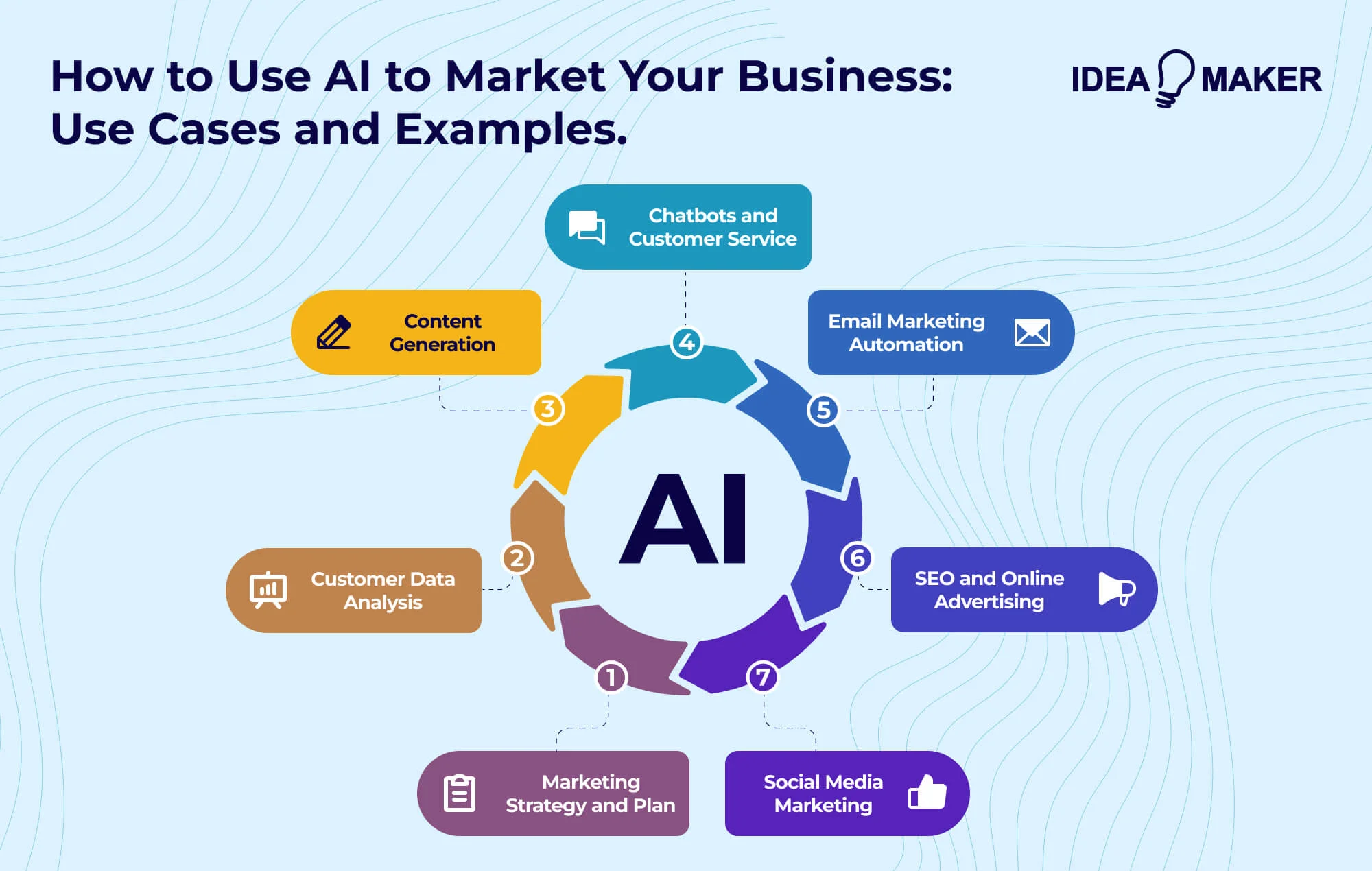
The real advantage of AI in small business marketing emerges when it is embedded in daily marketing workflows rather than treated as a separate tool. That’s when AI strengthens the activities that directly influence pipeline and revenue. As a result, businesses respond faster to demand, allocate budget more accurately, and convert interest into sales with greater consistency.
Below, we present practical ways on how to use AI for small business marketing, along with examples that show how these use cases drive measurable results.
Marketing Strategy and Plan
Small businesses can use AI to support marketing strategy by analyzing historical customer data, website behavior, and campaign performance to identify patterns that are difficult to spot manually. Machine learning models can highlight which customer segments convert most often, which channels drive the highest engagement, and which messaging resonates best with different audiences.
Companies using predictive AI for targeting and segmentation report 20-30% higher conversion rates.
You can also take advantage of various generative AI marketing solutions for small businesses to handle simple tasks, such as generating emails, creating social media content, and copywriting. By doing so, small businesses can reduce costs and ease employee workloads, making the technology an extremely efficient use of your budget and resources.
Customer Data Analysis
AI’s ability to analyze customer data from CRM systems, websites, email platforms, and social media interactions helps the marketing team understand their user base. For example, in addition to uncovering data-driven insights into behavior, preferences, and online engagement, the technology can also analyze the time of day that customers generally open emails, which can increase open rates by up to 20%.
AI marketing solutions for SMBs can then build a profile for each customer, enabling you to implement more effective targeting strategies like sending time-optimized emails. Scheduling emails to be sent at the optimal time for each recipient can significantly improve engagement and increase the likelihood that customers will make a purchase.
Content Generation
With 83% of organizations exploring the use of generative AI, it has become a practical solution for small businesses that need consistent content but lack large marketing teams. Tools like Jasper, Copy.ai, and Lately are now widely used to generate social media posts, promotional emails, product descriptions, and ad copy, cutting content drafting time by 99% and marketing costs by 50%.
So rather than starting from scratch, marketing teams can use AI-generated drafts as a foundation and refine them to match brand voice and campaign goals.
Chatbots and Customer Service
By investing in a custom chatbot trained on your product data, specifications, order history, FAQs, and browsing preferences, you can provide your customers with around-the-clock personalized support. This is a highly effective means of enhancing your customer experience, as the chatbot can instantly respond to queries and resolve issues through natural conversation.
However, if approached with a complex matter that they can’t properly handle, the chatbots can also escalate the issue to a human agent for more in-depth support. Due to this efficiency, chatbots are commonly used on small business websites, social media platforms, and messaging apps. Omnichannel chatbots can also be implemented across all company channels for consistent, cohesive, and convenient customer support.
Email Marketing Automation
AI has shifted email marketing from broad, one-size-fits-all campaigns to behavior-driven, revenue-focused communication. For small businesses, where every subscriber matters, AI enables precise segmentation based on browsing activity, purchase history, engagement patterns, and lifecycle stage. Instead of sending the same message to an entire list, emails adapt to what each customer is most likely to respond to.
Predictive models identify customers with similar buying behavior, while recommendation engines tailor product suggestions inside each email in real time. AI also optimizes send times based on when individual recipients typically open emails and dynamically adjusts content based on location, device, or timing.
As a result, small business marketing teams can boost open rates, click-through rates, and conversions without requiring constant manual testing or campaign rework.
SEO and Online Advertising
AI supports SEO and paid advertising by continuously analyzing performance data and optimizing content in real time. Almost 70% of Businesses Report Higher ROI from Using AI in SEO.
For SEO, AI tools surface high-value keywords, suggest content optimizations, and predict which topics resonate most with your audience. Small businesses can rank higher without dedicating hours to manual analysis.
In paid advertising, AI adjusts bids, targeting, and creatives automatically based on engagement and conversion patterns, maximizing return on ad spend.
These data driven actionable strategies helps small businesses to compete with larger competitors and scale campaigns efficiently without increasing team workload.
Social Media Marketing
Social media platforms often employ AI to analyze a wide range of user data, including age, gender, the type of posts they are drawn to, and the advertisements they interact with. This information is then used to create a user profile that the platform’s AI can use to present related content.
As a small business, you too can take advantage of the power of AI to enhance your reach on popular social media platforms. Facebook, for example, even offers a segmentation tool called Lookalike Audience that marketers can use to discover potential customers. For this, the platform’s AI compares data regarding user demographics, interests, and behaviors to create a “lookalike audience” with similar characteristics to your existing customers. You can then hone in on this audience so that your ads target the right users.
Other AI-enabled social media tools like Hootsuite, Buffer, Brandwatch, and Agorapulse further support content scheduling, performance tracking, and sentiment analysis.
Common Challenges in Implementing AI in Small Business Marketing
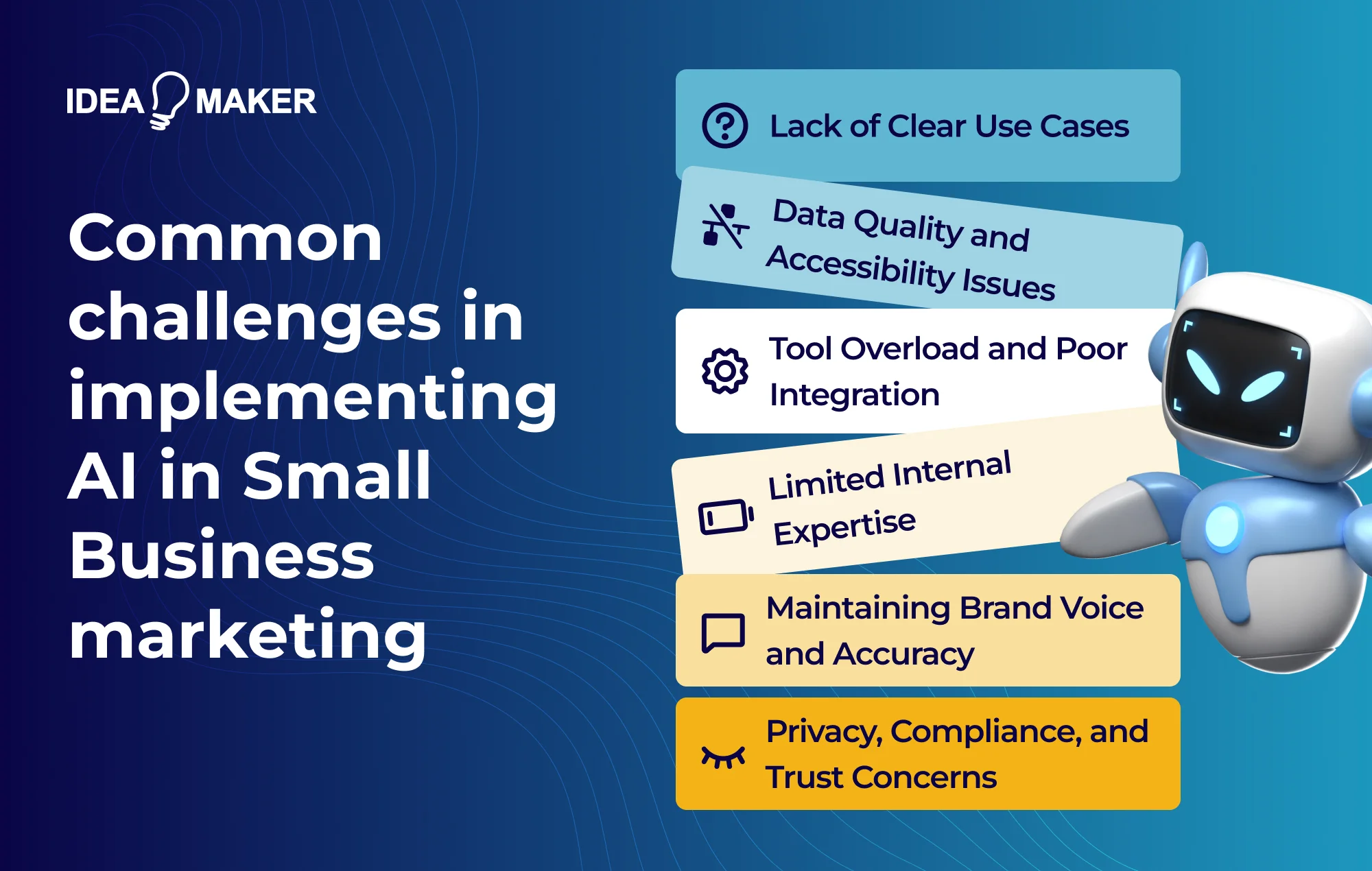
Lack of Clear Use Cases
Many businesses adopt AI tools without clearly defining the marketing problems they want to solve. Lack of clarity leads to underused features, poor ROI, and fragmented AI-driven marketing efforts.
Data Quality and Accessibility Issues
AI systems rely on accurate, structured data, but small businesses often struggle with incomplete, siloed, or inconsistent customer data across CRM, email, and analytics platforms.
Tool Overload and Poor Integration
With hundreds of AI marketing tools available, businesses face difficulty selecting the right platforms and integrating them smoothly into existing workflows and technology stacks.
Limited Internal Expertise
Marketing teams may lack the technical knowledge needed to configure, train, and interpret AI tools effectively, resulting in misaligned campaigns or overreliance on automation without oversight.
Maintaining Brand Voice and Accuracy
AI-generated content can drift from brand tone or produce generic messaging. Consistent brand voice requires prompt engineering expertise paired with human review.
Privacy, Compliance, and Trust Concerns
Using AI for customer data analysis raises concerns around data privacy, consent, and regulatory compliance, especially when handling personal or behavioral marketing data.
How to Implement AI in Your Marketing for Small Businesses
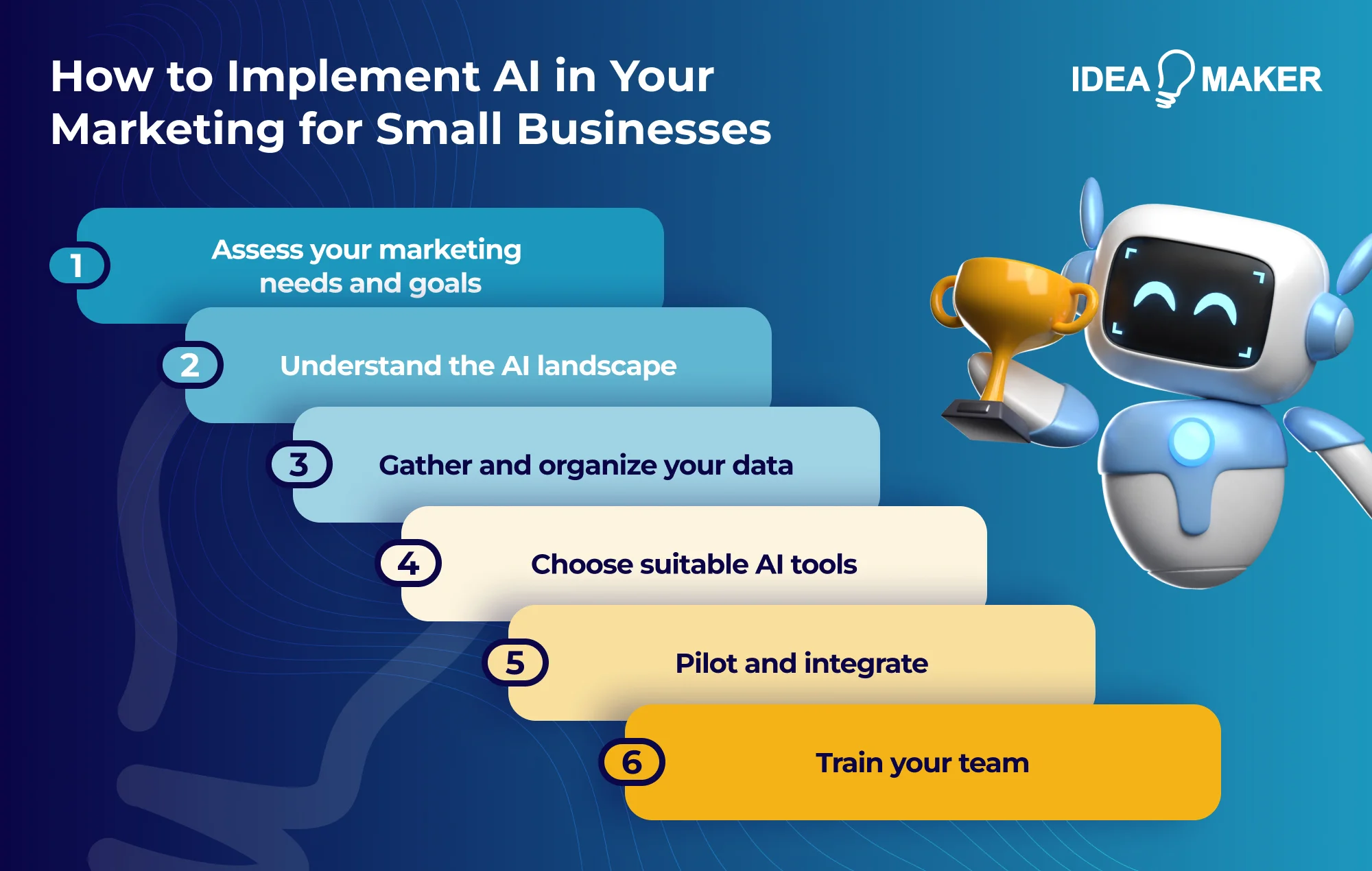
We understand that for small businesses, implementing AI into marketing workflows shouldn’t be a complex or resource-heavy task. The goal is to enhance existing processes without overwhelming limited teams or budgets.
Our roadmap below outlines what to expect at each stage and how AI can deliver smarter, measurable marketing results without disrupting daily operations.
Step 1: Assess Your Marketing Needs and Goals
When implementing AI marketing for a small business, the first step is to clearly identify your main objective. For example, do you want to improve email engagement, increase social media consistency, reduce manual campaign work, or gain better insight into customer behavior? The answer here will ultimately help inform your future marketing decisions, providing you with the information needed to determine whether you can integrate AI into any of your existing processes.
Step 2: Understand the AI Landscape
To better grasp the AI landscape, it’s important to understand that artificial intelligence encompasses a wide range of tools, applications, and solutions. Most AI systems, however, generally fall into four distinct categories:
- Intelligent Process Automation (IPA): Combines AI with workflow automation and robotic process automation to handle repetitive tasks such as data entry, lead routing, and campaign reporting.
- Artificial Intelligence: A broad category that includes systems designed to simulate human decision-making, such as natural language processing, computer vision, and large language models used in chatbots and content generation.
- Machine Learning: Enables systems to analyze historical data, recognize patterns, and make predictions, commonly used in audience segmentation, lead scoring, and campaign optimization.
- Deep Learning: A subset of machine learning that uses neural networks to process large and complex datasets, often applied in personalization engines and advanced recommendation systems.
Step 3: Gather and Organize Your Data
AI systems depend heavily on the quality and relevance of the data they use. Before adopting AI marketing for a small business, you should identify the required data sources based on the intended use case. For example, personalization engines require access to product catalogs, browsing behavior, and purchase history, while email optimization tools rely on engagement and timing data. Organizing data across CRM systems, analytics platforms, and marketing tools ensures AI models produce accurate and useful outputs rather than unreliable recommendations.
Step 4: Choose Suitable AI Tools
After you’ve thoroughly assessed your marketing objectives and gathered relevant data, you can begin identifying which AI tools for small businesses will best suit your needs and budget. This will involve extensively researching various tools and applications that can help you achieve your overall goals within budget. The focus should be on tools that integrate smoothly with existing systems and deliver clear operational value.
Starting with a limited set of AI marketing solutions for SMBs allows you to test performance, measure results, and expand adoption with confidence.
If your business needs guidance in tool selection, integration, or long-term planning, AI consulting for small businesses can provide a practical roadmap that aligns AI investments with real marketing needs, existing workflows, and growth objectives.
AI Marketing Tools for Small Businesses Marketing
- HubSpot Marketing Hub: Combines AI-assisted automation with CRM integration to streamline lead nurturing, email workflows, and performance analytics for inbound marketing.
- Mailchimp: Uses AI to optimize email send times, segment audiences, and recommend content based on engagement patterns, ideal for small business email marketing.
- Jasper: A generative AI tool for producing high-quality marketing copy, social posts, blog outlines, and ad text quickly, while maintaining brand tone.
- Copy.ai: Generates persuasive copy for ads, landing pages, and social media; useful for teams that need content velocity without hiring extra writers.
- Lately AI: Converts long-form content into social posts automatically and predicts what types of content will drive engagement based on historical data.
- Canva AI Content Tools: Built-in AI assists with design suggestions, text generation, and layout optimization, helping small teams produce visuals faster.
- Hootsuite: Social media management platform with AI scheduling, performance insights, and content recommendations to improve engagement across channels.
- Buffer: Offers AI-powered post suggestions, optimized scheduling, and engagement analytics for streamlined social publishing.
- Brandwatch: Combines social listening with AI sentiment analysis, making it easier to monitor brand reputation and customer conversations online.
- ChatGPT (OpenAI): A flexible AI assistant for generating marketing strategies, content drafts, chatbot responses, and creative brainstorming.
- Drift: Conversational AI chatbot that qualifies leads, answers visitor questions in real time, and hands off complex inquiries to sales or support teams.
- Intercom: AI-enhanced messaging platform that automates customer interactions, personalized responses, and drives conversions across web and apps.
- Google Analytics 4 (with Insights): Uses AI to surface predictive metrics and trends, helping businesses understand customer journeys and optimize conversions.
- Clearscope: SEO research and content optimization tool that leverages AI to recommend high-impact keywords and structure content to rank better.
- Surfer SEO: An AI-assisted optimization platform that helps improve on-page SEO through real-time content scoring and competitor analysis.
- RankIQ: Provides AI-guided content strategies for small sites, recommending topics with realistic ranking potential to grow organic traffic.
- AdEspresso (by Hootsuite): Simplifies AI-powered A/B testing and optimization for Facebook and Instagram ads, maximizing ad efficiency with minimal setup.
- Semrush: Combines AI insights for keyword research, competitive analysis, and content auditing to inform smarter SEO and paid search strategies.
- Zapier: An automation platform that uses simple AI logic to connect marketing apps, reduce manual work, and trigger workflows across tools.
- Customer.io: Enables AI-driven behavioral segmentation and automated messaging across email, SMS, and push notifications for lifecycle marketing.
Step 5: Pilot and Integrate
Once your marketing AI software has been developed and thoroughly tested by your software development team, you will need to pilot it to see how it works in real life. It involves rolling it out to a small, representative group within your marketing team and running it alongside existing tools. A structured onboarding plan is essential for a smooth transition and to minimize disruption.
During the pilot period, the system should be used across its intended use cases, such as campaign execution, content generation, or customer engagement. Feedback from users should be collected to identify performance gaps, usability issues, or integration challenges. Iterative refinements can then be made before expanding deployment across the broader organization.
Step 6: Train Your Team
Once the new AI software has been integrated, your team will need to learn how to properly use the system prior to its official launch. This can be accomplished by providing a robust training program for all members of your staff who will utilize the software on a regular basis. Training should cover both day-to-day usage and best practices for oversight and quality control. Proper training helps prevent misuse, builds confidence, and ensures AI supports marketing workflows rather than complicating them.
Future Trends of AI in Marketing
Hyper-Personalization at Scale
AI will move beyond basic audience segmentation toward understanding individual customers in real time across channels. This will be achieved by combining real-time behavioral data, contextual signals, and predictive analytics. Content, offers, and messaging will dynamically adapt to individual users and their current situations. Small businesses will then be able to compete with larger brands without increasing marketing complexity or costs.
Generative AI for Multichannel Content
Generative AI will continue to evolve beyond text. It will support the creation of images, video scripts, audio, and interactive content. Marketers will use these tools to rapidly produce and repurpose content across websites, email, social media, and advertising platforms while maintaining brand consistency and relevance.
Increased Focus on Ethical and Compliant AI
As AI adoption grows, marketers will face greater scrutiny around data privacy, transparency, and responsible use. Future AI tools will place stronger emphasis on consent management, explainability, and compliance with regulations so that businesses build trust while leveraging customer data effectively.
Autonomous Marketing Optimization
Autonomous AI will continuously learn and optimize marketing performance so that teams can focus more on strategy and creative direction. AI agents will independently manage end-to-end campaigns by analyzing massive datasets, executing real-time, multi-channel adjustments, and creating personalized content with minimal human intervention.
Implement AI Into Your Marketing Workflow With Idea Maker
At Idea Maker, we understand that implementing AI marketing solutions into your small-business marketing strategies can seem daunting. That’s why we’re here to help. Our 30+ experts are dedicated to walking with you every step of the way to help you choose the right off-the-shelf tools or develop high-quality custom AI software tailored to your small business.
Set up a free consultation with us to learn more about how our services can enhance your marketing plan!
Conclusion
AI for small business marketing allows small businesses to work smarter, reach customers more effectively, and make data-driven decisions. By leveraging AI for content, customer insights, automation, and personalization, businesses can boost efficiency, engagement, and ROI. With careful planning, the right tools, and ongoing optimization, small businesses can leverage AI to compete smarter, deliver better experiences, and drive measurable growth.
FAQs
What is the typical budget range for implementing AI marketing tools in a small business?
Costs depend on the number of tools used, the features required, and whether custom integrations are needed. Early-stage startups might start with just $20–$100 per month for foundational tools. Growing businesses usually scale to $200–$2000, and established small businesses often spend $2000-20000+ per month on more advanced AI-powered automation and analytics.
How long does it typically take to see ROI from AI marketing implementations?
Simple AI tools, like copywriting assistants, social schedulers, or Canva automation, often show immediate productivity gains within 1–3 months. By 3–6 months, teams see initial returns through improved content output and efficiency. Strategic ROI appears in 6–12 months as AI-driven targeting and campaign optimization boost engagement and conversions, while full transformation with predictive analytics and integrated AI may take 12–24+ months.
Do I need a technical team or an IT department to use AI marketing tools?
In most cases, no. Many AI marketing tools are designed for non-technical users and offer plug-and-play integrations. Technical support is mainly required for advanced customization or custom AI solutions.
How much customer data do I need before implementing AI marketing solutions?
You don’t need massive datasets to get started. Even a few months of customer, email, or website interaction data can be enough for a small business. You can start small and gradually make AI systems more accurate as more data is collected over time.
What are the most common mistakes small businesses make when adopting AI for marketing?
Common mistakes include using too many tools at once, relying on AI without human review, and adopting AI without clear goals. AI works best when applied to specific problems with clear KPIs defined.
How do I ensure my AI marketing practices comply with data privacy regulations like GDPR or CCPA?
Start by collecting only necessary data, securing user consent, and choosing tools that support compliance features such as data access controls and opt-out management. Regular audits help maintain compliance as regulations evolve.
Can AI marketing tools integrate with my existing CRM and marketing platforms?
Yes, most modern AI marketing tools integrate with popular CRMs, email platforms, and analytics systems. Integration capabilities should be evaluated early to ensure smooth data flow and consistent reporting.
How do I measure the success and performance of my AI marketing initiatives?
Success criteria should be defined before AI adoption. It is measured using metrics such as engagement rates, conversion rates, customer acquisition costs, and campaign efficiency. Comparing performance before and after AI adoption provides clear insight into the impact.
What tasks should remain human-led versus AI-automated in my marketing strategy?
AI excels at accelerating repetitive processes, research, ideation, optimization, and personalization, so campaigns move faster and insights surface sooner. Let humans lead the strategy, narrative, and creative direction to ensure everything aligns with your goals.
How often do AI marketing tools need to be updated or retrained with new data?
Most AI tools continuously learn from new data, but periodic reviews are important. Retraining or fine-tuning is typically needed when customer behavior changes, new products launch, or marketing goals shift.