
In the past decade, mobile apps have become the primary way businesses connect with customers. Whether you're ordering food, booking a ride, or managing finances, there's an app for that. But here's the thing: building a quality mobile app from scratch is expensive, time-consuming, and requires specialized skills that most businesses simply don't have in-house.
This is where outsourcing comes in. Companies of all sizes, from scrappy startups to Fortune 500 giants, are handing off their app development to external teams. The numbers back this up: the global IT outsourcing market is worth hundreds of billions of dollars, and mobile app development makes up a huge chunk of that growth. Why? Because hiring a full-time iOS developer in San Francisco costs around $150,000 a year, while an equally skilled developer in Eastern Europe or Southeast Asia might cost a third of that.
But outsourcing mobile app development isn't just about saving money. It's about accessing talent pools you couldn't reach otherwise, speeding up your time to market, and letting your internal team focus on what they do best while experts handle the technical heavy lifting.
The problem is that outsourcing can go horribly wrong if you don't know what you're doing. Maybe you've heard the horror stories: projects that run months over deadline, apps that barely function, teams that disappear mid-project, or partnerships that dissolve into finger-pointing and legal disputes. These aren't rare exceptions. Poor planning, miscommunication, and choosing the wrong partner turn outsourcing from a smart business move into an expensive disaster.
So how do you actually do this right? How do you find a team you can trust, structure a contract that protects you, manage developers across time zones, and ensure the final product matches your vision? That's exactly what we're going to cover. You'll learn the specific steps to take, the red flags to watch for, and the practical strategies that separate successful outsourcing projects from failed ones.
Why Companies Choose to Outsource Mobile App Development
Most companies don't outsource because they want to; they do it because it makes practical sense. The reasons vary wildly depending on where you are as a business. A bootstrapped startup might be desperate to build something functional without burning through their seed funding. A mid-sized company is expanding into mobile for the first time and realizes it doesn't have anyone on staff who knows Swift or Kotlin. An enterprise might need to spin up a project quickly without going through six months of hiring. Whatever your situation, outsourcing solves specific problems that are expensive or slow to fix internally.
Optimize development budgets without sacrificing quality
Some companies prioritize cost effectiveness, making outsourcing mobile app development the best choice, especially for startups and enterprises.
This also depends on the scale of your mobile app project and the location from which you choose to outsource. Onshore is often more expensive, compared to nearshore or offshore app development agencies.
Access specialized talent across global markets
Outsourcing your project to an agency from across the world could open up new possibilities in terms of talent and expertise. The best app development companies have better global market insights, especially those with portfolios spanning across industries and countries.
Speed up time to market while staying lean
Some companies often work on a tight schedule. Back to back project deliverables. Lack of manpower and resources. It's one of the most common phenomena in the working industry. This is when mobile app development outsourcing is necessary.
Application development outsourcing could help you cut corners in several ways like skipping the whole hiring process and ensuring timely delivery with an agency that is dedicated to your project fully, without compromising your in-house devs.
Improve focus on internal core competencies
When your business outsources app development to an external team, your company can allocate internal resources strategically. This allows your business to focus on core functions and thus enhancing overall performance and productivity.
Scale teams up or down based on business demand
When your business outsources app development, this gives room for scalability. You could scale resources up or down based on project requirements, without needing to maintain an in-house mobile app team.
How to Choose the Right Outsourcing Model for Your Mobile App
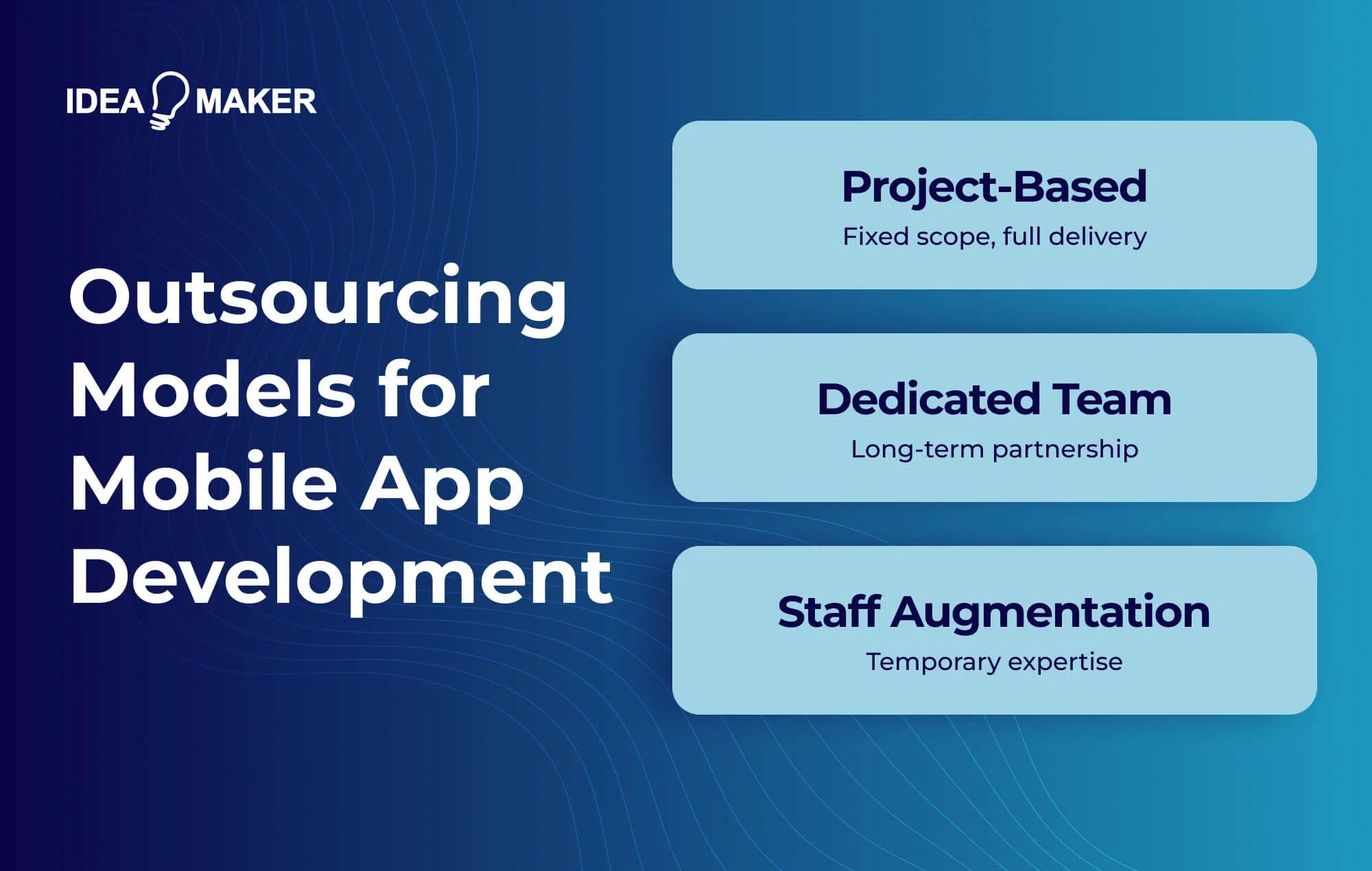
Project-Based Outsourcing:
Outsourcing app development on a project basis helps you communicate clear requirements, expected deliverables and a defined scope to your external team. Essentially, your outsourcing team manages the entire project end-to-end, from blueprints, UI/UX, development, testing, execution and maintenance.
You may opt for this model if your business requires a complete and functioning mobile app without compromising your in-house team for the daily development, or if you want predictable costs through fixed-price contracts.
Dedicated Development Team:
Outsourcing an external team to dedicate their resources to your primary product is ideal if you're looking to build a long-term and future-proof mobile app.
For example, if your primary business goal is to build a successful social media app that evolves without compromising your internal team, outsource a dedicated team that can offer you their expertise, especially for constant app updates, new features or long term maintenance.
Staff Augmentation:
Staff augmentation offers you flexibility without full commitment. This model is perfect for when you only require extra external talent for your in-house team.
Reasons why companies prefer staff augmentation are to fill in skill gaps your in-house team may be lacking, expedite timelines without having to go through another hiring process, or needing temporary assistance for a specific sprint.
Onshore vs. Nearshore vs. Offshore:
Each location-based outsourcing has its pros and cons. The benefits of onshore (same country) mobile app sourcing are matching time zones, making communication and collaboration easier. The downside however, is high cost.
Nearshore (neighboring or close-by countries) outsourcing has a more balanced approach: slightly different time zones, lower cost than onshore, and still makes for good collaboration.
Lastly, offshore (distant countries) outsourcing is the best option for when you’re looking to reduce significant costs and gain access to a wide talent pool. However, communication might be more difficult due to vast difference in time zones and possible language barrier.
| Outsourcing Model | Control | Flexibility | Cost | Ideal Use-Cases |
| Project-Based Outsourcing | Low to Medium – Vendor manages end-to-end execution with minimal day-to-day involvement from your internal team | Low – Scope, timeline, and deliverables are fixed upfront | Predictable / Fixed – Often fixed-price or milestone-based | Best for companies that need a fully built mobile app with clear requirements, limited internal technical oversight, and a defined scope (e.g. MVPs, one-off apps, short-term projects). |
| Dedicated Development Team | High – You retain strong control over priorities, roadmap, and technical direction | High – Easy to evolve features, scale workload, and pivot long-term | Medium to High – Monthly retainer but cost-effective over time | Ideal for businesses building a core product, such as SaaS or consumer apps that require continuous development, updates, and long-term maintenance. |
| Staff Augmentation | Very High – External developers work directly under your internal management | Very High – Scale resources up or down per sprint or phase | Variable – Pay per role or hourly, no long-term commitment | Best when you need to fill skill gaps, accelerate timelines, or add temporary expertise (e.g. Flutter devs, backend engineers, QA specialists) without hiring full-time staff. |
How to Scope Your Mobile App Before Starting the Outsourcing Process
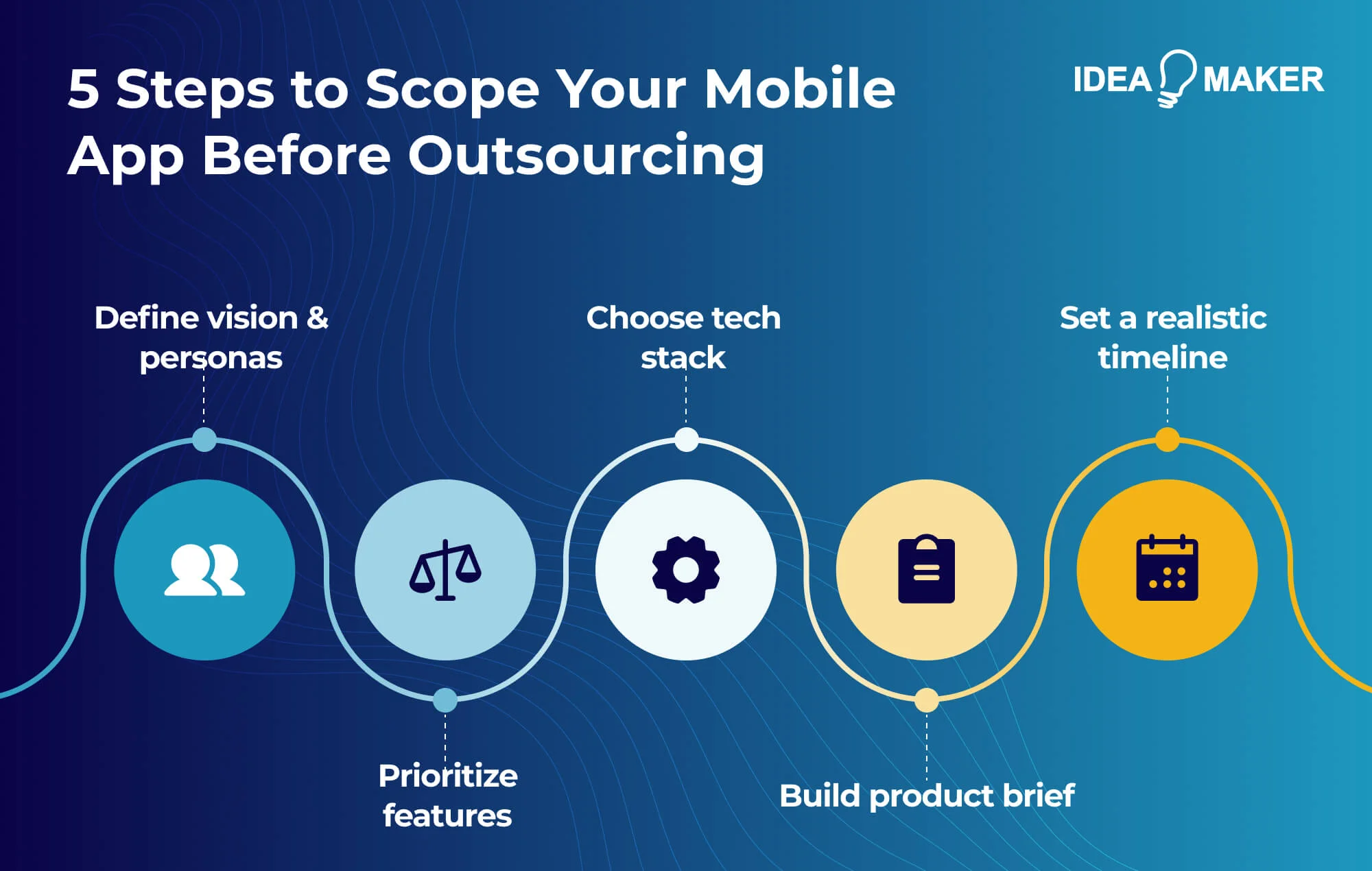
Before you start interviewing development teams or comparing quotes, you need to know exactly what you're building. This sounds obvious, but it's where most outsourcing projects fall apart. You can't expect a development team to read your mind or fill in the blanks on critical decisions you haven't made yet. The more clarity you provide upfront about what your app needs to do, who it's for, and how success gets measured, the better your chances of getting what you actually want. Think of this phase as drawing the blueprint before construction begins skip it, and you'll end up with costly revisions and missed expectations.
-
Define product vision, business objectives, and user personas
Communication on your product specifications should be made clear before trusting and kickstarting off your project to an external team. User persona is also vital.
According to a study, there's a 35% boost in user retention rates if your app is tailored to your targeted audience. Clarifying user persona to your agency helps them understand user pain points, behaviors and must-have UI experiences to develop the right app for your audience.
So, there’s a few key questions you need to answer before you outsource your project: What is the main vision of your product? What are some of the problems your app aims to solve? What are the business goals of the app production? Who is your target market?
Providing clear cut answers to these questions can provide your agency a clearer understanding to meet your expectations, deadlines and business goals.
-
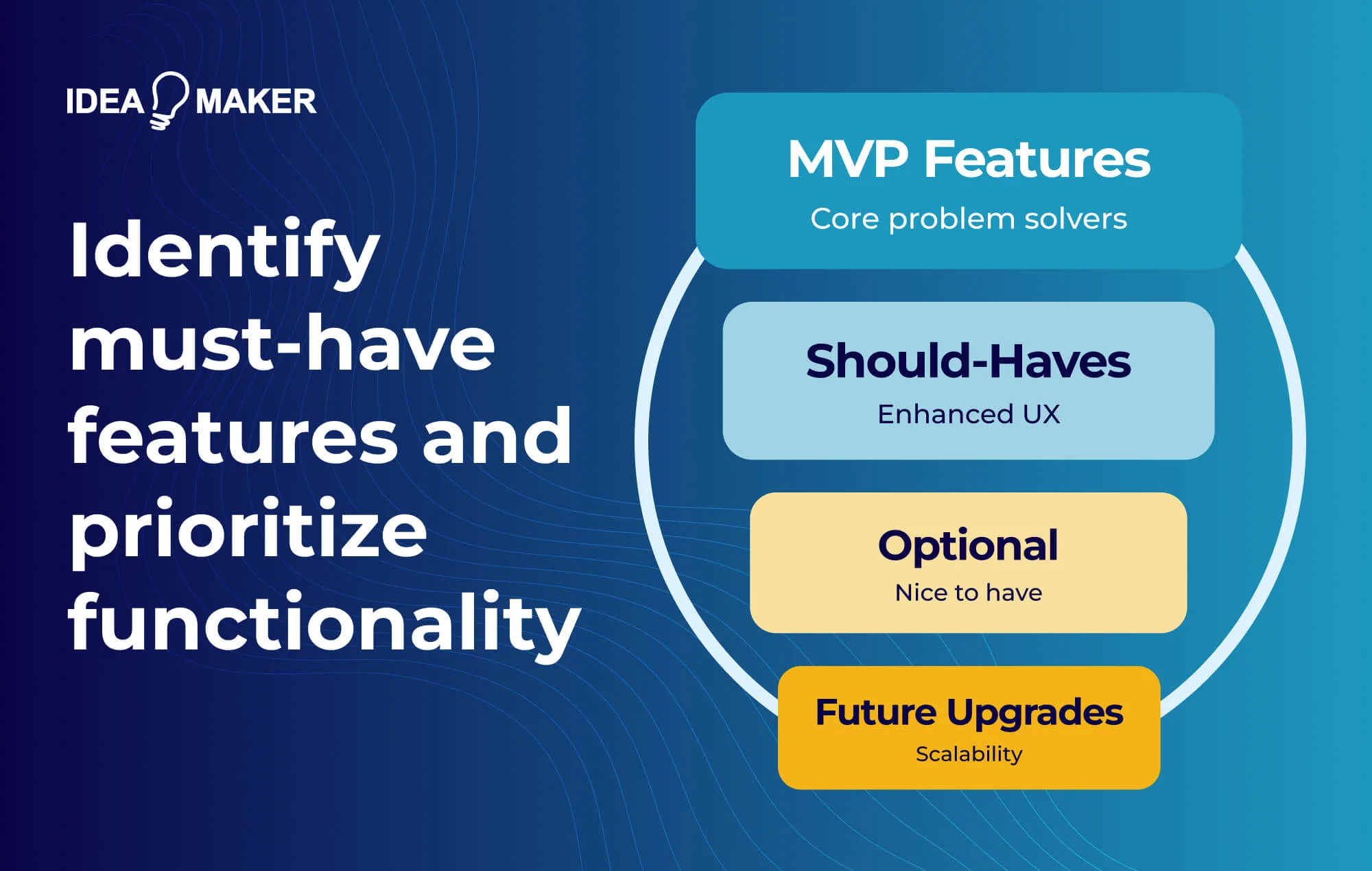
Identify must-have features and prioritize functionality

Wanting an all-inclusive app sounds great until you realize it’s way over your initial budget. This is where scalability of features and functionality takes place to make the most of your outsourced team without breaking the bank.From the list of features you’ve envisioned for your product, list them down into separate categories: MVP, Should-haves, Optional and Future Upgrades.
Strip down what’s unnecessary and retain the core functions that solve user problems. Clear product vision and core function prioritization make a cohesive collaboration between partners.
-
Choose between native, hybrid, or cross-platform technologies
Choosing the ideal tech stack for your product development is crucial because it impacts your product performance, project cost, timeline, future updates, scalability and maintenance. It is the heart of your project, and choosing the wrong one will potentially put your project at risk.
Native apps like Swift for iOs and Kotlin for Android are tech stacks specifically built for seamless function and pixel-perfect user experience, though it can be expensive due to dual app development for two different platforms.
Hybrid apps like Ionic and Cordova are web-based tech stacks (HTML, CSS, JavaScript) built for mobile app development. Using this method is easier and faster to build, especially for web dev experts with years of experience using those tech stacks. However, the risk is the performance that may vary so your project must be monitored closely to avoid bugs and other tech complications.
Lastly, cross-platform apps like Flutter and React Native are ideal methods if you're looking to spend less time and cost without compromising quality. It is essentially a one-codebase development deployed on both iOS and Android. However, it is not ideal if your product vision is complex, like an AAA game, AR-heavy app, VR, advanced camera app.
Experienced agencies will recommend what suits your budget and goals, but you should understand the trade-offs before outsourcing.
-
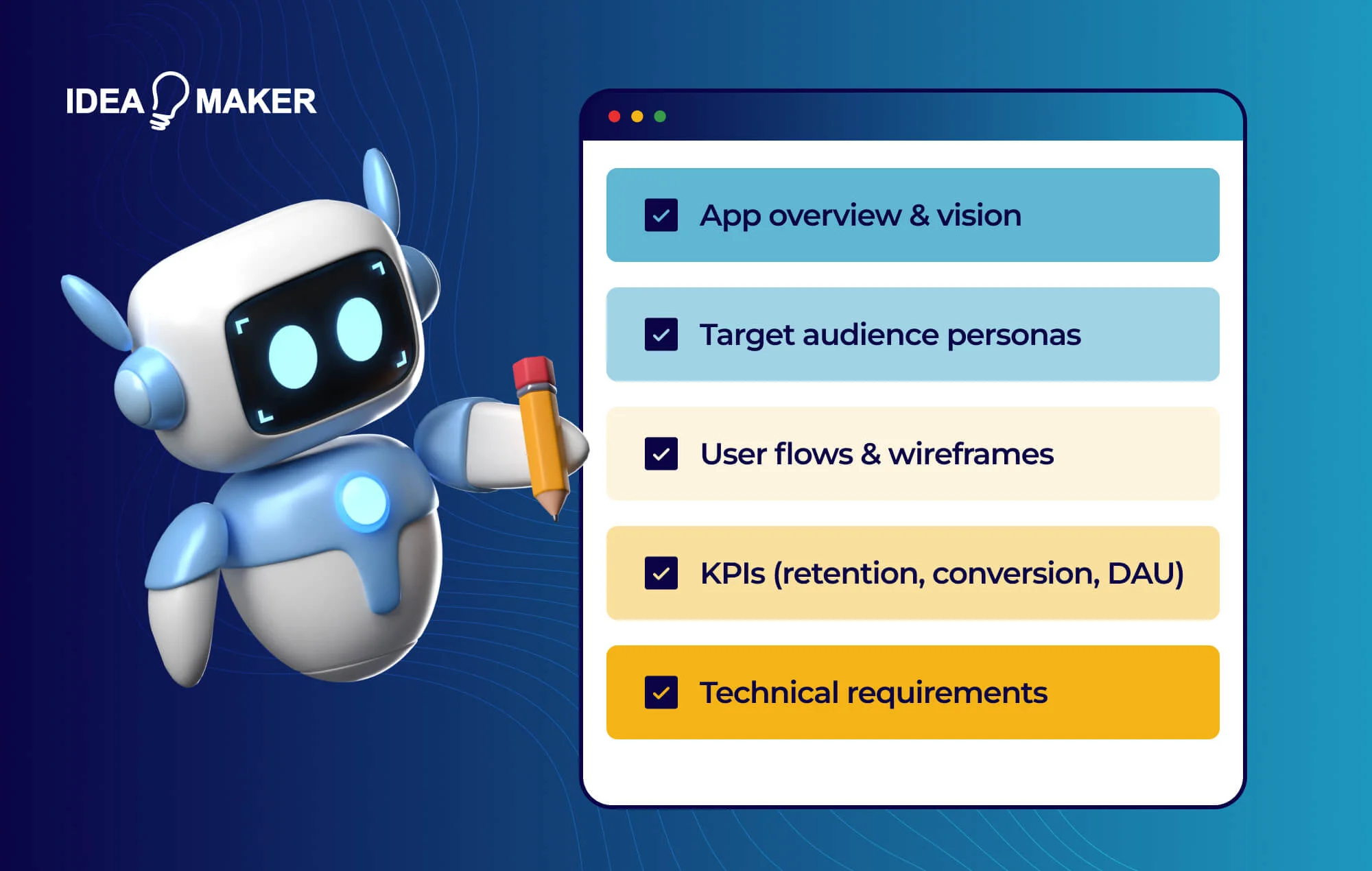
Build a product brief with user flows, wireframes, and KPIs
Only 40% of product launches are successful out of 30,000 each year. One of the factors of such staggering failures is unclear briefs that lead to scope creep.In order to be in the top 40%, you should communicate your product vision to your team clearly. This is where a comprehensive product brief is paramount to ensure the success of your project.
Your brief should include an app overview, target audience, user flows, fundamental wireframes or screens as well as KPIs like user retention, conversion rates or daily active users.
Setting these expectations and information head on will help your outsourced team to transform your concept to code seamlessly.
-
Create a realistic timeline and delivery expectations
Unrealistic deliverables will sabotage your project quality. Outsourcing your project to a team is delicate work that requires attention, so you have to set a realistic timeline to avoid quality compromise.
Categorize your timeline into: MVP, beta and final release with interval buffer time for testing, QA and bug fixing. Set clear expectations on the frequency of updates, deliverables for each stage, as well as the approval flow to avoid unproductivity.
How to Find the Right Mobile App Development Partner
Finding a development partner isn't like shopping on Amazon where you can just read star ratings and hit "buy now." You're entering into what could be a months-long relationship with a team that will shape how thousands of users experience your product. The wrong choice costs you more than money; it costs time, momentum, and sometimes the entire project. But here's the challenge: every agency claims they're experts, their portfolio looks polished, and their sales pitch sounds convincing. So how do you actually separate the teams who deliver from the ones who overpromise and underdeliver? You need a systematic way to evaluate potential partners that goes beyond surface-level impressions and digs into what really matters.
-
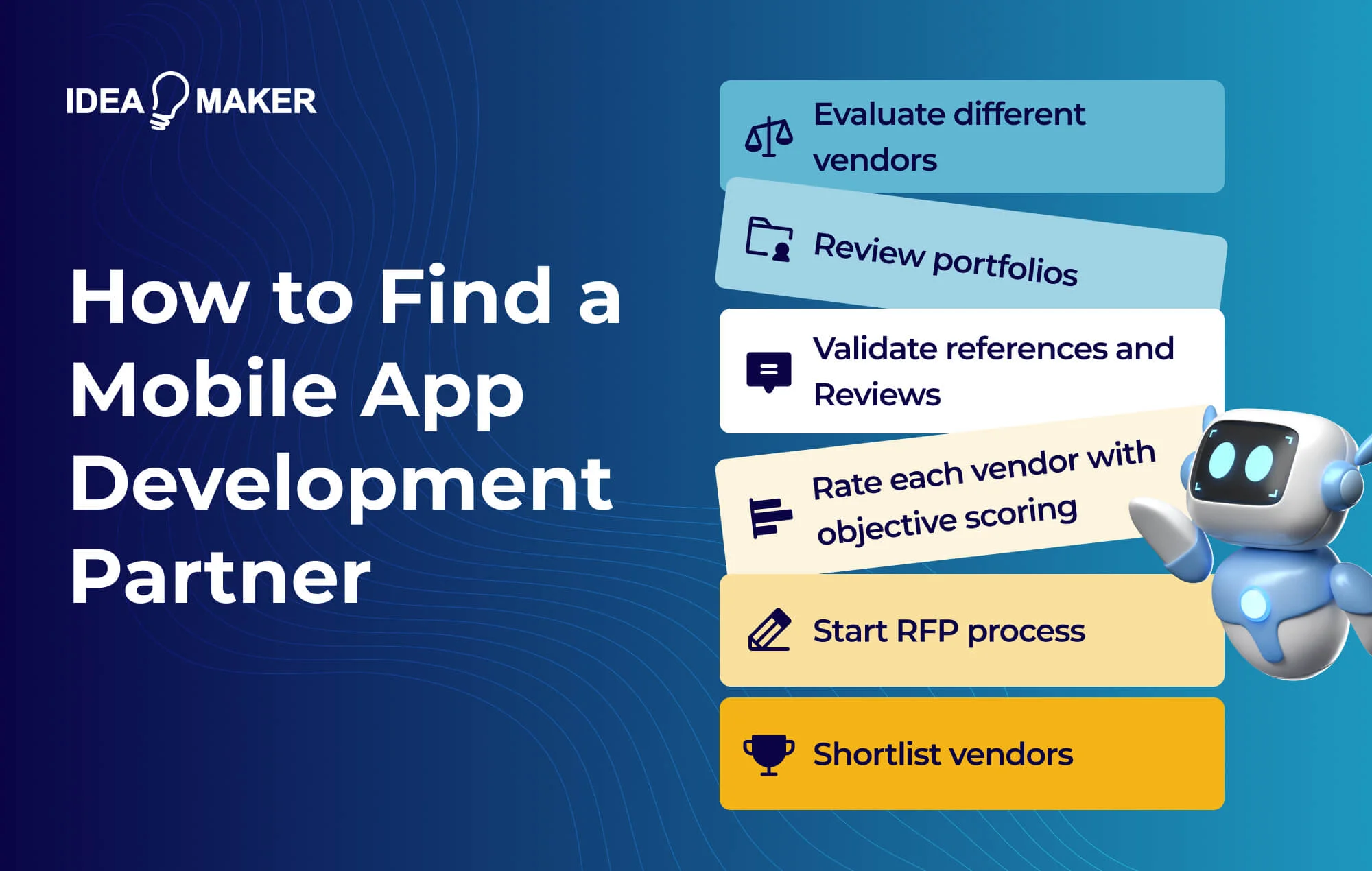
Evaluate different vendors
Before you begin your search, start off with a pool of candidates suited to your preferences such as location (either onshore, nearshore or offshore), pricing model and expertise (native, hybrid or cross-platform).
You may find these candidates on LinkedIn, Clutch, GoodFirms, DesignRush, directories or even referrals from other networks or businesses. Once you have a pool, develop a comparison matrix to filter the best ones for your project needs.
-
Review portfolios
Reviewing portfolios and case studies might be a good step to determine your agency of choice, but the real test is to download your candidate’s past apps they’ve developed and experience their digital solutions first-hand.
Upon experiencing their apps, consider this: Is the UI to your taste? Are the layouts intuitive? Do you experience any bugs or lag? Is it efficient performance wise? Here’s the truth: a beautiful case study can deceive, but a real app cannot.
-
Check communication practices, availability, and time zone overlap
30% of projects fail due to poor communication, according to PMWorld Journal. Before you outsource mobile app development to an external team, you can already evaluate how they communicate with you during the inquiry process.
Do they respond in a timely manner? Are they transparent in their offerings? Do they overpromise or are acting suspiciously optimistic about your project?
In a more technical sense, you may ask the following: Are they available during your business hours? Can they provide you frequent updates? Who will be your point of contact? These are some of the more in-depth questions you can clarify to your external team.
-
Validate references and client reviews with objective scoring
Browsing reviews might seem easy, but you need objective scoring to build a comparison matrix. Visit Clutch, Google Reviews, DesignRush, GoodFirms, or LinkedIn to view who testimonials across all platforms.
For the objective scoring rubric, you may want to consider the following specifics like project delivery, post-launch maintenance, the agency’s agility and communication skills and other priorities according to your needs. From the rubric, rate them 1-5 for communication, expertise, credibility, delivery and problem solving. From this process, you may already short-list a few vendors of choice.
-
Use a structured RFP process to compare short-listed vendors
Request for Proposal is the final step before you make a well-informed decision for your agency. During this stage, it is essential that you list down your scope, features you want in your app, expected deliverables, budget and tech stack expertise.
When you’ve listed down all the key details you need from each vendor, you can already make your decision by analyzing their proposed solution, timeline, service offerings, transparent cost breakdown and even post-launch solutions. A structured RFP transforms your selection from guesswork to objective decision-making.
Questions to Ask Before Hiring an Outsourced App Development Team
- What’s your process for onboarding new mobile app projects?
A well thought-out onboarding mobile app project process means seamless execution. Consider learning about their discovery process, how they help refine your MVP scope, and the requirements they need from you to kick off the project. - How do you ensure code quality and technical documentation?
Poor code quality with no proper documentation means higher cost due to constant troubleshooting, bug fixes and updates. You should look out for how they follow coding standards, if peer review is done, testing practices they use and the sort of documentation they can provide like API endpoints, system architecture, deployment instructions and more. - What post-launch support and maintenance do you offer?
Post-launch maintenance is one most vendors tend to overlook, but this is the part which determines the overall performance of your app in the long run. Ask vendors if they offer a maintenance package, free post-launch support under warranty period, and how quickly they can respond to urgent issues. - How do you handle project delays or scope changes?
Projects are agile, and scope changes. Ask vendors if they use change request longs, how they re-estimate the cost and timeline from said changes, how they document every scope change, and if they opt for an agile approach in project management. - What security measures do you follow to protect IP and data?
Data security and IP protection is the most important thing when outsourcing your app development project to any agency. It’s important to know if there's a NDA agreement between you and the vendor, how source code is protected and if they handle secure data storage. Not only that, but do they follow OWASP mobile app security guidelines, protect your IP and enforce confidentiality?
How to Manage Outsourced Mobile App Teams Effectively
Signing a contract with a development team is just the beginning. The real work starts when you need to coordinate across different time zones, keep everyone aligned on priorities, and make sure the project doesn't drift off course. This is where many companies struggle. They find a great team, kick off the project with enthusiasm, and then watch things slowly unravel because nobody established clear processes for how decisions get made, how progress gets tracked, or what happens when problems arise. Managing an outsourced team isn't drastically different from managing an internal one, but the distance and lack of face-to-face interaction means you need tighter systems. Without structure, small miscommunications compound into major setbacks.
-
Define contract structure and service-level agreements
Service-level agreements (SLAs) in contracts are more important than you think, and project management issues usually ensue from the lack of contract structure.
When developing your contract before you sign with any vendor, ensure that your contract outlines scope of work, timeline of your project, payment terms, IP ownership clause, exit terms as well as SLAs highlighting response time for any technical issue, bug-fix turnaround, downtime limits.
-
Set up a unified collaboration and communication stack
According to Project Management Institute, one third of projects fail due to poor communication. To ensure the success of your project, you may centralize collaboration and communication stacks.
For project management, consider Jira, Trello or Asana. GitHub, GitLab and Bitbucket for code management. Confluence and Notion for documentation. Slack, Flock and Teams for basic communication. Figma and Invision for design collaboration.
-
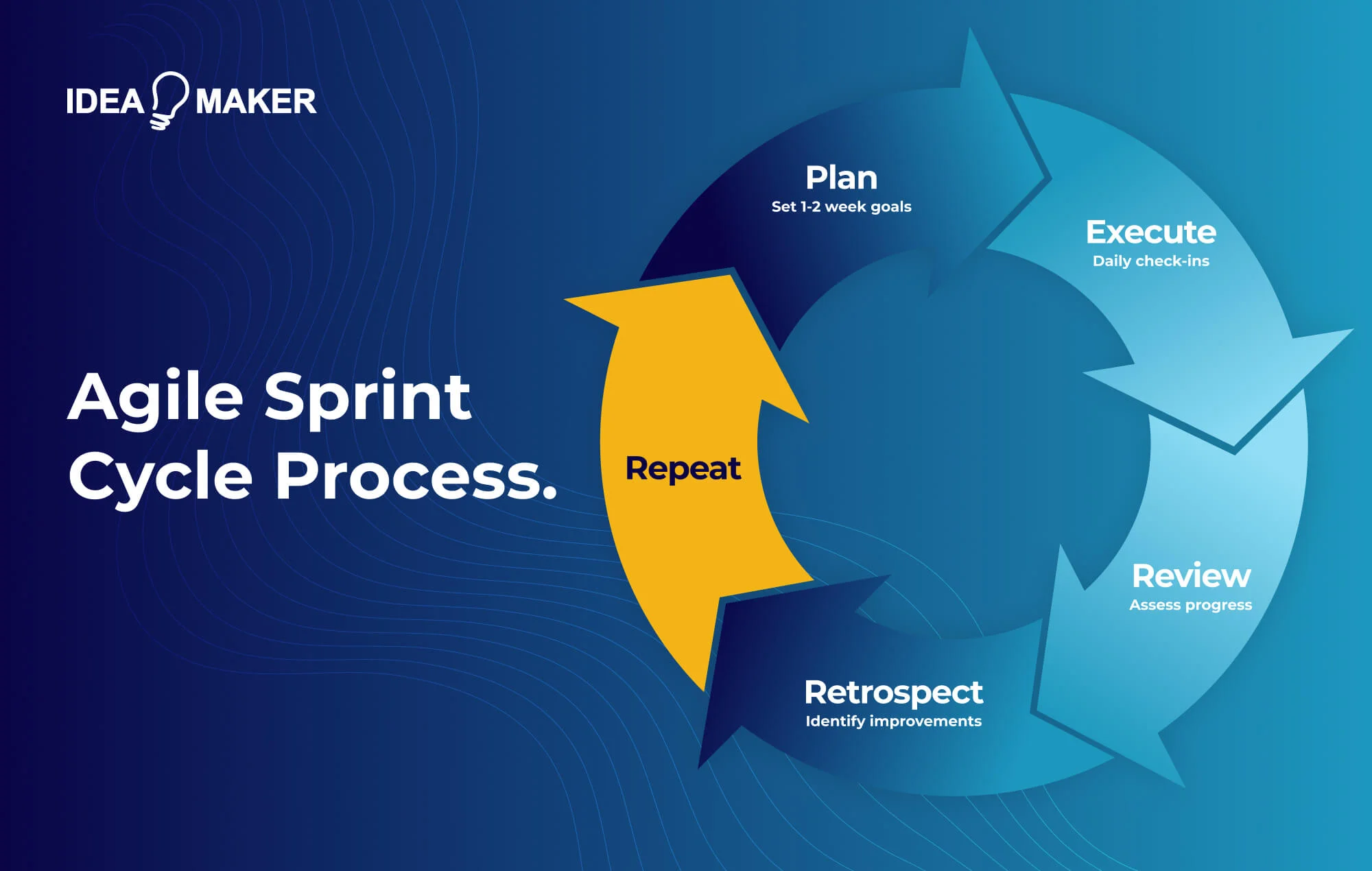
Run agile sprint cycles with clear milestones
There are a few challenges when you outsource app development projects, which are the misalignments, unclear communication and final products that don't align with your expectations.Running agile sprint cycles help prevent all these risks by working in goal-specific sprints. For instance, if you want to develop a meditation app, you can kick off by dividing your timeline into sprints of one or two weeks. In each sprint, set a goal like ‘complete calming UI/UX design’. During the sprint, the team works toward that goal while doing daily check-ins to resolve technical blockers quickly.
At the end of each sprint, you may run sprint reviews to assess progress, and then a sprint retro to work on improvements in order to proceed to the next sprint.
Your milestones can also be divided into the following phases: UI/UX, core features, beta release, final QA and app-store deployment. Agile development cycles help you keep track of your project progress, staying flexible, transparent and predictable.
-
Maintain code quality through automated standards
Code quality is the heart of every successful app development project. With good quality coding, your app will avoid all unnecessary technical issues involving bugs, crashes and even constant updates.
Work on a code QA structure by running automated testing, linting tools, CI/CD pipelines, automated code reviews and regular refactoring sessions. By controlling these standard procedures, your code quality stays future-proof and scalable throughout.
-
Align reporting cadence with stakeholder expectations
Reporting updates should be consistent and predictable, so set reporting norms such as weekly progress updates, roadmap updates after each sprint or development phase, risk reports to mitigate technical issues, monthly billing summaries and demo day for each sprint to brief the product performance progress.
Cost of Outsourcing Mobile App Development: What to Expect
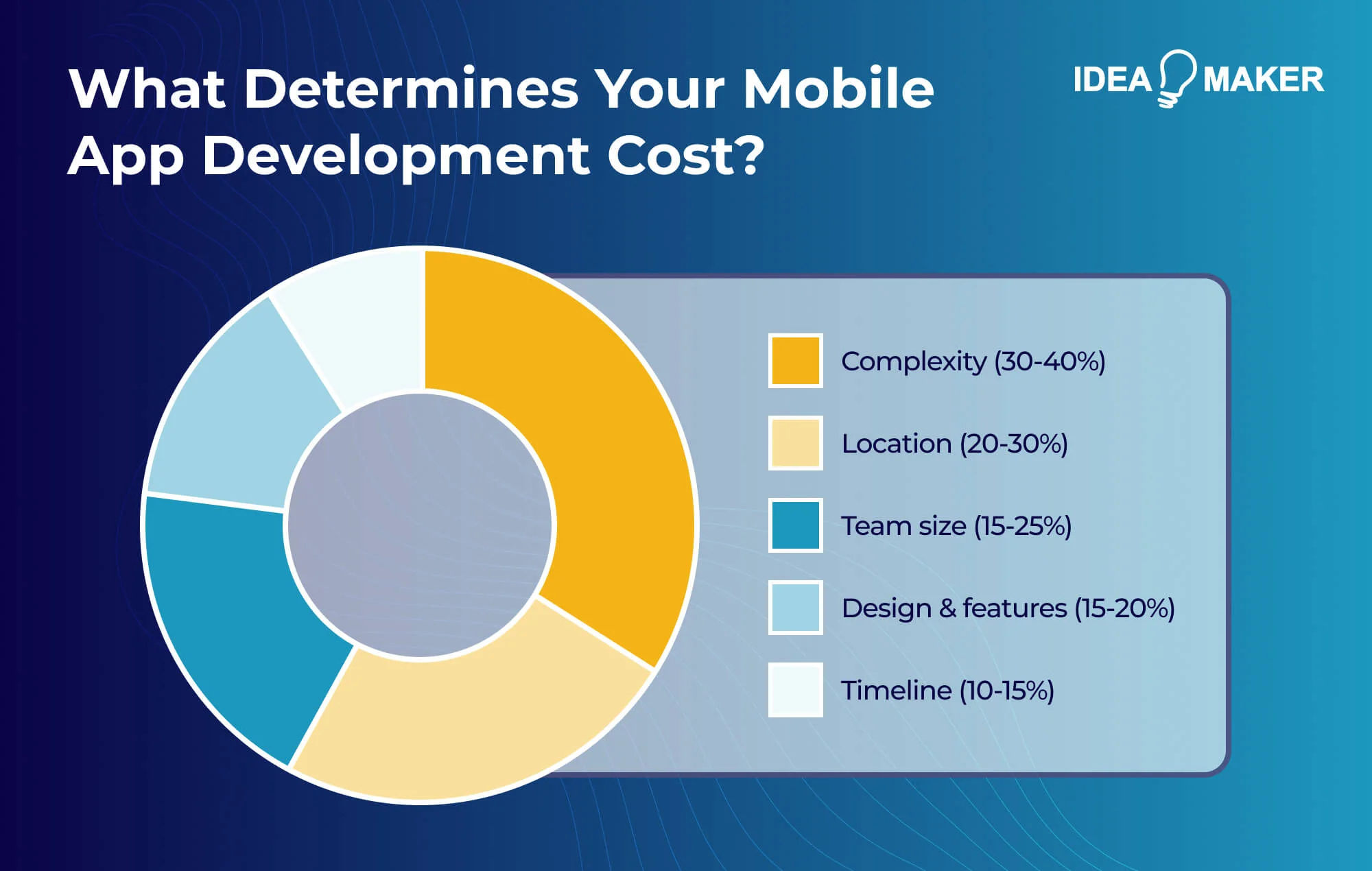
Price is usually one of the first questions companies ask when considering outsourcing, but it's also one of the trickiest to answer. A simple app might cost $20,000 or $200,000 depending on who builds it, where they're located, and what "simple" actually means once you dig into the requirements. And that's just the baseline, there are always extra costs that catch people off guard. Maybe you need ongoing maintenance, or your developer charges separately for app store submissions, or you realize halfway through that you need a backend infrastructure you didn't budget for. Understanding the full financial picture before you commit prevents nasty surprises later. You need to know not just what things cost, but why they cost that much and where you can realistically trim without compromising quality.
-
Compare development costs across global regions
Depending on your budget and priorities, prices vary across global regions. If you’re looking for onshore mobile app agencies, the cost is higher, nearshore is more average, and offshore is often cheaper.
If you’re looking to hire agencies from North America and West Europe, rates are higher, but you’re paying premium talent and expertise. The price could range from $100 to over $250 per hour.
In East Europe, you could still get good quality mobile app development services at a mid-range cost of about $30 to $70 per hour. In South America on the other hand, you could find services at the $40 to $80 range.
If you’re looking for cheaper alternatives, Asia offers a big talent pool. They can offer good quality services if you assess and filter the agencies correctly. You could get $20 to $60 per hour.
-
Estimate costs based on app complexity and features
Besides location of your agency, the features and complexity of your app framework plays a pivotal role in determining the cost. Simple apps with basic utility features range from $20k to $60k.
Mid-range complex mobile apps like social platforms, marketplaces and payment integration on the other hand cost around $60k to $150k.
App projects with high complexity features like AI, custom animations or real-time data integration can cost anywhere from $60k to $150k.
The cost structure can also depend on the UI/UX frameworks, number of screens or pages, API integrations, backend framework complexity, payment gateways and real-time features.
-
Identify and plan for hidden development expenses
Planning your cost structure can give you a rough idea on how much you should spend on a project, but beware of hidden costs that can also sneak up in your billing.
One of the hidden development expenses you should look out for is app store fees, where Apple charges $99 per year, and Google Play $25 one-off.
Other hidden costs include third-party APIs, infrastructure and hosting, post-launch support like bug fixes and patches, security updates and OS version compatibility, QA and more.
-
Build a forecasting model with line-item budgeting
Setting your expectations and budgeting ahead helps prevent unwarranted surprises in the future when the bill comes around. When budgeting, consider categorizing the project into line items such as UI/UX, frontend, backend or APIs, admin dashboards, QA and testing, optimization, project management, deployment and maintenance.
Your forecasting model should be as accurate as possible, so details of each line should include estimated hourly rate, buffer for changes, recurring costs and more.
-
Balance cost with quality in vendor selection
Opting for the cheapest budget could compromise the quality of your mobile app project, but to overspend doesn’t mean better quality, either.
You should budget wisely while considering the quality mobile app services that fits your business needs. Evaluate the value of your shortlisted vendors who could deliver clear communication, offer quality code standards, organized and well-documented SOPs, overall performance, comprehensive post-launch maintenance that could guarantee better ROI instead of cheap quality work.
Risks and Challenges in Mobile App Outsourcing (and How to Mitigate Them)
-
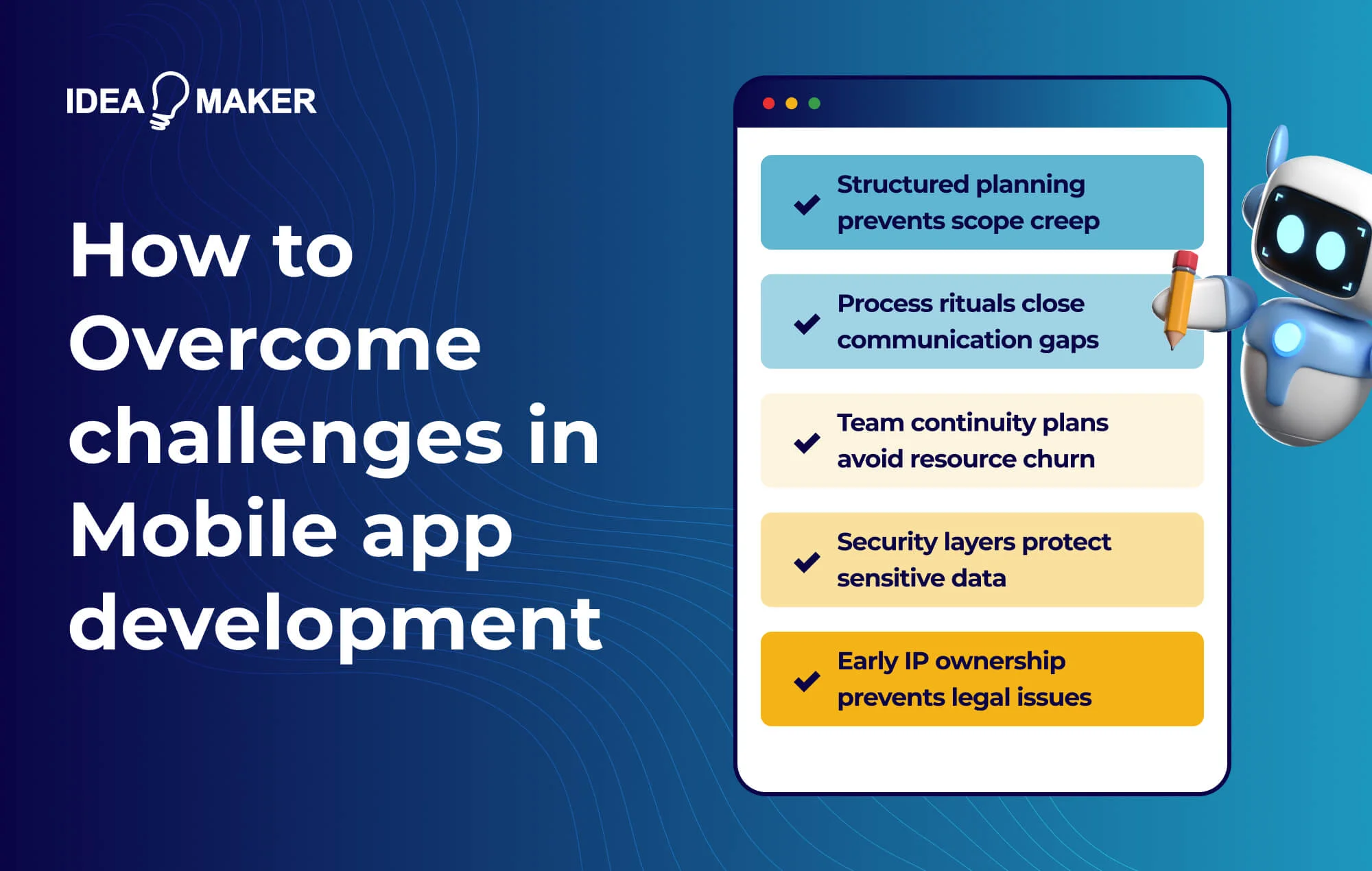
Prevent scope misalignment with structured planning
One of the most common hurdles of outsourcing app development projects to an external team is the scope misalignment that is often rooted from lack of communication, structured planning and documentation.
To avoid this from happening, vendors should run a detailed discovery phase, understanding your business needs as their client. You on the other hand should prepare a detailed product brief that contains all requirements you need in your app.
-
Avoid communication gaps with process rituals
Communication is key to any successful project, so set communication channels to help you track progress, updates and even evidence for any documentation purpose.
Schedule weekly sprint reviews to keep everyone in the loop on the project development. You should also keep all documentation in a single shared space so everyone can access it easily. Not only that, but project dashboards are also
-
Mitigate resource churn through team continuity plans
Team continuity is an important aspect that needs to be discussed between vendor and client early on. This is to avoid inconsistencies in scope, expertise and knowledge gaps that may disrupt the project overall development.
When planning, ask if your potential vendor can provide a core team that stays throughout your project within a specific timeline. Ask if they have back up plans should their team discontinue. Both parties should also discuss a pristine task handover process when experts do leave a project.
-
Protect sensitive data with enforceable security layers
Your data is a gold mine. Protection and security layers are non-negotiable, so communicate with your vendor on enforcing NDAs for the parties involved, secure code repositories, encryption standard procedures, compliance with OWASP Mobile Security guidelines and more.
-
Establish IP ownership early in the engagement
Intellectual Property (IP) is the most vital component of any business developing an app. Establish ownership early on to avoid legal issues and the risk of losing your app altogether.
Mitigate these risks early on by including clear IP clauses in your contract, ensure all code, designs and assets are stored in your accounts and establish ownership on those components. You should also get rights to modify, extend or migrate the product should you wish to continue with another vendor.
How to Plan for Post-Launch Support and Maintenance
Post-launch support is more important than you think. The ongoing performance of your app really depends on how well-planned your team is for updates, performance monitoring, and scalability after the app goes live. A well thought out post-launch support framework helps you reduce downtime, manage costs, and improve the longevity of your app.
Define a support agreement for ongoing updates and bug fixes
Ensure that you and your mobile app development agency are clear on the post-launch support packages when reviewing the agreement. Post-launch services like addressing bug fixes, OS updates, optimisation and security patches should be discussed thoroughly and how soon these issues should be resolved. This will prevent future unnecessary hidden costs and misunderstandings.
Set performance metrics for uptime, stability, and speed
Setting key performance indicators (KPI) for the post-launch is vital to keep your app in its best performance. Some of the metrics you can consider are uptime percentage, crash rates, load times, response speed and more. Reviewing these KPIs help identify warning signs early and maintain a smooth-sailing experience for users despite traffic growth and other possible factors that may compromise performance.
Develop a roadmap for future iterations and scaling
Developing an app doesn’t just end there. It goes beyond development, and more on improvement of the app long term and how it can evolve seamlessly in future digital landscapes. Creating a roadmap can encourage scalability by prioritizing new features like UX improvements, adding on and removing what’s best for the app function.
Prepare for a smooth transition to internal ownership if needed
When you’ve grown to like your outsourced mobile app dev team, you might probably plan to bring them in-house later. It is essential to plan early to avoid future hiccups during the transition phase, so ensure proper documentation, clean code practices, and knowledge transfer sessions are included in your agreement. This makes it easier for internal teams to take over without disrupting app performance or user experience.
Track usage analytics to guide product evolution
Data analytics is everything. Understanding how your users interact with your app after launch can give you a clear idea on the overall app performance and usability. Tracking metrics such as active users, feature usage, drop-off points, and session duration provides valuable insights into what’s working for your app and what doesn’t. These crucial insights will help you make data-driven decisions for future developments.
Top Mobile App Outsourcing Companies to Explore
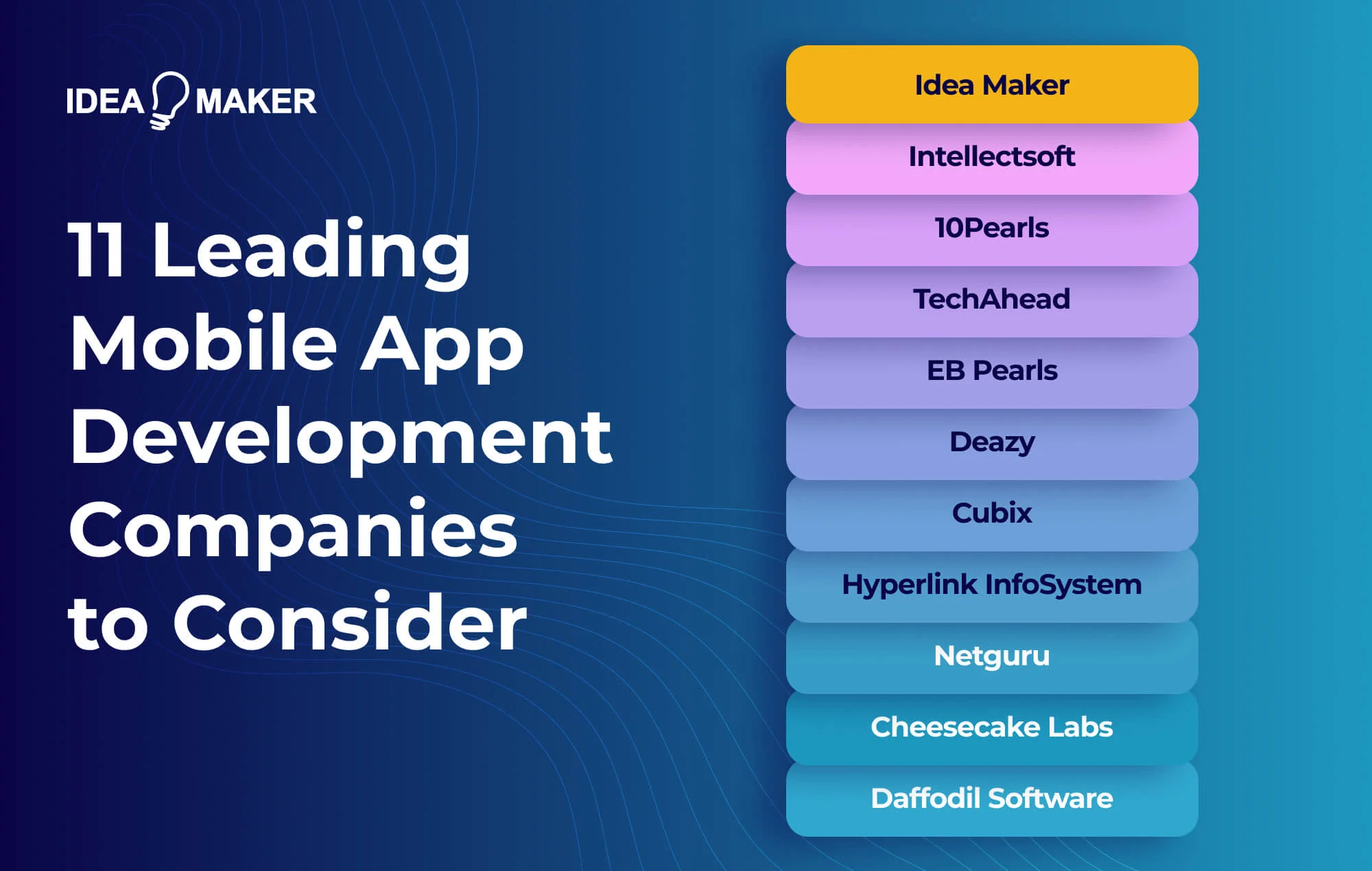
Just provide a one paragraph overview for the whole section and the add the list of the names of the companies as given below.
- Idea Maker
Recognized by SelectedFirms, Idea Maker is positioned as one of the top mobile dev companies in California. A US based software development agency known for its specialization in native and multi platform apps for clients of diverse sizes and industries. They focus on high-performing web and mobile solutions with a stellar focus on UI/UX clarity, scalable frameworks, and future-proof solutions. - Intellectsoft
Known for its expertise in enterprise-level mobile solutions, Intellectsoft is a global software engineering company focusing on handling large-scale, high-security projects in industries like healthcare, finance, and logistics. - 10Pearls
Focusing on mobile and AI-based solutions, 10Pearls stands as a global brand with teams across the US and Asia, driving to provide digital transformation that thrives on innovation, responsiveness and human-centered design. - TechAhead
Tech Ahead positions themselves as a mobile development company with experience in mid to enterprise clients across industries like fintech, wellness and retail. Their strong touchpoints in UX design, performance optimization, and cross-platform expertise. - EB Pearls
EB Pearls is a well-established mobile and software development firm known for delivering digital solutions with fast turnaround times. They excel in UI/UX, cross-platform builds, and offer budget-friendly solutions tailored to startups and SMEs. - Deazy
Deazy is a B2B marketplace that connects businesses with credible nearshore and offshore engineering teams. Ideal for clients who are looking to outsource projects without the hassle of vetting and hiring an external team. - Cubix
Cubix is a full-spectrum software development company focusing on mobile apps, games, and enterprise solutions. They are known for their expertise in complex and custom tailored builds, including backend systems and feature-rich consumer apps. - Hyperlink InfoSystem
Hyperlink InfoSystem is a recognized offshore development company, offering full-spectrum mobile and web development services. They are known for their affordable rates and fast delivery, making it an ideal choice for startups and those on a budget. - Netguru
Netguru is a European European app development company known for their top-tier design, research-backed user experiences, and robust digital engineering. They’ve experience working with global brands and tech startups to build scalable solutions for both mobile and web. - Cheesecake Labs
Incepted in Brazil, Cheesecake Labs is a mobile development agency focusing on UI/UX design quality, collaborative processes, transparency, and delivering aesthetically pleasing digital products. - Daffodil Software
Daffodil Software is a credible outsourcing app development agency offering mobile solutions, cloud engineering, and product modernization. They pride in their expertise and scalability to sustain and maintain long-term projects.
How Idea Maker Supports Outsourced Mobile App Development Execution
- Full‑cycle delivery: strategy → design → development → launch → optimization
At Idea Maker, our team of experts handle end-to-end product lifecycle, providing clients with full support in every aspect. From UI/UX design, agile development cycles, QA, performance testing, deployment and even post-launch maintenance, we ensure your project runs seamlessly. - Expertise in cross‑platform architectures (ReactNative, Flutter) and cloud‑native ecosystems
Our team of web developers possess in-depth expertise in cross-platform and cloud-native frameworks, such as React Native, Flutter, AWS and GCP for a budget-friendly dual-platform approach. Our experience in developing apps with modular architecture has provided clients fast-performing, cost-efficient and stellar quality mobile apps, suited to their business. - Security‑first development, transparent collaboration with global teams
Idea Maker takes security and transparency seriously. We follow the industry security standards like OWASP Mobile, encrypting data flows and securing authentication to protect your data.Our team also thrives on transparency, ensuring all communications are clear to keep our clients not only in the loop during development cycles, but to align goals and visions in creating the best app for their business. - Flexible engagement models tuned to project complexity and long‑term support
We adapt to your business needs. From project-based to staff augmentation or dedicated dev teams to keep your project running long-term, we offer flexibility in our services.We’re also big on scalability, offering our full-spectrum mobile app development services that are tailored to various business levels, either startups, SMEs or enterprises. We ensure that Idea Maker fits your timeline, product scope and maturity, as well as budget.
Emerging Trends in Mobile App Development Outsourcing
-
Increased demand for AI-enabled mobile features
With emerging trends, anyone can use AI like ChatGpt to create the perfect mobile app for their business, but what about AI-enabled mobile features? More businesses in the current digital era are turning to AI-enabled mobile features to enhance user experience and elevate product quality. From entertainment and personalization to data insights, automation, and productivity tools, AI is becoming a core differentiator in modern mobile apps.
-
Growing adoption of hybrid cloud and backend-as-a-service (MBaaS)
To save time, cost and lower engineering complexity without risking quality, more businesses are opting for hybrid cloud and MBaaS platforms. Commonly used tools like Firebase, AWS Amplify and Supabase provide ready-made backend components that comprises authentication, databases, storage, APIs and more without having to manage them manually. As for hybrid cloud models, it is efficient in distributing workloads across public and private clouds.
-
Rising importance of cybersecurity in outsourced projects
With the rise of cyberattacks recently, security measures can no longer be compromised. Organizations expect agencies to follow industry standard security practices like the OWASP Mobile Security, encryption processes and secure coding practices and repositories.
-
Sustainability, accessibility, and inclusive design as new baselines
What used to be competitive advantage is now the new baseline when organizations rise with high-performing apps in the market. The three most essential components; sustainability, accessibility and inclusive design that pleases and performs, are now non-negotiable.
Apps in the current digital landscape should be more energy-saving, one that doesn’t drain battery life and data usage. Not only that, sustainability like creating lighter apps and optimized cloud resources are vital as well. Inclusive UI/UX design with human touch is now the new norm, an expertise that vendors should already possess.
-
Agile-first outsourcing becoming industry standard
Agile-first workflows are becoming the new culture among companies who opt for outsourcing app development to external teams.
Weekly sprints, sprint reviews, and rapid progress tracking are expected to ensure productivity under a tight deadline, consistent improvements and flexible scope adjustments.
FAQs About Outsourcing Mobile App Development
- What’s the difference between outsourcing and offshoring?
Outsourcing is a general term to hire an external team to develop your app. Offshoring is a more specific term to hire an external team from another country, mainly due to cost and wider talent pool. - Can I outsource just part of the mobile app (e.g., backend only)?
Yes, and this is often called staff augmentation or modular outsourcing where you only hire an external team to work on a specific component of your project. Some examples include backend or API dev, UI/UX design, mobile frontend, QA and testing,and maintenance. - How long does it usually take with an outsourced team?
It depends on your product scope and complexity. Simple MVP apps take 2 to 3 months. Medium or large complexity apps take anywhere from 3 to 12 months, and enterprise level systems often take more than a year. - Which tech stack is best for outsourced mobile dev?
Native apps like Swift and Kotline are ideal for complex or hardware-heavy apps. Cross-platform like Flutter and React Native is the best choice if you’re looking to cut corners on budget without compromising quality. Hybrid stack like Ionic and Cordova is ideal if you’re developing simple apps or rapid prototypes. - How do I protect IP when outsourcing globally?
Establish clear IP ownership clauses in your contract. You should also ensure all codes, assets and designs legally belong to you and in your repositories. Get NDAs for all involved parties and use secure communication and file-sharing practices. Gain access to rights to modify, extend and migrate your product anytime.
Final Thoughts on Outsourcing Mobile App Development
To outsource app development means trusting an external agency with your project and product vision to come to life. It’s not just about developing an app, but to work around your available resources while tapping into new opportunities like access to global talent and market insights.
The most vital key to success is clarity in communication and collaboration, trust in expertise, an organized and well-documented process as well as a professional partnership that focuses on business growth.
Before you begin outsourcing your project to a mobile app agency, remember to scope your mobile app, go through the steps to find the ideal mobile app development partner, structure your costs effectively, prepare risk mitigation and finally, plan for post-launch support for your app’s long-term performance.
At Idea Maker, we collaborate with clients worldwide, onshore, nearshore, and offshore, to build mobile apps that combine performance, scalability, and great user experience. Connect with us to meet our team and uncover new opportunities for your product.