Businesses today spend millions building mobile apps as the market races toward $700 billion within the next decade. Smartphone usage continues to grow, and users now expect continuous value through subscription models. That raises expectations. People compare your app to the best ones already on their phone. Yet over half of mobile apps fail before they reach year three. The reason is rarely bad technology. It's bad partner selection.
When you search for mobile app development companies, you face thousands of providers offering similar promises. Many look credible until you sign the contract. The real challenge is not finding developers who can code. It's finding a provider who understands your regulatory constraints, fits your budget model, matches your timeline, and can support long-term maintenance after launch.
There is no universal "best company." What matters is fit. This guide shows you how to evaluate providers based on what actually protects your investment.
Start With Market Reality and Business Context
If you are about to commit a budget to a mobile product, before anything, you need to put time into understanding the market you are entering. Mobile is not a speculative channel anymore. The mobile market is on its way to go beyond $700 billion within the next 10 years.
Smartphone usage is still increasing every year. Network infrastructure today is much stronger compared to five years ago. Apps also do not depend only on one-time downloads anymore. Most products use subscription models or in-app payments, so users expect continuous value. Because of this, expectations are higher now. People compare your app with the best apps they already use on their phone.
At the same time, vendor saturation continues to increase as thousands of agencies and independent freelancers offer similar mobile application development services.
Why “best company” is the Wrong Framing?
A large number of apps fail within the first few years because they do not meet user expectations in real usage. In many cases, the problem starts with selecting the wrong mobile apps development company. When you begin searching for the best mobile app development companies, it may feel like the right starting point, but that alone does not guarantee you will choose the right one for your product.
There is no universal best. What matters is whether the company fits your situation.
Your regulatory exposure, available capital, technical complexity, and product roadmap determine which company you choose.
When Should You Outsource?
Outsourcing mobile app development for business works well in practical situations, such as:
- You need to launch within a fixed timeline without delays.
- Building internally requires recruiting new talent and takes several months before new hires reach full productivity.
- You want engineers who already work daily within a specific stack rather than hiring engineers who must build that expertise from scratch.
- You prefer experienced mobile application development services providers who apply proper engineering practices instead of testing approaches during your first release.
- You do not want to assign internal release managers, QA leads, and business analysts when established providers already include those functions in their operating model.
In-House vs Outsourced vs Hybrid Models
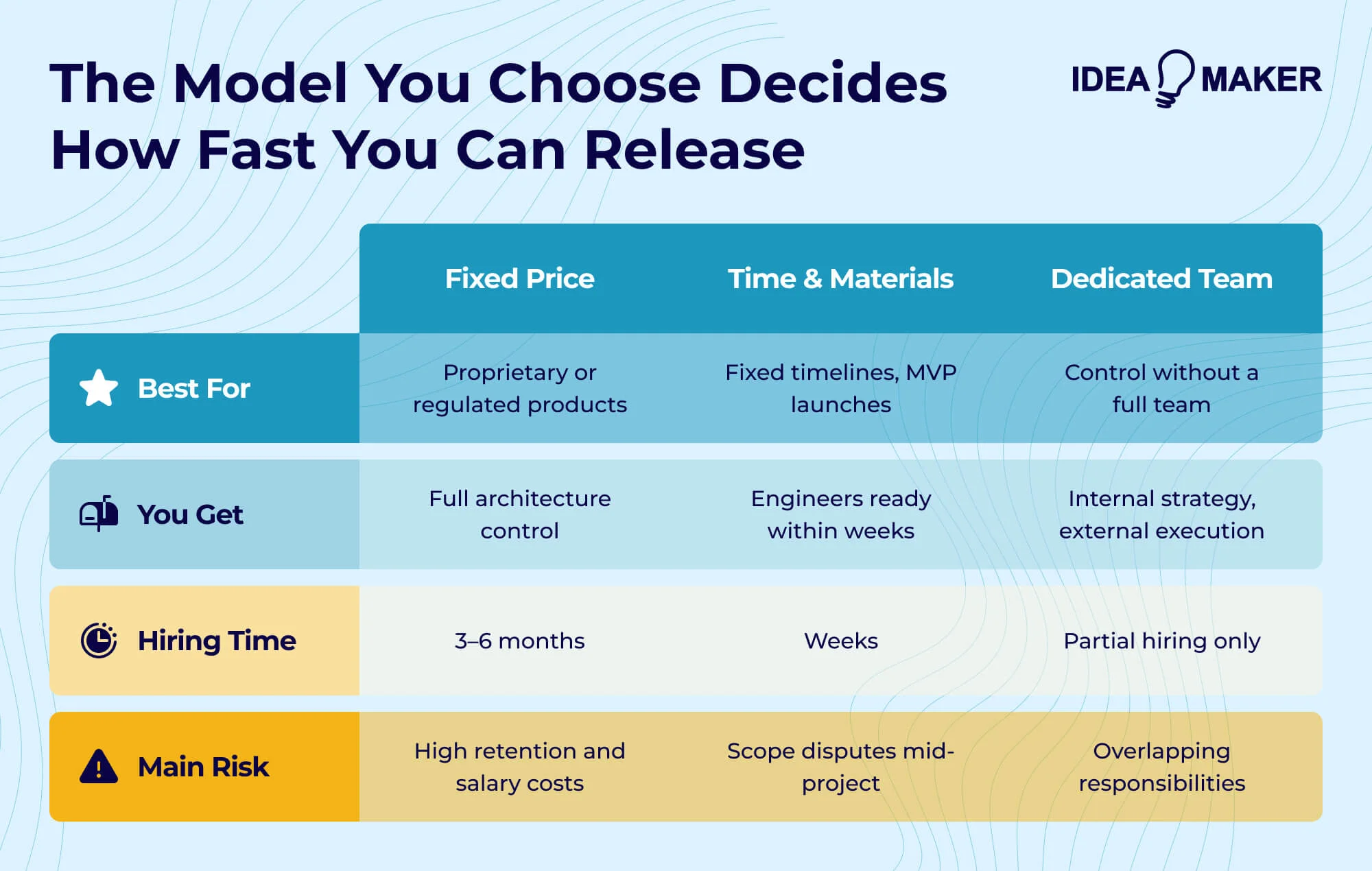
Before you start talking to outside providers, figure out how you actually want to build this. In mobile app development for business, that early choice decides how fast you can release the product.
In-house model
When you build in-house, you hire developers, UX engineers, QA engineers, business analysts, and DevOps. You control the development lifecycle, including architecture, testing, releases, and security policies directly. This model works well when your product involves proprietary logic or strict regulatory requirements. However, you carry full salary, infrastructure, and retention costs.
In this model, hiring alone can take three to six months. New hires need time to understand internal systems and gain expertise in the technologies as productivity does not start on day one.
Common failure scenarios:
- Leadership assumes new hires will deliver immediately and underestimates onboarding time.
- Attrition forces knowledge transfer and slows releases.
- You still have to pay your employees even when product priorities change.
Outsourced model
Outsourcing means you hire an external service provider to develop your app according to your requirements. You do not need to manage your own development team.
Many providers can begin within weeks because they already have engineers who work daily within specific tech stacks. This reduces hiring delay and gives you cost flexibility during MVP or expansion phases.
You also avoid maintaining internal release managers, QA leads, and devOps. The provider typically includes those roles within their operating structure.
Common failure scenarios:
- You request changes during development without checking the provider’s change policy, and they push back because the scope was already agreed upon. This leads to delays.
- Architectural decisions go forward without direct input from your internal technical lead.
Hybrid model
A hybrid model keeps a small internal team responsible for roadmap, architecture, and technical standards, while an external provider handles execution scale. This structure works when you want strategic control but cannot afford hiring a full team.
Common failure scenarios:
- Internal and external teams both wait for approval on critical decisions.
- Responsibilities overlap and cause duplicate work.
- No one owns final release accountability.
Selecting the right model prevents operational mistakes, but it does not define product intent. You still need to separate business goals from feature wishlists and decide whether you are launching an MVP or a full-scale product.
Clearly Define What Matters for Your Mobile App
Before you talk to any development company, take a step back and think about what you actually want this app to do. Not in vague terms, but clearly.
Business Goals vs Feature Wishlists
Many founders think business goals and feature lists mean the same thing. They do not.
A business goal explains what result the app should create for the company. A feature wishlist lists what the app should include. One defines success. The other describes functionality.
For example, you might say you want referrals dashboards, push notifications, and analytics. Those are features. But the real goal might be to increase repeat purchases or reduce customer churn. If you never define that outcome, the feature list keeps growing.
To separate the two clearly:
- Write the business goals in simple terms. For example, increase repeat purchases by 20% in one year.
- Identify only the features that directly support that result.
- Move everything else into a later phase.
When you send requirements to your hired provider, start with the goals. Then show the features that support it. This way, you avoid endless debates about adding more screens and keep everyone focused on what the app needs to achieve.
MVP vs Full-Scale Product Expectations
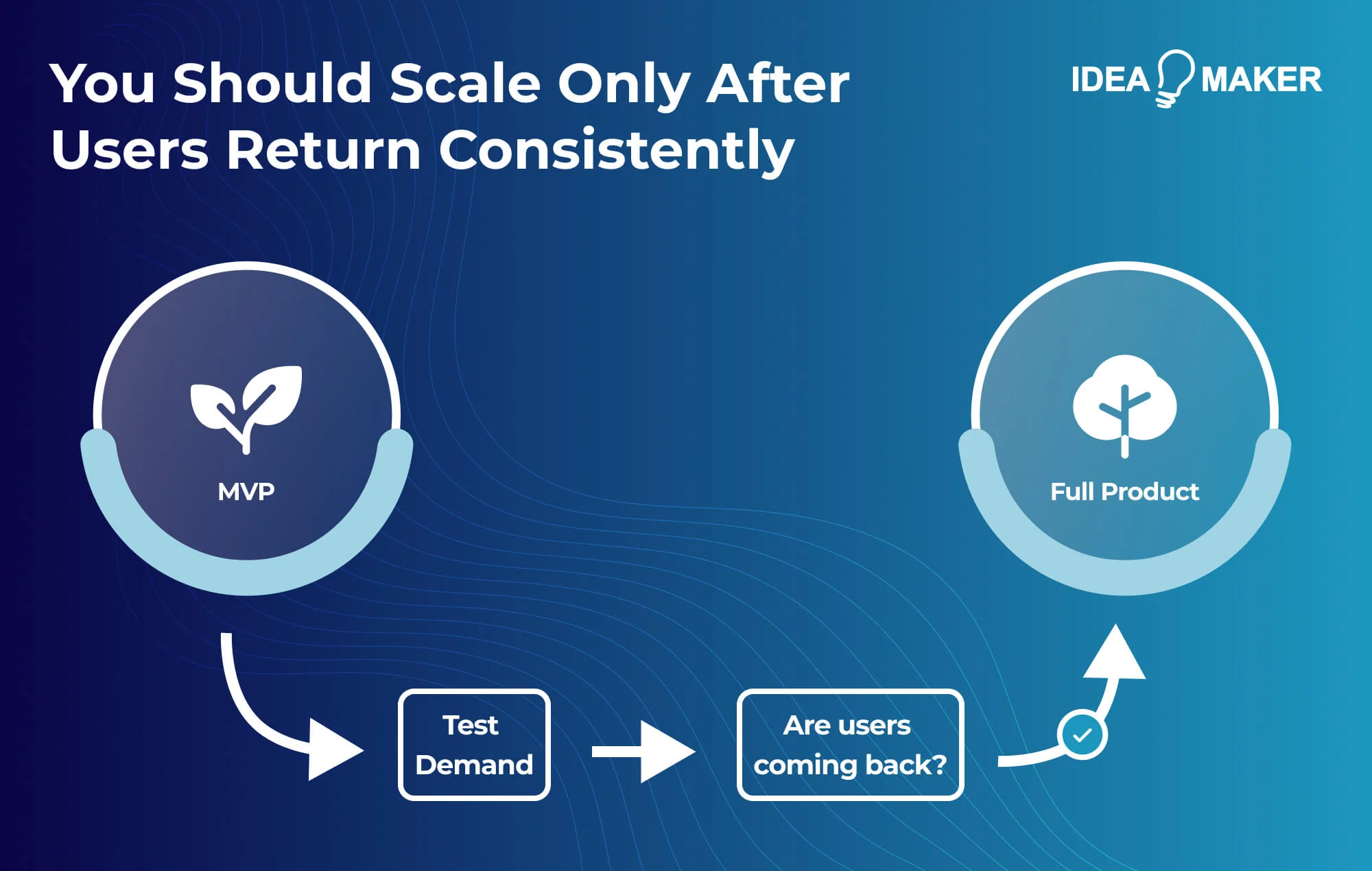
Many leaders say they want an MVP. Then they describe a platform with multiple user roles, advanced dashboards, integrations, and automation. That is not an MVP. That is a scaled product.
An MVP exists to test demand. A full product exists to scale demand.
Let's see the difference:
| Area | MVP | Full Product |
| Main Purpose | Test whether users value the core solution | Deliver a mature and scalable solution |
| Feature Scope | Only the essentials are needed to validate the idea | Extended workflows, automation, and integrations |
| User Base | Early adopters or a limited segment | Broader market with higher expectations |
| Infrastructure | Built to support learning and iteration | Built to support sustained growth |
| Investment Approach | Control risk and spend carefully | Invest to optimize performance and expansion |
| When to Expand | When retention and usage become consistent | When revenue and growth justify scale |
You should scale only after users return consistently and metrics show real traction. If you scale too early, you spend more money before you even know whether users truly want the product.
After you define the scope, you need to clarify three technical expectations that directly affect architecture and cost.
- User Experience: Decide what level of usability and interface maturity you require at launch. If this app represents your brand in a competitive market, you cannot treat design as secondary. Clear navigation, simple flows, and consistent interaction matter from day one.
- Performance: Define how fast the app should respond and how stable it must remain under normal usage. If you process payments or real-time data, you must plan for reliability early. Fixing performance later costs more than designing for it upfront.
- Scalability: Estimate how many users you expect in the first year and what growth looks like after that. Infrastructure decisions depend on this number. If you underestimate growth, your system will struggle when active users increase.
Align Success Metrics Before Vendor Evaluation
A success metric is a defined performance indicator that represents what you expect the app to create in your business. When you consider these metrics before evaluating a mobile app development company, you create a clear basis for comparison. You can compare vendors based on their ability to influence these KPIs.
Time to Market
Time to market is the duration from approved requirement to production release. In software projects, this can range from six to twelve months for a standard mobile application and several years for large regulated systems.
Faster release allows earlier revenue and earlier user feedback. Delays increase opportunity cost and allow competitors to capture market share.
With Time to Market, you need to clearly define the following items.
- Target production date
- Scope included in version one
- Release criteria and testing thresholds
Total Cost of Ownership
Total cost of ownership includes all costs across the system lifecycle. It goes beyond development fees.
At this stage, calculating the total cost of ownership is important because early product and vendor choices affect how much you will spend after launch. The architecture they design will influence cloud usage, database development, and API consumption costs. The way they plan maintenance and updates will impact how much you pay for ongoing support. These expenses continue throughout the app lifecycle and are not limited to the first milestone release.
This includes other costs, such as those below.
- Initial development effort
- Cloud hosting and infrastructure
- Maintenance and support contracts
- Upgrade and migration costs
- Downtime impact
A lower build quote can result in higher operational expenses after the product release. This usually happens when critical engineering work is reduced to win the project at a lower price. The provider may skip proper architecture planning, automated testing, or performance optimization.
Long-Term Maintainability
Maintainability determines how easily you can modify the system after launch. Architecture, test coverage, documentation quality, and deployment automation directly affect this.
Mobile app developer companies should explain how they handle:
- Modular architecture
- Automated regression testing
- CI/CD implementation
- Proper technical documentation
Once you clarify these metrics, you are no longer evaluating vendors based on price alone. With that, the next question that comes to your mind is, "Have they actually done this before in situations similar to yours?"
Evaluate Proven Industry Expertise and Real Reputation
When you think about how to choose the best mobile app development company, expertise and reputation should weigh more than branding. You need evidence that the company has already handled problems similar to yours.
From what we have seen, domain knowledge directly affects development speed. If you are building a fintech app and the company you hired has already worked with identity and access management, they will design access control correctly from the beginning. You will not lose time fixing permission errors later. In contrast, generic portfolios that list many unrelated industries may look impressive, but they often show breadth rather than depth, and that can mean they learns your domain while building your product.
A company can say “we built this app,” but you can still research the story and confirm it. Search for the case study outside their own site. Check if the app actually gained users or performed well in the market. Do not trust posters or social media posts that show a few screens and say “successful launch” without anything you can verify.
When they claim they built an app for a client, go and test the real app yourself. Download it from the store and use it like a normal user. Then read the reviews and look for repeated complaints. Do not accept every claim just because it sounds confident. Some providers exaggerate or even make things up to win the project, so your own testing protects you.
How to Spot Fake Portfolios and Inflated Case Studies
You can use simple checks to see whether a company offering custom app development services is showing real work or only marketing.
If they say “we built this app,” go and find it yourself. Search for it in the App Store or Google Play to verify. Download it and use it. Do not rely on screenshots from their website. Check ratings, read negative reviews, and look at the update history. An app that has not been updated for a long time gives you warnings.
Next, use reference calls and backchannel checks. Ask to speak with past clients. If that is not possible, reach out through LinkedIn and verify their involvement.
Be cautious with “stealth” or NDA-heavy portfolios where most projects are marked confidential and no live apps can be verified. In mobile app development, it is normal to sign NDAs, but a company should still be able to show at least a few public apps or provide limited proof of their role.
Once you confirm that a company’s experience is real, the next thing you need to examine is its expertise in using modern technologies.
Assess Technical Depth and Use of Modern Technologies
A company can say “we use the latest tech,” but that does not prove depth. You need to understand how they make technical decisions and whether those decisions fit your product.
Ask them directly:
- Do you recommend native or cross-platform for this app, and why?
A good company will explain performance impact, device-level integration, long-term maintenance effort, and platform-specific release constraints. - How do you design backend systems and APIs?
Ask how they handle authentication, data validation, versioning, and cloud deployment. Weak backend architectures will limit future features. - How do you plan for scalability?
Ask how they estimate user load, handle peak traffic, and prevent database bottlenecks. - How do you approach performance optimization?
Ask how they profile the app, reduce API latency, and monitor crashes after release. - What testing practices do you follow?
Ask whether they provide automated test suites instead of manual testing. Confirm if they run regression testing at each milestone release.
Review their Security, Compliance, and Data Protection Readiness
Security in mobile app development means protecting user data and business logic from breaches. It must be built into the architecture from the initial phase.
Secure architecture and threat modeling
Secure architecture defines how the mobile app, APIs, and cloud systems protect data and resist attacks. Threat modeling means identifying potential security vulnerabilities that can impact the user before you release it to end users.
You should ask the mobile app development company things like the following:
- Do you follow OWASP Mobile Top 10 guidelines?
- How do you secure APIs? Is it OAuth 2.0-based or token-based?
- Do you use TLS for encrypted communication?
- How do you protect data in iOS Keychain or Android Keystore?
- Do you assess risks like reverse engineering?
IP protection and codebase ownership
Clarify who owns the source code, repositories, and deployment accounts. Check whether the contracts clearly define intellectual property rights and transfer terms.
Industry compliance expectations
Confirm whether they understand requirements such as HIPAA, GDPR, PCI-DSS, or SOC 2 if your app handles regulated data. Compliance affects architecture, storage, logging, and audit trails.
Even a technically strong provider can fail if their delivery model creates delays, confusion, or uncontrolled scope changes. So let's look at how they should plan work, run sprints, handle feedback, and respond when requirements change.
Understand the Development Process and Delivery Model
Will this company allow changes to requirements once development starts, or will every change turn into a contract issue? The development methodology they follow directly affects that flexibility.
In a fixed scope contract, you lock requirements early, and change becomes expensive. In Agile, using Scrum or Kanban, you work in iterations with a prioritized product backlog. Also, you follow a defined Definition of "Done". Agile fits iterative product developments but only if stakeholder feedback is active.
Check how they run sprint planning and demos. Do they define a Sprint Goal and show a working increment every two weeks? Do they track their progress and refine capacity based on real data?
Moreover, you need to check how they manage change requests. Mature providers use formal change control, impact analysis, and updated effort estimates. If they say "yes" to everything without revising the scope or cost, you will pay for it later.
Why “Yes-Only” Developers Are Dangerous
A provider who agrees to every request without pushback may feel cooperative at first. In reality, that behavior often hides weak planning. When no one evaluates feasibility against scope, timeline, and available engineering capacity, delivery quality drops.
We have seen projects where leadership kept adding features mid-sprint, and the development side kept saying yes. No one recalculated the effort. No one revalidated the roadmap. As deadlines got closer, they reduced QA cycles and skipped regression testing. The result was a release full of defects. So what happened was that users blamed the brand, not the vendor. That is the hidden cost of poor product decisions.
Strong partners do not say no to be difficult. They challenge assumptions with data. They explain trade-offs between scope, budget, and release stability. If you want to understand how to choose the best mobile app development company, see how they respond when you propose something unrealistic. Honest resistance protects your product far more than blind agreement.
Many projects go over budget, not because of poor engineering, but because engagement terms were not clear from the beginning. Next, you need to understand how they structure contracts and where hidden cost traps usually appear.
If you want to explore more about established providers, you can also read about some of the best mobile app development companies in California to compare their capabilities.
Learn their Engagement Models, Pricing, and Hidden Cost Traps
When you think about how to choose the best mobile app development company, do you fully understand how they will charge you once development begins? Pricing models affect long-term cost more than most founders expect.
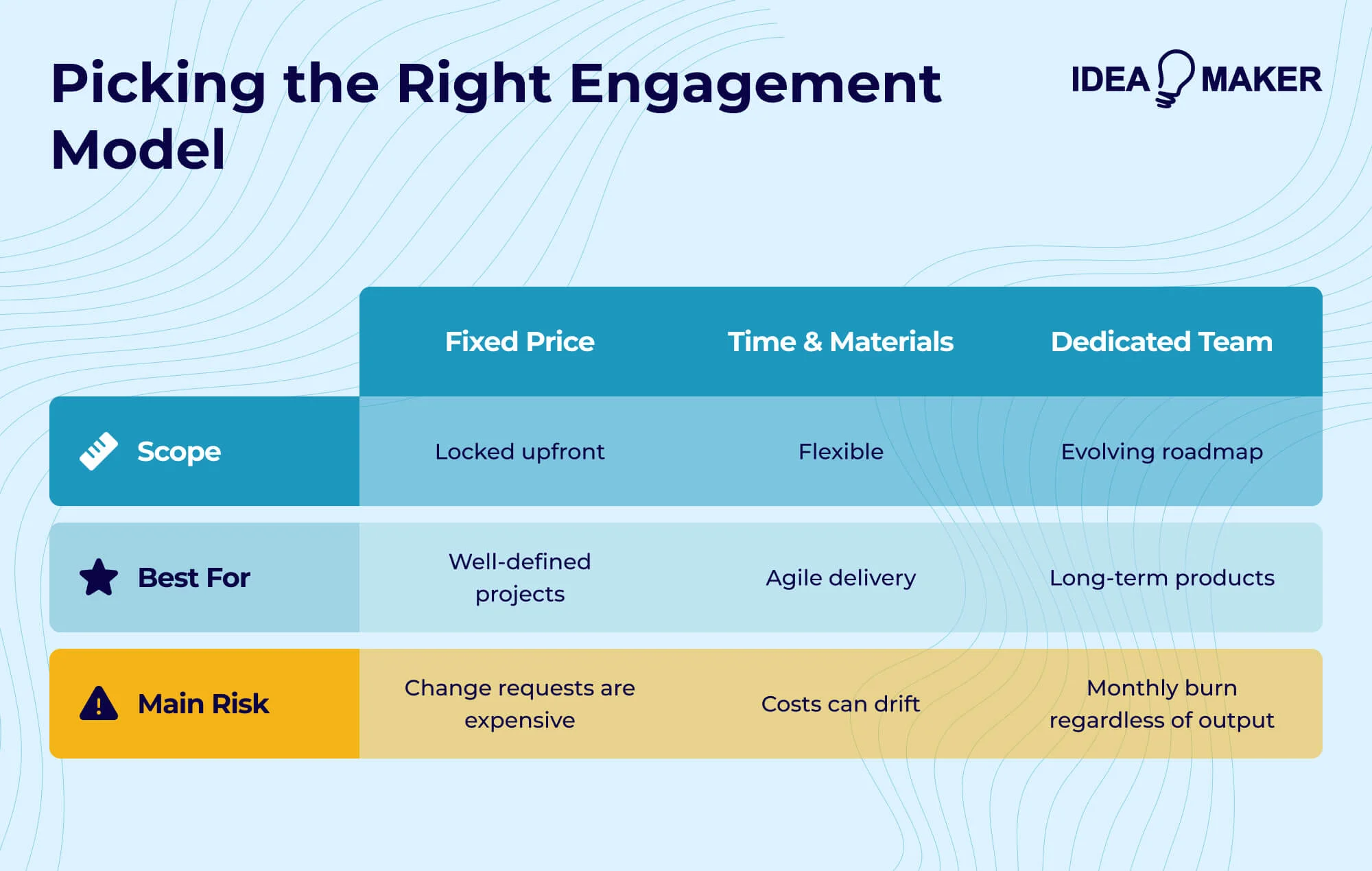
Most providers work under three engagement models:
- Fixed price - Scope is fixed through a Statement of Work (SOW). Good for well-defined requirements. Risk appears when change requests trigger contract renegotiation.
- Time and Materials (T&M) - You pay for actual hours logged. Works better for growing backlogs and Agile delivery.
- Dedicated team - You pay monthly for allocated engineers. Useful for long-term product roadmaps.
Do not compare vendors only by hourly rate. A lower rate with poor estimation, weak sprint control, or low development speed often costs more in total delivery effort.
Also, clarify hidden cost areas early:
- Third-party API fees
- Cloud hosting and DevOps infrastructure chargers
- Additional cost for extended QA and deployment cycles
- Costs for third-party services/integrations
Common Budget Killers to Watch For
Budget overruns rarely happen because of one big mistake. They usually come from small costs that no one discussed clearly at the beginning.
Third-party service fees often surprise founders. Payment gateways, SMS providers, push notification services, maps APIs, cloud storage, and monitoring tools all carry usage-based pricing. If traffic increases, those bills increase. Make sure projections include realistic API calls, data transfer, and cloud resource consumption.
Post-launch “support” that isn’t real support is another trap. Some contracts include only minor bug fixes for a limited period. They may exclude OS updates, security patches, performance tuning, or feature improvements. Clarify what SLA terms actually cover and how incident response works.
Underestimated QA and deployment costs also cause problems. Proper regression testing, device compatibility testing, CI/CD integration, and App Store review cycles take effort. If QA time gets cut to protect margin, users experience bugs, and you may pay in reputation damage and rework.
The next question is who will actually build your product once the project starts.
In the next section, you need to look beyond proposals and examine the real delivery plan behind their words.
Evaluate the Actual Delivery Team and Collaboration Model
Many founders evaluate a company based on who joins the sales call. That is rarely the group that will build your product. Ask who will work on the implementation, design the flows, and review the architecture. Request profiles of the software engineers assigned to your project. You need to know their experience level and availability before you sign.
A clear delivery model matters more than presentations. Confirm whether there is a dedicated tech lead who owns architecture decisions. Then check who will be your project’s product manager, who manages the backlog. Clarify who handles QA and who approves releases.
You also need clarity on decision-making authority. Identify who can approve scope change requests and who resolves blockers when they arise. Define escalation paths early so conflicts do not impact progress.
Moreover, agree on communication methods and documentation standards. Weekly demos, sprint reports, and shared access to tools like Slack, Jira, and GitHub create transparency. Properly organized reporting protects both sides and reduces bottlenecks during development.
Use Pilot Engagements to De-Risk Long-Term Commitments
A pilot engagement is a short, controlled phase that is helpful for you to test how a mobile development company actually works before you commit long-term. It can take the form of a discovery phase or a paid pilot sprint. This approach reduces risk and prevents overinvestment in a vendor that may not fit your product.
A discovery phase is useful when the scope is unclear or when you plan a complex mobile platform with integrations. During this phase, you should define business goals, technical requirements, budget limits, timeline, and risk factors. Research shows that many software projects exceed budget because most of the hiring companies skip proper upfront definition.
During a paid pilot, you need to validate:
- Code quality and architecture decisions
- Development velocity against sprint commitments
- Communication gaps and issue handling
- Integration with APIs, SSO, or cloud services
Also, think about exit readiness. Check whether you can retain source code, documentation, and deployment access if you decide not to proceed with the engagement.
Support and ownership define how safe your investment really is. If post-launch responsibilities and exit terms are unclear, risk can be hidden until a crisis arises.
Now let’s look at the common mistakes that quietly destroy otherwise good mobile app decisions.
Evaluate Post-Launch Support, Maintenance, and Long-Term Viability
Your responsibility does not end at launch, and neither should theirs. Before you choose a provider, understand how they plan to support your product after it goes live.
- Short-term bug fixing:
Most companies offer a limited support period. This usually covers bugs that can cause from agreed features. It does not include enhancements or major environment changes. Therefore, confirm the duration and scope in writing. - Ongoing product maintenance:
Check how they manage continuous updates, refactoring, dependency upgrades, and backlog management. - Release management:
Check on how they handle iOS and Android updates, SDK changes, and framework upgrades. A well-documented release plan created by a release manager with version control and rollback strategy can help to reduce downtime. - Performance monitoring and incident response:
Check if they implement logging, crash reporting, observability tools, and alert systems. Define how quickly they respond to production incidents. - Future scalability and evolution:
Clarify how they support new feature/feature improvement requests, technology upgrades, security fixes, higher user loads, and architecture changes as your business scales.
Clarify Code Ownership, IP Rights, and Exit Readiness
After a few years in this industry, I can tell you this is where many founders make quiet but expensive mistakes. You may pay for development, yet you still do not fully control your product. That risk is there when ownership terms are vague or access is restricted.
Ownership of source code and assets
Your contract must clearly state that you own the source code, UI designs, documentation, and related IP once payment is complete. The repository should be in an account you control on platforms such as GitHub or Bitbucket. If the vendor hosts everything under their account, you depend on their cooperation to access it later.
Access to infrastructure and third-party services
You should have admin access to cloud hosting, app store accounts, analytics tools, and push notification services. I have seen cases where companies lost access because all these services were registered under the provider’s email.
Vendor lock-in and exit readiness
Lock-in happens when knowledge, credentials, or architecture decisions remain undocumented. Define a handover process early. This should include repository transfer, infrastructure documentation, environment setup guides, and a transition support window if you move to an internal team or a new external company.
By now, you understand how much you need to consider behind a simple vendor decision. Still, many companies ignore these fundamentals and repeat the same avoidable mistakes.
Common Mistakes to Avoid When Choosing a Mobile App Development Company
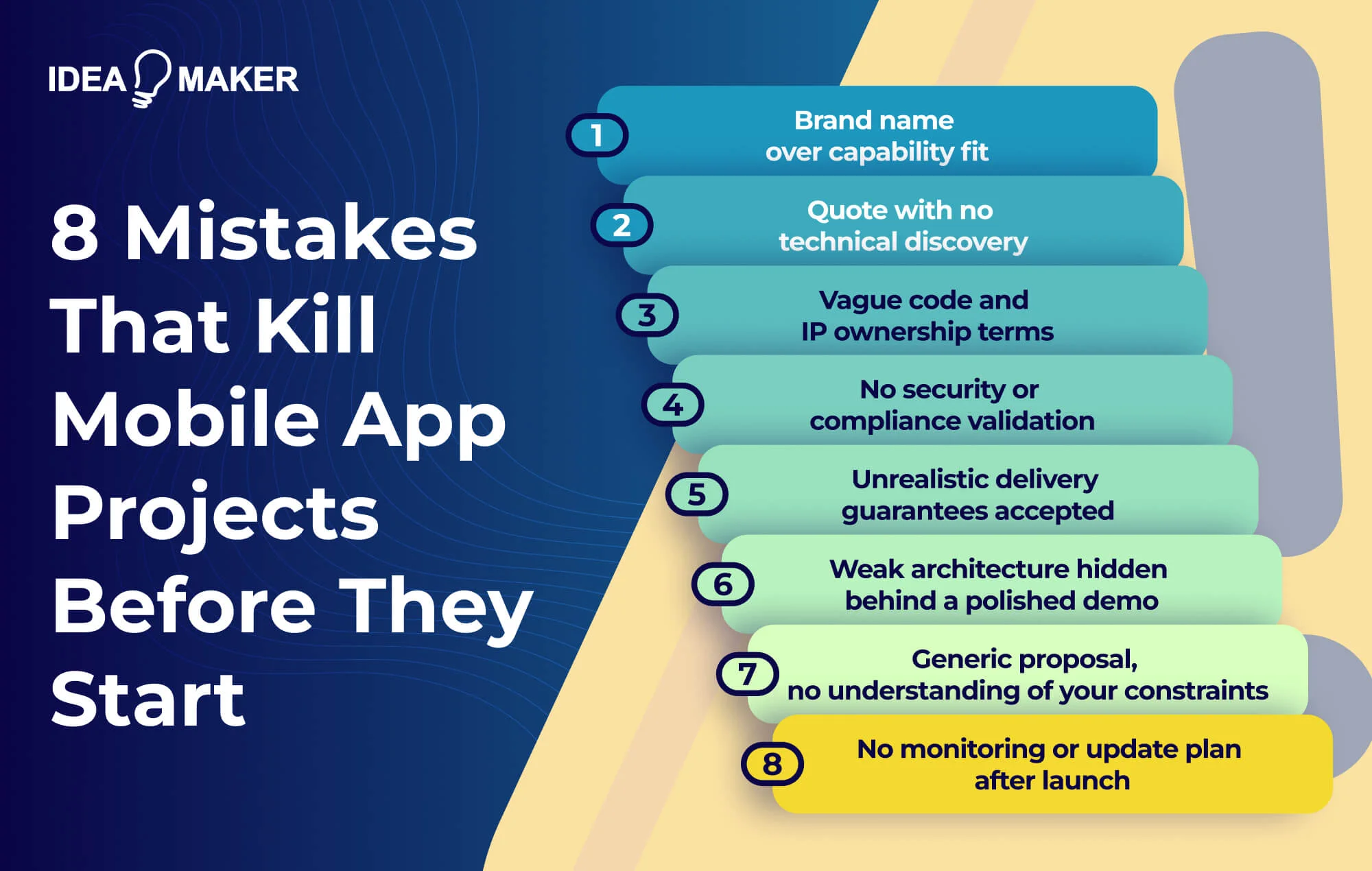
Let’s look at the common traps that derail projects even before development begins.
Chasing brand names instead of capability fit
Many founders assume a big name guarantees the right outcome. In reality, capability matters more than reputation. I saw a fintech startup hire a studio that mainly builds lifestyle or B2C mobile apps. The team produced strong visuals but struggled with payment reconciliation and compliance logic. The client later replaced them to fix the core architecture.
Trusting estimates without technical discovery
When a company gives you a quick fixed quote without a proper explanation, it can be that they, too, are not confident about their estimates. That guess often hides integration complexity or edge cases. One logistics app doubled its budget because API dependencies were never mapped early.
Ignoring long-term support and ownership details
Launch excitement hides operational risks. I have seen founders realize too late that repositories and cloud accounts were under the vendor’s control. That made the transition slow and expensive.
Skipping security and compliance validation
Security gaps rarely show in demos. A healthcare product once missed encryption standards and audit trails. Regulators forced urgent remediation.
Overpromising timelines (guarantees)
Quality usually suffers if a provider guarantees unrealistic delivery dates. Rushed releases often reduce testing depth, which leads to production bugs.
Lack of technical depth in discovery calls
When architects cannot clearly explain data flow or authentication design, you should question their experience. Weak early design decisions create long-term instability.
Generic proposals
A template proposal shows minimal effort. It often ignores your real constraints and your unique integration needs.
No clear post-launch support strategy
Without monitoring, update planning, and performance tracking, apps degrade over time, and user trust declines.
So far, you have seen what can go wrong and what you should carefully evaluate. Now the questions are:
- Are there the best mobile application development companies?
- How to choose a mobile app development company that can meet those standards in practice?
Why choose Idea Maker as your Mobile App Development Company
When choosing the best mobile app development company, consider the key services they offer and where they have the most expertise.
Idea Maker has worked with more than 200 clients across e-commerce, fintech, and healthcare and maintains a 4.9 rating, which reflects consistent delivery. Idea Maker has also been honoured with the title of “Best Company to Work With,” which highlights its commitment to innovation and positions it as a trusted partner for businesses undergoing digital transformation.
Idea Maker provides custom app development services, including:
- Mobile App Development
- UI/UX Design
- Testing (QA)
- App Launch and Marketing
- Ongoing Maintenance
Our expertise covers native iOS and Android development using Swift, Objective-C, Java, and Kotlin. We also build cross-platform apps with React Native and Flutter, as well as hybrid solutions using Ionic and Xamarin. We also provide payment gateway integration, analytics, chatbots, and machine learning as needed.
From discovery to post-launch optimization, Idea Maker focuses on performance, scalability, and long-term viability so your product supports real business growth rather than short-term release goals.
Frequently Asked Questions About Choosing Mobile App Development Companies
- How long does it typically take to develop a mobile app with a third-party professional company?
A simple MVP usually takes 8-16 weeks when the scope is clear. A full product with backend & testing often takes 4-9 months. Complex apps can run for a year or more due to reviews and integrations. - What’s the average cost range for professional mobile app development?
Professional mobile app development costs range from $ 30,000 to $ 700,000 or more, depending on scope. Costs increase when you add backend systems, admin panels, and advanced testing. - Should I choose native development or cross-platform frameworks?
Choose native development when you need maximum performance and deep device integration. Choose cross-platform frameworks when you want faster delivery from a shared codebase. - How do I verify a company’s claimed expertise in specific technologies?
Review the apps they have launched. Check their update history in the app stores. Request a technical walkthrough of their development approach. Speak with past clients to confirm their actual contribution. - What percentage of the budget should go toward post-launch maintenance?
Plan to allocate around 15-20% of the initial build cost each year for maintenance. You should treat maintenance as a required operational expense. - How important is geographic location when choosing a development partner?
Time zone differences can slow feedback and release cycles. Data residency and compliance rules may also influence your choice. - What contractual terms protect my intellectual property rights?
Your contract should include clear "work made for hire" provisions and a complete assignment of intellectual property rights to you. It must confirm that you own the source code and design assets. Check whether you receive full access to repositories and infrastructure during the product delivery.
Final thoughts Making the Strategic Mobile App Development Partner Decision
Selecting a mobile app development company is not only about technical skill. It is about how seriously they treat your product beyond the proposal stage. One practical way to move forward is to ask the provider to walk you through a realistic delivery plan for your specific app. Pay attention to whether they discuss real constraints such as scaling limits, API dependencies, security exposure, release risks, and long-term maintenance effort.
If you are still thinking about how to choose the best mobile app development company, focus on the following actions:
- Define your business goals clearly before vendor discussions begin.
- Choose the delivery model that fits your timeline
- Align on measurable success metrics instead of vague expectations.
- Validate real technical depth through architecture discussions and proof of work.
- Confirm post-launch ownership, access, and support terms in writing.
The right partner will not promise perfection. They will show you how they plan to manage complexity responsibly.