
You risk wasting time, budget, and resources if your mobile app development lacks a clear strategy, especially when integrating AI. Without careful planning, you may build features that don’t deliver value, increase complexity, or fail to meet your business goals.
AI has the potential to transform mobile apps, but it can add unnecessary complexity if added without a clear strategy. For example, Netflix Platforms like Netflix and Spotify use AI to drive engagement and retention. They strategically use AI to suggest shows or playlists to users based on their past behavior. You can also achieve similar benefits, but only if you align AI features with measurable business outcomes and real user needs.
A solid mobile app development strategy can help to tie the app to clear business outcomes. It helps pick the right platforms like iOS or Android, and sets KPIs from the start. It builds in data and governance from the start of this AI era.
This article explores how to build a strong mobile app development strategy in the age of AI. It covers planning, tools, risks, and best practices.
Table of Contents
What Is a Mobile App Development Strategy?
A mobile app development strategy is a clear plan that guides how and why an app is built. It connects business goals with product decisions and technical choices. It is not just about features. It defines the purpose of the app and the results it must deliver.
A strong mobile app strategy answers key questions:
- What problem does the app solve?
- Who are the target users?
- How will the app support business goals?
- How will success be measured?
- What platforms will be used?
- How will the app make money or create value?
Many decision makers confuse strategy planning with strategy execution. The purpose is defined through the planning, and making that purpose a real product is achieved through execution.
The following table shows the different roles that strategic planning and execution teams play in the mobile app development process.
Strategic Planning vs. Execution and Delivery
| Aspect | Strategic Planning | Execution and Delivery |
| Focus | Defines vision and direction | Builds and launches the app |
| Key Activities | Market research, user research, tech selection, and AI feasibility | UI/UX design, coding, testing, deployment |
| Main Question | What should we build and why? | How do we build and release it? |
| Timeline | Happens before development starts | Happens during the development cycle |
| Outcome | Clear roadmap and priorities | Working mobile application |
Skipping this strategy phase exposes you to serious risks. Without a solid foundation, your team may experience feature bloat, building functionality users never need. You could also pivot platforms mid-build, wasting time and budget.
Monetization models can also require late rework that can delay revenue. Even AI features added at the last minute often fail to deliver because your data, infrastructure, and user workflows were not ready. The result is a product that may launch, but struggles to meet business goals or scale effectively. Even a technically strong app can underperform without a clear strategic foundation.
Defining Business Goals and App Objectives
A mobile application is a business strategic tool. It must lead to business growth and advancement in addition to improving customer interaction.
First, your team must align the app with company outcomes. For example, an eCommerce app may focus on increasing sales and repeat purchases. A banking app may focus on user trust and daily transactions. A service-based company may use an app to reduce support costs through automation and AI chat features.
Common business goals include:
- User growth and market expansion.
- Income increases with subscriptions or in-app purchases.
- Better participation and retention.
- Reduced support expenses and accelerated internal functions.
You can also convert these objectives into quantifiable standards using metrics like monthly active users, customer lifetime value, churn rate, or cost per acquisition. Properly defined metrics assist groups in monitoring progress.
Moreover, the strategy also varies depending on the app stage. For example, a minimum viable product (MVP) aims to test demand with a few features. Conversely, a scale-ready application gives more attention to capital, security, AI efficiency, and long-term infrastructure.
Identifying and Understanding the Target Audience
Your mobile application strategy will require you to know your target customer, not the general market. Even the most advanced AI functions will not work when they are not applied in the context of real user behavior, expectation, and usage habits. Here is how to identify and understand your target audience:
- You must develop data-driven user personas that include demographics, location, digital practices, income status, and device choice. Gather this information with analysis solutions like Mixpanel or Amplitude, along with surveys, interviews, and market reports.
- Use the Jobs-to-be-Done JTBD framework for better decision-making. Trace the “jobs” that your users are getting your app to do. For example, do they want to save time or get personalized recommendations? Knowing these jobs will make you focus on features that address the actual problems rather than creating general functionality.
- Use empathy mapping to understand users’ feelings, motivations, and obstacles. As an example, when speed is a leading pain point, your AI suggestions should not slow performance. Make sure to prioritize AI-based content or product suggestions in the early stages of the roadmap, when engagement is based on personalization.
- Conduct qualitative and quantitative analysis. Run usability tests, interviews, and focus groups to collect the qualitative information. Compare time spent in sessions, feature usage frequency, and retention rates for quantitative analysis. For mobile apps, it is recommended to track in-app events with a platform like Firebase Analytics or Hotjar to understand how users navigate the app, where they get lost, and how they use it.
These measures will enable you to make wise decisions about which features to create first, where to place AI, and how to simplify the user experience. It will not bloat with features; make sure your app delivers actual business value.
Creating Platform Strategy: iOS, Android, or Cross-Platform
The choice of the right platform and development methodology is one of the most strategic configuration choices you can make when developing your mobile app. Platform choice affects coverage, output, price, and subsequent changes.
Android controls 72.77% of the global smartphone market. This renders it significant to a wide audience, particularly in developing economies. In the meantime, iOS collects nearly 67% of all app revenue due to higher user spending, despite a smaller device share.
Platform choice should be based on user location, revenue goals, and performance needs. It should also account for proper maintenance and scalability.
Here are some trade-offs to consider:
| Criteria | iOS (Native) | Android (Native) | Cross-Platform |
| Global Market Reach | Strong in high-income markets | Highest global reach | Depends on deployment |
| Revenue Potential | Higher ARPU in many regions | Large user volume | Depends on platform mix |
| Development Cost | Separate codebase | Separate codebase | Single codebase (lower initial cost) |
| Time to Market | Moderate | Moderate | Faster initial launch |
| Performance | Highly optimized | Strong but varies by device | Good, may vary in complex apps |
| Device Fragmentation | Limited device range | High device diversity | Must handle fragmentation |
| AI Hardware Optimization | Strong on premium devices | Wide range, varies by model | May need platform-specific tuning |
| Long-Term Maintenance | Separate updates | Separate updates | Shared updates, but framework dependent |
Native development allows you to access operating system capabilities and hardware device features better. It is particularly necessary when your application depends on real-time processing, intensive graphics, or an on-device AI model.
For example, iOS applications can run machine learning models on the device with Apple Core ML framework. It can also enhance speed and minimize the necessity to transfer sensitive data to cloud datacentres.
We believe that Native development is valuable for apps that rely heavily on real-time voice processing, computer vision, or AR features.
Moreover, cross-platform frameworks like React Native or Flutter can help you set up one common codebase on iOS and Android. This will save you on your first development and decrease the time to launch.
However, this approach can introduce trade-offs. Because some advanced device features may require specific customization across different platforms. Performance can also vary depending on the framework and app complexity.
A good example of this is Airbnb’s adoption of React Native to speed up development across platforms. Over time, the shared framework created performance issues and added complexity at scale. Airbnb later returned to fully native development after several years of maintenance challenges.
This case shows an important lesson. Cross-platform development can accelerate early-stage development, but large products may eventually outgrow shared frameworks.
AI performance also depends on the platform choice. Native applications have better access to device capabilities, such as real-time voice or image processing. AI can be compatible with cross-platform apps through additional customization, which may be needed to support advanced on-device features. For AI-driven apps, platform capabilities should be evaluated early.
Monetization Strategy and Revenue Models
Develop a powerful monetization plan at the beginning of your app strategy. The mobile app market has become a multi-billion-dollar economy with a value of $330.02 billion in 2026. And the way you decide to make money impacts product design and user experience (UX).
Common monetization models include:
- Subscription: Users pay a set fee regularly to access premium features. Subscription apps can generate a stable income. In many markets, subscription apps earn more revenue per user on iOS.
- Freemium: The application is free to use. But the advanced features are available only with paid access. This model is effective for productivity apps and AI-powered tools.
- In-App Purchases: Users buy items or content within the app. Over 64% of global app revenue now comes from IAPs. Also, YouTube generated close to $1 billion in IAP revenue in January 2024 alone. This shows their strength as a strategy.
- Ads: Free apps can earn through ads. Reward ads and video ads are among the highest-engagement formats.
For example, Spotify operates on a freemium model. It offers a free version with ads and a premium subscription. This model supports both growth and recurring revenue. Moreover, Duolingo combines ads, subscriptions, and premium features. This hybrid approach allows revenue diversification.
Monetization can also be more specific with the help of AI. Here’s how:
- Personalized recommendations: Introduce collaborative and content-based filters or blended recommendation systems to recommend products or content dynamically. These models may be deployed using tools such as TensorFlow Serving or RedisAI. This enhances conversion rates as tools can analyze what customers are more likely to be interested in.
- Churn prediction: Predict which users are likely to cancel subscriptions through propensity scoring or survival analysis. You can build these models using scikit-learn or PyTorch. The goal would then be to reach out to these high-risk users with retention programs such as back-office incentives or special offers.
- Dynamic pricing: You can also use machine learning models to adjust pricing, discounts, or promotional offers based on demand signals and user behavior. For example, recommendation and pricing engines can analyze browsing history, purchase patterns, and market demand to determine which products to promote or discount. Large e-commerce platforms like Amazon and Walmart use similar AI-driven systems to increase average order value and optimize promotions.
Moreover, AI pricing should be transparent. Hidden pricing adjustments can create trust issues. Regulatory frameworks such as the EU AI Act now require clarity in automated decision systems in many regions. In addition, a sustainable revenue policy balances between growth and user confidence. Maximizing short-term revenue may lower retention when it degrades the user experience.
Competitive and Market Analysis
A good mobile application strategy should also include understanding the competition. Identify the direct competitors addressing the same issue and the indirect competitors who offer substitutes. The app cannot be easily implemented without this analysis.
For competition benchmarking, analyze your competitors’ UX, prices, features, and reviews. Do not copy them. Rather, identify holes that your product can fill. Search issues that users complain about in their reviews, missing features, or performance problems that anger users. Apply these lessons to define priorities, direct AI integration, and influence your value proposition.
No one can achieve long-term success after simply introducing another similar application. For example, Spotify differentiates on personalization. Its “Discover Weekly” playlist, powered by AI, drove higher engagement and retention.
This example shows how AI can become a strategic differentiator when applied to a clear user problem. It can provide customized suggestions, predictive searching, intelligent notification, and automatic assistance to enhance user experience. But these features should address actual problems. AI that adds complexity without clear value can reduce engagement.
Also, AI will enhance your competitive intelligence. To conduct app-related analytics, you may use tools such as Apptopia or Sensor Tower. Such tools offer feature benchmarking, user engagement metrics, and download trends. You can extend this analysis using AI techniques.
For example, you can build sentiment analysis pipelines with app store review data and NLP models from Hugging Face. This helps identify recurring user frustrations or unmet needs. You can also use Mixpanel cohorts analysis to detect behavioural gaps in competitor apps and uncover opportunities for differentiation.
Defining Success Metrics and KPIs
A mobile application plan must define quantifiable, effective results. Without clear KPIs, your team can’t determine performance and make decisions.
Success metrics generally fall into three categories:
| Category | Examples | Strategic Purpose |
| Business Metrics | Revenue growth, subscription rate, customer acquisition cost | Financial sustainability |
| Product Metrics | Feature usage rate, crash rate, load time | Product quality and stability |
| Engagement Metrics | Daily active users, session duration, retention rate | User value and stickiness |
AI is improving the analytics capabilities with predictive models that can estimate churn risk. It also offers behavioral clustering to identify high-value user segments. Moreover, AI forecasting models can estimate revenue trends based on engagement patterns. These insights allow earlier intervention.
However, you should carefully interpret AI metrics. Model predictions should be validated with real data. Over-reliance on automated insights without human review can lead to incorrect decisions.
What Changed in Mobile App Strategy Post-AI
AI is reshaping how companies plan and deliver mobile apps. Earlier strategies focused on static features. Today, strategy centers on adaptive systems that respond to user behavior in real time.
- The largest change following the implementation of AI is the transition from fixed features to dynamic experiences. Apps do not provide the same interface to all users anymore. They modify content, recommendations, and workflow dynamically based on behavior and preference.
- Users’ expectations have increased drastically. The current population requires customization, fast feedback, intelligent search, and self-service. Those apps that fail to fulfill such expectations lose their appeal fast.
- AI is also speeding up experimentation. Tools like A/B testing, automated user segmentation, and predictive analytics help teams test ideas quickly. They can experiment with pricing, layouts, or notification timing in controlled ways. This allows faster feedback and lowers risk before a full launch.
Planning is now about data governance, privacy, ethical AI usage, and infrastructural preparedness. The issue of privacy laws like GDPR in Europe and other regional data control laws demands transparency and consent from the user. Inappropriate data practices will result in reputation and legal losses.
Your strategy in the AI era has to consider trust, transparency, and long-term management of data, not the delivery of the features.
How to Leverage AI in Mobile App Development Strategy
The best advice for a reliable mobile app development strategy is to integrate AI in your strategy from the start. Do not add it as a late feature. We see many teams daily who add AI features late in the development cycle, only to discover that the app’s data architecture cannot support model training or real-time inference.
On the other hand, if you plan AI early in the process, your app architecture will naturally support experimentation, model iteration, and personalization at scale.
Below are a few ways to integrate AI into the mobile app development process.
1. User Research and Market Validation
AI can process large amounts of behavioral data faster than traditional surveys to identify trends. As an example, a ride-hailing application can apply unsupervised clustering algorithms to group users based on their travel behavior. Google Analytics 4 and Mixpanel tools can indicate which user behaviors are likely to predict high engagement or churn. You can use these insights before making any feature investments to reduce wasted development effort on low-impact functionality.
2. Feature Ideation and Prioritization
AI can also help you find out which features of your app will deliver the most value. Product teams can use this strategy. They can measure propensity scores and analyze competitive gaps to look for features that will offer better retention and revenue. For example, Netflix uses collaborative filtering to prioritize recommendation features. This makes sure that high-impact features are rolled out first. Teams often overbuild and misalign features with user needs without these prioritizations.
3. Personalization
Machine learning can help you offer personalized content and suggestions to users. You can also choose on-device ML platforms if privacy is your main concern. You can easily customize your workflows with Core ML on iOS or TensorFlow Lite on Android without transferring all data to the cloud. One example is how Spotify employs ML to create daily playlists based on the listening habits of the user to enhance engagement and retention.
And we can tell you that teams that build their models without clean and structured data pipelines often experience model failures that result in irrelevant recommendations and a poor user experience.
4. Predictive Analytics for Retention and Monetization
Predictive analytics helps you anticipate user behavior rather than reacting to it. You can implement models such as:
- Propensity scoring models to predict which users are likely to convert or upgrade.
- Churn prediction models to identify users at risk of leaving.
- Lifetime value LTV models to forecast revenue potential.
These models allow you to trigger automated actions. For example:
- Send retention messages to users with high churn probability.
- Offer discounts to users likely to convert.
- Allocate marketing spend toward high-LTV segments.
Many large platforms depend on these techniques. One prominent example is Uber using ML demand forecasting models to predict rider demand in specific locations and time windows. They also used these models to set up dynamic pricing systems and balance the supply and demand process in real time. Uber builds large-scale data pipelines, real-time event processing systems, and model training infrastructure to achieve all this.
5. AI Readiness and Infrastructure
Successful integration of AI is not just a simple checklist. You will need a strong ecosystem. For example:
- Data pipelines to enrich and clean user data in real-time.
- Edge or scalable cloud infrastructure to deploy real-time predictions.
- Monitoring and retraining to ensure that the models can evolve with changing behavior.
- Policies on governance and compliance. This implies adherence to GDPR, EU AI Act, and Apple’s App Tracking Transparency.
- Intersection between analytics and product systems. This will help AI insights inform both product decisions and user-facing behavior.
Teams that ignore AI readiness often deploy features prematurely. With AI as a capability planned in the very beginning, you can achieve scalable, adaptive, and compliant systems that provide quantifiable business value.
Creating the App Roadmap and Strategic Vision
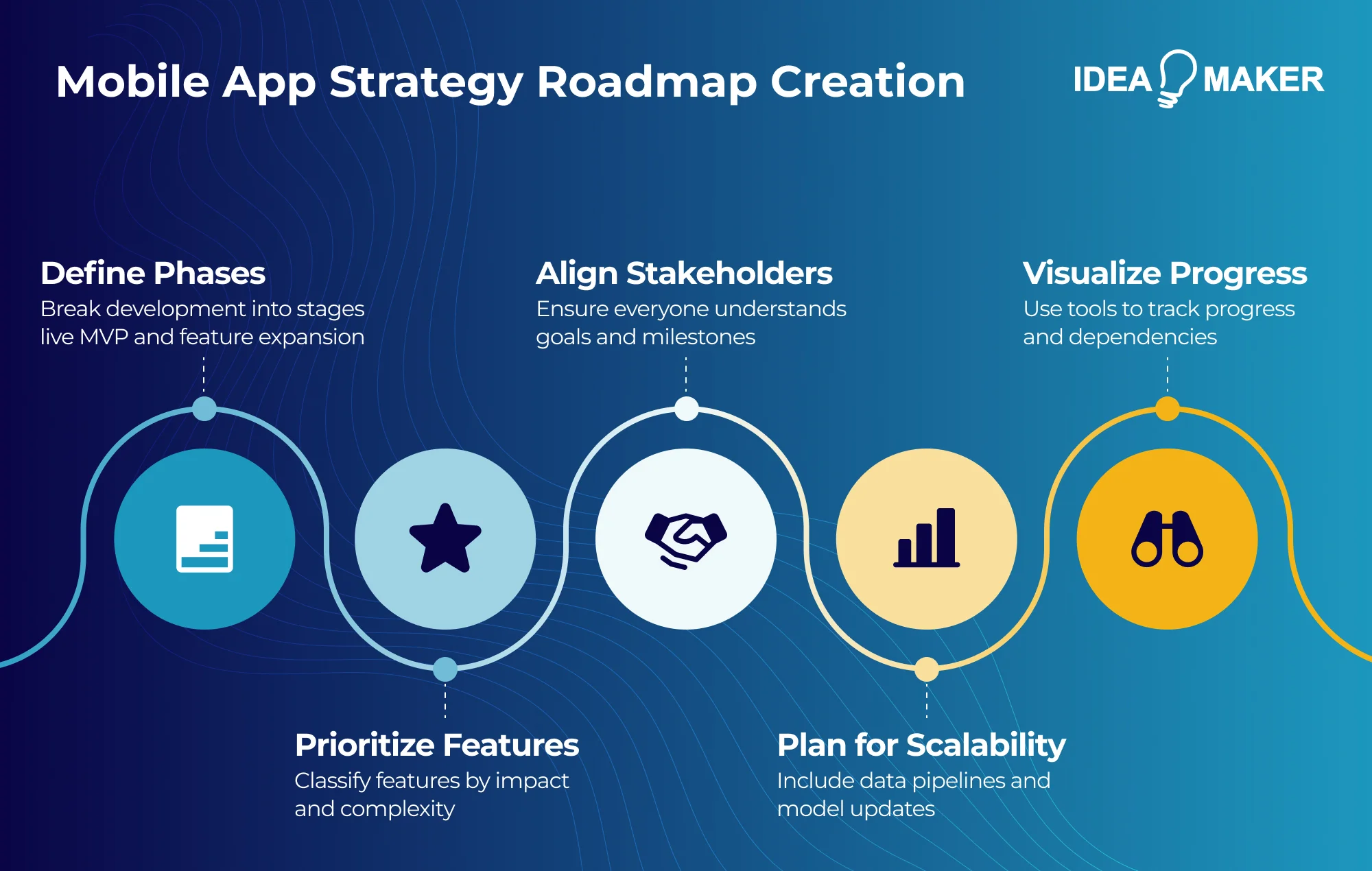
A sound mobile app strategy will be worth more when it is turned into a roadmap. The roadmap will be more of a visual map that will provide your app with direction on its journey to launch and beyond. It will make sure that all your team members are fully aware of what they are to build, when, and why.
Step 1: Define Phases
Break development into multiple phases. For instance, MVP development, feature expansion, and scale-ready versions. Start with core features that address key user problems, then gradually introduce advanced functionality like AI enhancements, personalization, and automation.
For a deeper understanding of how to structure these phases and decide between a prototype, MVP, or full product, see our guide on POC vs. MVP vs. Prototype.
Now, let’s discuss how you can prioritize features that provide value-driven business outcomes.
Step 2: Prioritize Features
List all desired features, including AI capabilities, and score each by business value, user impact, and technical complexity. Use frameworks like RICE (Reach, Impact, Confidence, Effort) to rank them objectively. Highlight AI features where they deliver the most measurable value, such as personalization or predictive insights, rather than adding them for novelty.
Once you have prioritized features, the next step is to align stakeholders so everyone is on board with what will be built.
Step 3: Align Stakeholders
You can create an app roadmap as a vision board to streamline the executives, product teams, designers, and developers. Everyone should clearly understand short-term objectives, such as milestones or success criteria.
With stakeholder alignment in place, you can also confidently plan for scalability and continuous improvement.
Step 4: Plan for Scalability and Learning
Adaptive AI systems and features require ongoing learning. Construct a roadmap comprising data pipelines, model modification, and infrastructure enhancement. This guarantees that the app can expand with users and automatically enhance with time. For example, Netflix has publicly described how continuous model updates and monitoring systems support its personalization framework at scale.
The last step after planning the growth and learning involves visualizing progress to ensure that the strategy remains on track.
Step 5: Visualize Progress
Take into account the roadmap tool like Productboard, Roadmunk, or a visual board with timelines, priorities, and dependencies. You may also track the progress using tools like Jira, Trello, or Miro, and do not lose sight of the strategic vision. This visualization will aid in tracking all the steps, features, and learning stages, and work towards a long-term strategy.
An effective roadmap guarantees that every change of direction in development leads to a holistic strategy and sustainable development.
Common Mobile App Strategy Mistakes to Avoid
Most mobile applications fail not because they were poorly developed, but because of a poor strategy. Here are some mistakes that you should avoid:
- Developing features without verifying user requirements
You risk feature overload and low adoption when you rely on assumptions rather than research. Google+’s demise demonstrates how investing in features that consumers do not want can result in a failed product. - Selecting platforms based on assumptions
The decision on the platform must be based on the audience behavior, geography, and potential revenue. Choosing the wrong platform can limit reach, reduce monetization, and create costly technical rework later. For example, Quibi’s failures serve as a reminder of how poor platform assumptions can jeopardize even well-funded products. - Waiting until after launch to consider the monetization strategy
Know that your revenue model can affect your feature design, user flow, and retention strategy. If your monetization strategy changes later, your app may need expensive redesigns. - Considering AI as a feature rather than a capability
AI rarely delivers value when it is added late in development as a standalone feature, such as a chatbot or recommendation tool. Treating AI as a capability means designing your data pipelines, analytics, and architecture from day one to support personalization, predictive models, or automation throughout the product. Without this foundation, AI features struggle to function correctly, provide meaningful insights, or scale, resulting in wasted development effort and poor user experience. - Overengineering AI in the absence of obvious business advantages
Complex machine learning systems are more expensive, and they need more upkeep. AI is not worth the investment if it does not directly enhance user experience or business results. - Disregarding infrastructure preparedness and data quality
AI systems need scalable infrastructure, organized datasets, and dependable data pipelines to function properly. Bad quality of data results in poor quality predictions and poor outcomes. - Measuring vanity metrics rather than significant results
Metrics like downloads or page views may look impressive, but rarely indicate real product success. Instead, focus on retention, active users, conversion rate, and lifetime value (LTV). These metrics reveal whether users continue to find value in your app and support sustainable growth. - Using assumptions rather than research.
Product decisions based only on internal assumptions often lead to low feature adoption. You should validate ideas using user interviews, usability testing, and behavioral analytics tools such as Mixpanel or Amplitude. This will help you understand real usage patterns and prioritize features that solve genuine user problems.
How Idea Maker Agency helps you in your AI-Driven Mobile App Strategy
Turning an idea into a successful AI-powered mobile app requires more than coding; it starts with choosing the right mobile development company. It demands research, clarity, and disciplined execution.
At Idea Maker Agency, we help you move from concept to launch with a structured strategy process. Our goal is to ensure that every technical decision supports a measurable business outcome.
Here is what you gain:
- Clear business-aligned AI strategy
- Market validation before heavy investment
- Smart feature prioritization
- Scalable architecture planning
- Integrated analytics and performance tracking
We also guide critical architectural decisions. Platform selection, for example, has long-term consequences. We have seen many teams rush into cross-platform development to reduce costs, only to revisit native builds later when performance or AI integration becomes a constraint.
Contact us to get the strategic direction and technical depth to build an app that delivers measurable growth and sustainable revenue.
Frequently Asked Questions About Mobile App Development Strategy
What comes first: app idea or app strategy?
The app idea comes first. The strategy follows to set goals, understand users, and plan features.
How long should the mobile app strategy phase take?
Mobile app strategy usually takes 1 to 4 weeks. The time of planning could require 8-12 weeks to have apps that can scale with AI or other advanced features.
Can an app strategy change after development starts?
Yes. A strategy is a document that is alive. Roadmap changes can be triggered by new information in user testing, changes in the market, or AI analysis.
Is a mobile app strategy necessary for MVPs?
Absolutely. Minimal viable products should have both goals and clear audience awareness, and KPI tracking to prove demand quickly.
Do all mobile apps need an AI strategy?
Not every app needs an AI strategy. Add AI only when it enhances value, an experience, or simplifies processes. Misapplication of AI is costly and cumbersome.
When should AI be introduced in the app lifecycle?
Introduce AI in the strategy and design stages. Prepare data pipelines, infrastructure, and governance in advance, and AI performs excellently.
How does AI affect MVP planning?
AI shapes MVP planning by showing which features to build first. You can start with basic functions and add AI later using real user data.
What data is required to support AI-driven features?
You require quality, formatted, and pertinent user data. Add behavioral analytics, engagement patterns, and contextual data to make personalizations and predictions.
Final Thoughts on Mobile App Development Strategy
A good mobile app strategy will help you make all the major decisions based on your business objectives and user needs. This involves proper selection of the platform and prioritization of features among others.
Compared to static applications, data-driven and customizable products are better. The opportunities of AI as a strategic tool are enormous. With realistic infrastructure and clear governance, AI is worthy of investment rather than an expensive experiment. Building scalable and successful apps tomorrow starts with a planned approach today.